Portugal - Lagos
The Algarve, Lagos, Portugal, Ricoh GRiii ISO 200 1/125 f16
Change
Setting off on our Portuguese adventure, we knew things would be a touch different this time around. Everyone raved about Portugal being family-friendly, charming, and warm – just what we needed with our little whirlwind in tow. With our child now a toddler, we knew this wouldn’t be as easy as the last the last trip, but were up for the challenge all the same. As per our usual modus operandi, we booked this trip last minute, just a couple of weeks before takeoff, leaving a few nights open for those spontaneous "let's figure it out as we go" moments. Some things never change, even with a two-year-old sidekick.
One thing that did change, by design, was my camera game. This Portugal series will mark a shift on the Yarko On The Go blog – my first trip captured primarily digitally. Say hello to the Ricoh GRiii, the latest addition to the Ricoh GR family of “point & shoot” cameras celebrated by photographers like Daido Moriyama. It's compact, practically weightless, and boasts a 24MP APS-C sensor in a magnesium body that's so small, you need to hold it to believe it. Paired with a crisp 28mm lens, it seemed like the perfect choice for on-the-go parents. I'll spill the beans on this little beast (the camera, not the kid) in a dedicated post after the Portugal series – and whether I think it was the right decision.
Ricoh GRiii with Peak Design Cuff Strap
Why the change? Well, for starters, I wanted more family photos both as we explored new places and in general at home, and doing that with a manual film camera in this day and age is an impractical and expensive proposition. I wanted more “keepers”, and I wanted to know I had them. Sure, I packed the Olympus XA with a few rolls of film out of habit (and I love that camera), but I didn't want to end up with a sore back from lugging around cameras and lenses when I already had a toddler and all the kid gear weighing me down. The goal is to return with memories, not back pain, right? Let’s see what happens.
Stroller & Shoot, Lagos, Portugal, Ricoh GRiii ISO 160 1/250 f8
Lagos
The Algarve seemed the logical choice for starting our trip to Portugal. It was well recommended by friends, and since we were arriving in early September, the timing gave us the best chance of experiencing some beach-worthy weather to kick off the relaxation. We flew into Faro, picked up our rental car and made the roughly 1 hour drive to Lagos. Once in Lagos, you’re reminded that driving in older European towns can take a bit of getting used to for those of us from North America. In the Lagos Old Town, where our accommodation was located, roads were narrow, with sharp blind turns, one way streets, and buildings just tall enough to throw off our phone’s GPS. It took two loops of Old Town (predominantly one way streets) to realize I’d have to stop on a sidewalk a few blocks over from the apartment and walk our things over, before finding parking elsewhere. Once I got used to the layout of the town, navigating it became a non-issue, and ultimately we were comfortable exploring the surrounding area both on foot and by car.
Our rental Citroen. Not exciting to drive, but just big enough to fit all our stuff, and still fit the roads! Ricoh GRiii ISO200 1/2000 f4.
In Lagos we stayed at the Salty Lodge, which is an apartment hotel located in the heart of the Old Town. We chose one of the smaller apartments and found the accommodations quaint and well appointed with a little kitchenette if you feel like cooking-in. It’s ideally located as a jumping off point to wander the town or surrounding beaches. It’s also in a relatively quiet corridor of the city, whereas many alternatives closer to the bars are likely rather noisy well into the night. There is a rooftop patio with panoramic views, and the staff are friendly, knowledgeable about the area and helpful. Toughest challenge here (and likely with most accommodations in the Old Town) is parking. There’s really no parking within the city walls, and the most reliable spot I found was about 700m & a 10 min walk away. Not a big deal normally, but on cobbled streets it can be a chore to roll your bags (or stroller) this distance. Of course the full onload/load only happened on arrival and departure, so ultimately it was manageable.
Looking east from the roof of the Salty Lodge, the canal and Duna Beach in the background. Lagos, Portugal, Ricoh GRiii ISO640 1/30 f4
View southward from the Salty Lodge roof. Lagos, Portugal, Ricoh GRiii ISO640 1/20 f5.6
Balcony/patio view (courtyard) from the Salty Lodge, Lagos, Portugal, Ricoh GRiii ISO400 1/400 f8
Roaming Lagos
Most of our exploration of Lagos was in the vicinity of the old town and adjacent canal promenade. It’s a characterful place, and while it has it’s share of venues catering to those who want the taste and sound of the familiar everywhere they go (read: Pubs, Thai massages, souvenir shops), there are more distinctly local options here as well which the staff at our accommodation were happy to tell us about. The old town is easy to walk with very few viable routes for cars, but pushing a stroller can be challenging on some lanes where the mosaic streets are rough. Despite being here in the early shoulder season (September), the town center was bustling with tourists and generally quite busy, but you could find quiet nooks if you ventured off the beaten path.
Making my way to the Salty Lodge, Lagos, Portugal, Ricoh GRiii ISO 100 1/200 f8
Plaza near the Salty Lodge, Lagos, Portugal, Ricoh GRiii ISO200 1/200 f4
Casa Mae, tempting place to stay next time. Lagos, Portugal, Ricoh GRiii ISO160 1/200 f8
Preparing for the lunch crowd, Lagos, Portugal, Ricoh GRiii ISO400 1/250 f8
Renault 4’s seem popular in Portugal, Lagos, Portugal. Ricoh GRiii ISO100 1/200 f8
Wandering around Lagos, Portugal, Ricoh GRiii ISO125 1/250 f8
Wall Hats, Lagos, Portugal, Ricoh GRiii ISO200 1/250 f8
A few places stood out as memorable for dinning in Lagos. The first, Abigail’s Cafe, is an absolutely delightful stop for breakfast and easily my favorite spot in town. The food is delicious -try the pancakes and thank me later- the atmosphere is relaxed and it’s a beautifully designed space inside as well as a quiet and quaint lane to enjoy if dining outside.
Studying the menu at Abigail’s. Lagos, Portugal, Ricoh GRiii ISO1600 1/400 f11
Another other favorite spot was Nah Nah Bah, a funky casual burger joint in the Old Town. It’s a popular spot, so you may find yourself waiting on the stoop for a little while if you haven’t made reservations. I seem to recall them making a claim to having one of the top rated burgers in the world, and as a self-professed burger aficionado, I had to confirm the assessment. (Confirmed)
Nah Nah Bah Burger Restaurant, Lagos, Portugal, Ricoh GRiii ISO4000 1/4 f11
Finally, The Green Room proved a lively and tasty option if you’re craving a bit of South American food, particularly Mexican. Hot Enchiladas and a cold Sagres? Yes, I’ll have another please.
Up way past bed time at The Green Room. Lagos, Portugal, Ricoh GRiii ISO3200 1/40 f2.8
Beaches - Praia da Luz
The first day or two in Lagos were a bit chilly for dedicated beach time, but eventually the warmth came and we took full advantage. Gauging the movements of the clouds from our rooftop patio, we decided to chase the sun and head west out of town a bit to Praia da Luz for our first beach day. It’s a quick and easy drive from Lagos, and relatively easy to find parking just before the main promenade through the village. We were greeted by a broad sandy beach with plenty of room to find a space to ourselves. Sunbeds are available for hire as usual, but it wasn’t quite hot enough to warrant it, so we grabbed some sand near the sea and setup our towels for a few hours of relaxing.
The waves here were fairly strong, and the water quite cool, so swimming was relatively brief but refreshing. Too rough though, for the little guy, who had to settle for getting his feet wet whenever a big wave washed further up the sandy shore. It was good for a giggle, as was digging a moat bellow our towels to defend against rogue waves. This proved useful as the tide was coming in and at least one wave surprised us and many other beach goers by making it’s way some distance and almost up to our feet. I’m not sure if the surf is always like this here, but worth checking if you’re planning on visiting for a swim.
Praia da Luz, Portugal, Ricoh GRiii ISO200 1/125 f8
Praia da Luz, Portugal, Ricoh GRiii ISO200 1/250 f8
Step this way senhor, Praia da Luz, Portugal, Ricoh GRiii ISO640 1/320 f11

Sunbeds on Praia da Luz, Portugal, Ricoh GRiii ISO320 1/320 f8
Going his own way, Praia da Luz, Portugal, Ricoh GRiii ISO320 1/800 f7.1
There’s a scenic promenade that parallels the eastern edge of the beach which we decided to explore once we’d had our fill of the sand for the morning. One side opens to the beach while the other is lined with shops, cafes and tapas bars with seating perfectly setup for enjoying the view as well as people-watching along the path.
Walking along the Praia da Luz promenade, Praia da Luz, Portugal, Ricoh GRiii ISO250 1/250 f8
Her patience wearing thin, Praia da Luz, Portugal, Ricoh GRiii ISO200 1/250 f8
Intricate tile-work pervades the entire country. Praia da Luz, Portugal, Ricoh GRiii ISO320 1/250 f8
Beaches - Praia Dona Ana, Camilo, & Ponta Piedade
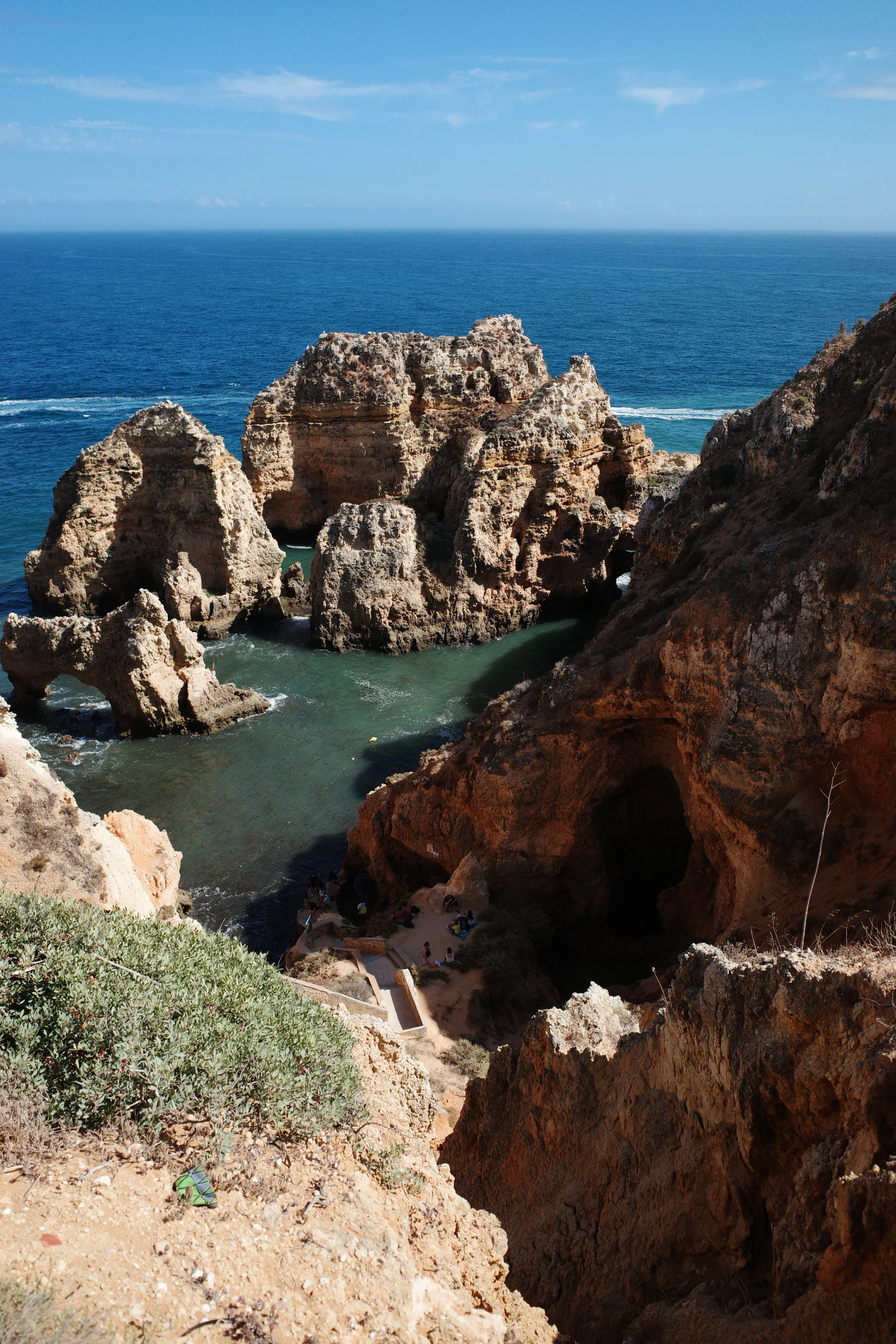
If you draw a line due south from Lagos Old Town it’ll cross most of the more famous beaches in the area, terminating at Ponta de Piedade. The distances aren’t too great to walk, and indeed we did walk to a few of them from our apartment, but for the further points we drove just to make it easier on the little guy. This area is elevated a few hundred feet above the sea, so inevitably making your way to the beach will involve some stairs and in some cases a lot of very steep stairs. Not a deal breaker, but with a toddler on your arm you are going to get a workout!
These beaches all face east and are generally sheltered bays and coves meaning much calmer seas for swimming. The tall cliffs dramatically backstopping the beaches do however mean that you’ll loose the sunshine earlier in the afternoon than say at Praia da Luz or Praia do Porto Mos, so visit them in the morning if you can to maximise the sun. The rocky outcroppings and striated stone formations are the hallmark of the area and change character throughout the day as the sun moves across the sky. Some of the beaches connect to other coves and hidden spots by way of tunnels through the cliffs, so be sure to scout around a bit to find your ideal spot. The sand is soft and warm, but there seemed to be quite a bit of seaweed on some of the beaches which significantly limited useable area and access to the sea in some cases. I’m not sure if this is a seasonal phenomenon or more of a regular occurrence. Also of note, there are surprisingly few restaurants or kiosks in this area, and those that we found were typically lined up, so pack your snacks and drinks!
Praia do Camilo, Lagos, Portugal, Ricoh GRiii ISO100 1/2500 f2.8
Abundant seaweed on Praia Dona Ana, Lagos, Portugal, Ricoh GRiii ISO320 1/320 f8
Praia Dona Ana, Lagos, Portugal, Ricoh GRiii ISO640 1/200 f11
Views of the Algarve, Lagos, Portugal, Ricoh GRiii,
View northwest from the Ponte Piedade trail, Lagos, Portugal, Ricoh GRiii ISO100 1/400 f8
Ponte Piedade trail, Lagos, Portugal, Ricoh GRiii ISO125 1/125 f8
At the southernmost point, Ponte Piedade is less about beaches (there are some but the routes to them seemed a touch perilous) and more about views and light hiking for more views. No doubt a great spot to visit at dawn or dusk and enjoy capturing the light playing on the cliffs and beaches east and west of you. There are also kayaking tours that let you get to hidden beaches in the area as well as under natural stone arches and into tucked-away bays and coves.
Wooden walkway at Ponte Piedade, Lagos, Portugal, Ricoh GRiii ISO100 1/1000 f4.5
Natural arch near Ponte Piedade, Lagos, Portugal, Ricoh GRiii ISO320 1/125 f16
Near Ponte Piedade, Lagos, Portugal, Ricoh GRiii ISO200 1/1600 f3.2
Praia Canavial and Praia de Porto Mos in the distance. Lagos, Portugal, Ricoh GRiii ISO200 1/125 f16

It was a hot day. Lagos, Portugal, Ricoh GRiii ISO100 1/400 f8
The Ricoh - A Quick Note on Color
You’ve no doubt noticed in this post that there are some notable differences in saturation, white balance and color temperature between some photos. While the slightly variable weather had a hand in some, chalk it up to my learning curve working with the Ricoh GRiii and getting used to digital cameras in general once again. Prior to the trip I’d learned about “Ricoh Recipes”, an app that allows you to pre-program and save to user customizable settings various alterations to image parameters, not unlike the film simulations on Fuji cameras and others. What I didn’t realize at the time was that doing so actually permanently impacted the RAW files. Oops. I don’t mind the results, but in the future I’d much prefer to apply such changes of character (if I felt like it) in post processing. Lesson learned, get to know your gear! Now back to our regular programming.
Sailboat passing through the canal. Lagos, Portugal. Ricoh GRiii, ISO250, 1/250, f8.
Where to next?
We didn’t have anything booked for the 4-5 days between the Algarve and our stays further north, and so we spent a few evenings while in Lagos looking online for our next destination. We debated finding another seaside town versus something a little different, quieter and off the beaten path. The latter won, owing to a general desire for a change of pace after a fairly busy and tourist-heavy stay in Lagos. We booked an AirBnB with stellar reviews much further inland on Albufeira da Barragem Santa Clara, a man-made lake (Europe’s largest at the time it was created) in the rolling hills a couple of hours north of Lagos. We planned a route that took us to the western coast, with a few scenic stops along the way (and likely enough time for our son to nap), before cutting back eastward to arrive in the early afternoon at our next destination. Stay tuned for the next post on living with the locals in rural Portugal!