
Blog
From cobblestoned Portuguese alleys navigated one-handed with a stroller to reef dives in Fiji, this is where the trips live. Told through words and whatever camera happened to be with me.
I shoot film and digital and travel with family in tow. These posts are part travel journal, part photography log, and part love letter to the places that made an impression. I hope they make you want to go see them for yourself.
Latest Articles




The Insta360 Ace Pro2 as a Travel Camera
Could the Insta360 Ace Pro 2 really work as a travel camera? After two weeks shooting with it across Athens, Sifnos and Milos, I came away impressed by its versatility—and increasingly aware of where a dedicated stills camera still wins.
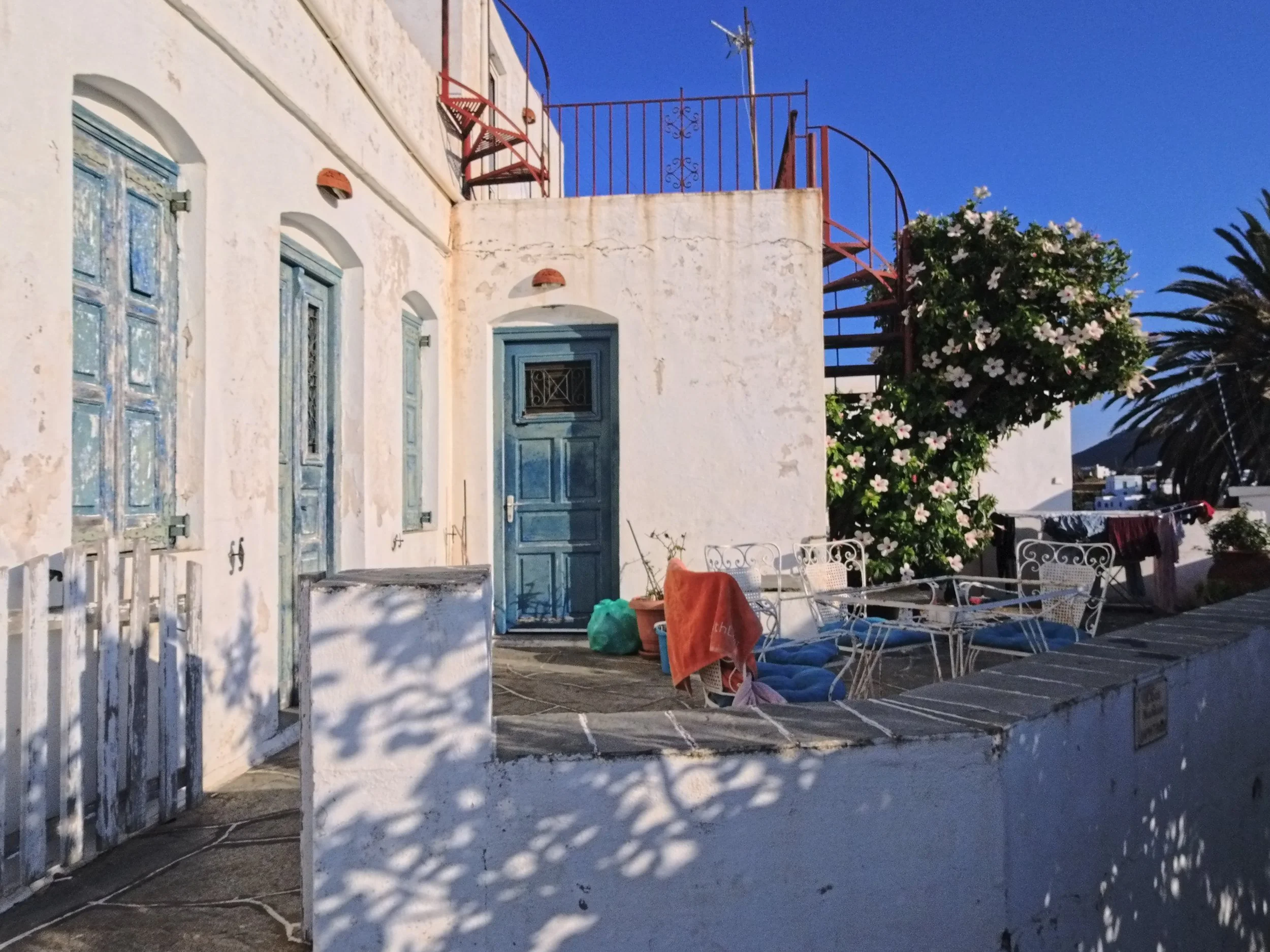
Characterful home in Ano Petali, Leica Natural, Sifnos, Greece, Insta360 Ace Pro2
Vintage Camera Vibes in an Action Cam?
My initial impressions review of the Insta360 Ace Pro 2 as a stills camera has become the most-read article on Yarko On The Go this year. That first test left me intrigued: the Ace Pro 2 was fun, versatile and capable of surprisingly characterful photos, but its shutter lag, ergonomics and image-quality quirks kept it from truly replacing a dedicated point-and-shoot.
Several months, a few firmware updates and a few plane tickets later, I took the Ace Pro 2 to Greece for a more demanding test: could it actually work as a travel camera for two weeks abroad?
I brought backup. The Ace Pro 2 shared my camera bag with a Leica M10-R and Ricoh GR III while travelling through Athens, Sifnos and Milos. That gave me the chance to use it for street photography, landscapes, family snapshots, video and eventually scuba diving—and, more importantly, to see which camera I actually reached for when a photograph presented itself.
So, can the Insta360 Ace Pro 2 replace a traditional travel camera? Not quite. But after two weeks with it, I think its strengths as a compact hybrid travel camera are considerably more interesting than I first gave it credit for.
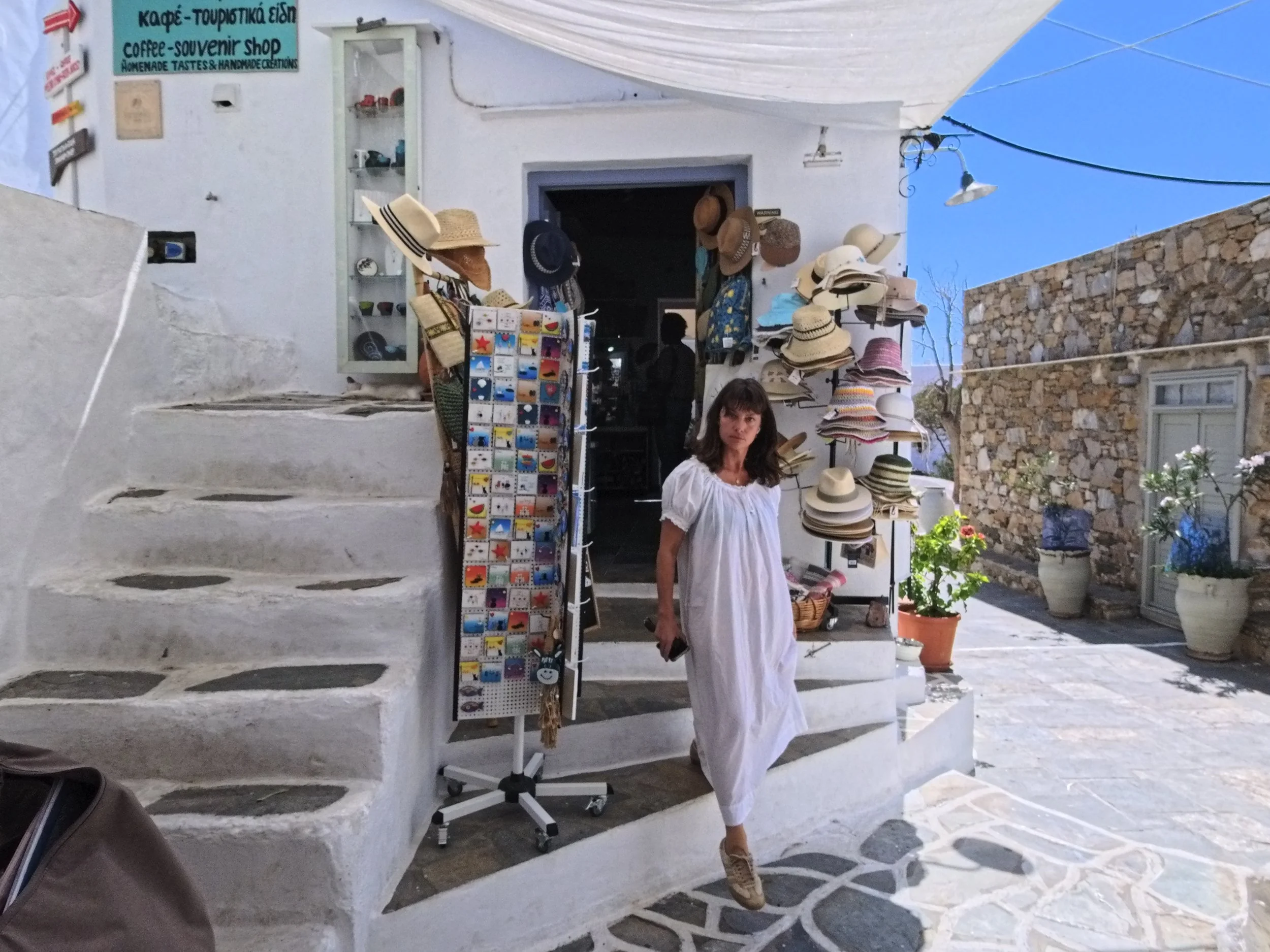
Guess I wasn’t that subtle. Woman exits a cafe, Kastro, Sifnos, Greece, Insta360 Ace Pro 2
Ace Pro 2 as a Travel Camera: At a Glance
| Travel-camera consideration | My experience |
|---|---|
| Daylight stills | Good, especially for social and web use |
| Leica JPEG profiles | Characterful; Leica Natural was my preferred travel profile |
| Battery life | Excellent with the Xplorer Grip Pro |
| Portability | Great in a sling; a little bulky in a shorts pocket |
| Shutter response | Still slower than a dedicated compact camera |
| Low-light stills | A clear weakness |
| Video | One of the strongest reasons to carry it |
| Water and rugged use | A major advantage over my traditional cameras |
| Replace a GR III? | No—but it makes an excellent secondary travel camera. |
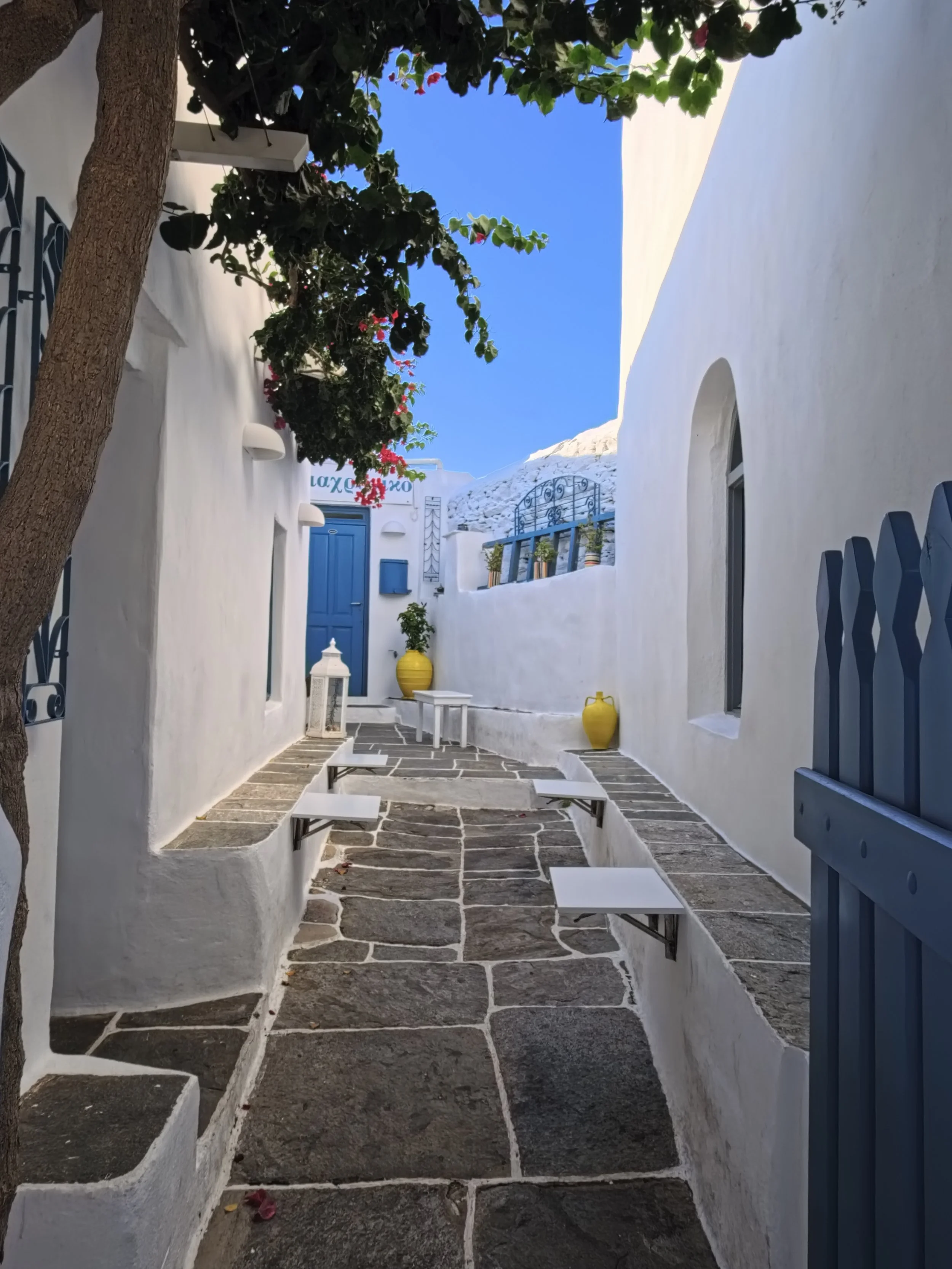
Still Life in an alley, Ano Petali, Sifnos, Greece, Insta360 Ace Pro 2
Cameras, cameras everywhere
One of the first things I noticed on this trip to Europe was the cameras and in particular -point-and-shoots. The hype is plentiful online regarding the resurgence of the camera (vs the smartphone) for photography, but it was quite reassuring to see the shift playing out before my eyes. Of course the Fuji X100Vi was prevalent, but with it other Ricohs, Canons, and more including the fresh out-of-the-box Leica D-Lux8 in my wife’s hands. (A birthday present received just a week before we flew). They weren’t all new either, some of the little digital cameras I saw were 10+ years old and others were shooting film. Cool!
It makes sense then that Insta360 would find it attractive to market one of their flagship action cams as an entrant in the burgeoning renaissance of dedicated cameras, but does it belong in that pack, or is it a pretender in point-and-shoot clothing? What follows is a distilled perspective of the strengths and weaknesses of the Ace Pro 2 for shooting stills on vacation.
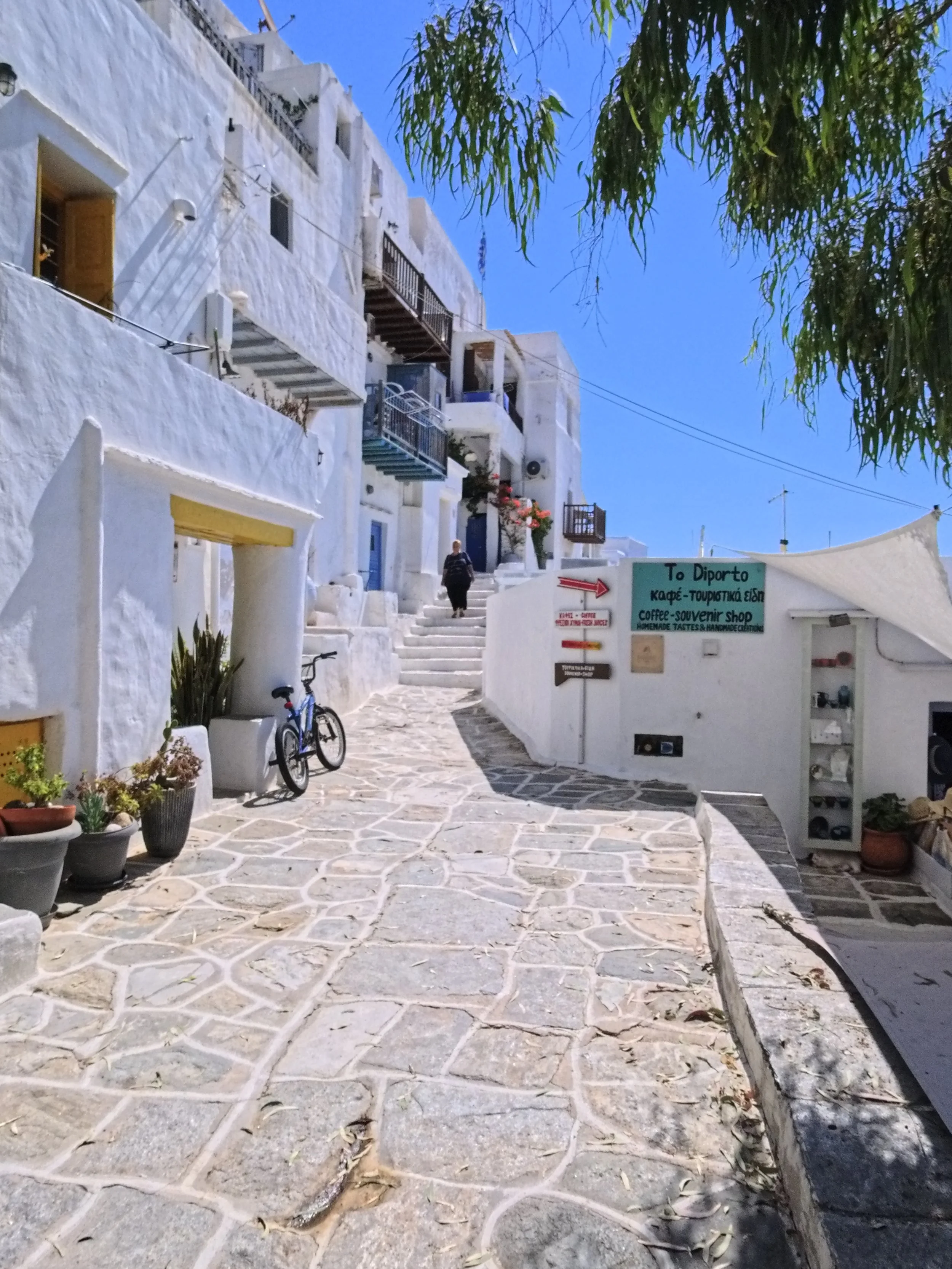
Woman descends the stairs, Kastro, Sifnos, Greece, Insta360 Ace Pro 2
Where the Ace Pro 2 Shines as a Travel Camera
Size and Travel Portability
For the first time in my travels, I decided to bring a sling bag to pair with a backpack on this trip. The Bellroy Lite Sling was the pouch of choice along with the Bellroy Lite Travel Pack 30L on my back. The Ace Pro 2 with Xplore Grip Pro easily fit in the sling along with my usual every day carry items including the Ricoh GRiii, giving me an opportunity to easily choose which camera to shoot with. (At times I even had my Leica on my neck strap as well, but frankly things started to get heavy and unwieldy at that point.) The Ace Pro 2 was easy to take in and out of the bag quickly, though the lack of cover for the lens protector occasionally made me nervous about scratches. My solution? - A wrist sweat-band I brought along and stretched over the camera when in the pouch. Not an elegant solution perhaps, but an effective one it turned out. To be fair, the flimsy automatic lens protector on the Ricoh doesn’t inspire a ton of confidence that it’ll survive bumping along in a pouch with other items either.
In a pocket however; the Ace Pro 2 does feel a bit bulky, particularly in the pockets of a light pair of shorts, which is what I wore the entire trip as it was 36 degrees C every single day! (Packing pants was a waste of space, it turned out). There are some other challenges with pocket-ability that I touch on later in the article.
Battery Life with the Xplorer Grip Pro
On the days I focused on the Ace Pro 2 for photography, I rarely had a situation where power got low enough to need a battery swap. With the Xplorer Pro Grip fully charged, there’s plenty of juice to take me through a day of still shooting even with some video thrown in as well. In stark contrast, I typically bring 3 spare batteries for my Ricoh GRiii for a dedicated day of photography. So, top points for battery life from me.
Ease of Use
Power it on and shoot! This is what the point & shoot ethos is all about and when travelling it just makes so much sense. One doesn’t always have a free-hand for manual focus or even to balance a larger camera to help compose a shot, for that matter. The Ace Pro 2 is easy to shoot horizontally and vertically, and I found myself doing the latter more often than you might expect given the availability of wide crop options. it also looks enough like a “regular camera” that nobody really bats an eye at it as you snap away throughout the day. Switching off the front panel indicator light and display aids in increasing the subtlety of the camera -particularly as daylight begins to fade.
Textures catching my eye outside a shop in Kastro, Sifnos, Greece, Insta360 Ace Pro2
Leica JPEG Profiles for Travel Photography
For the purpose of this trip, I focused almost entirely on the Leica Natural profile for my Ace Pro 2 JPEGs. On the camera screen, the images display a slightly nostalgic saturated colour palette with decent sharpness and dynamic range. These generally, but not always, coincided with what I’d see when I sent the images to my phone, though on the laptop, or Mac Studio sized screen, the limitations of the image quality begin to show themselves. If you’re sharing your photos mostly on socials, the output is often adequate and needed minimal editing if any to get to a point I was happy with. To me, these JPEGs remind me of some old film stocks I shot in the past, such as Agfa Vista, although the tonal contrast and gradient here seems a bit less refined, almost cartoonish at times, but with some sense of charm.
Colourful fishing boat homes in Milos, Insta 360 Ace Pro 2
Zoom and Field of View
While prime lenses are my weapon of choice, there’s something to be said for being able to zoom in on a subject or scene. I didn’t always remember the function was there (as neither of my other cameras offer this feature), but if I was mindful of it I think I would have made more use of it. (The toggle is on the front of the shutter button mount)
There are multiple fields of view as well from De-Warp to Linear to Megaview and more. I generally tried to stick to the FOV that gave me the least distortion, which best suits my style of photography. That said, there’s a lot of fun and creativity to explore with the other settings depending on your surroundings.
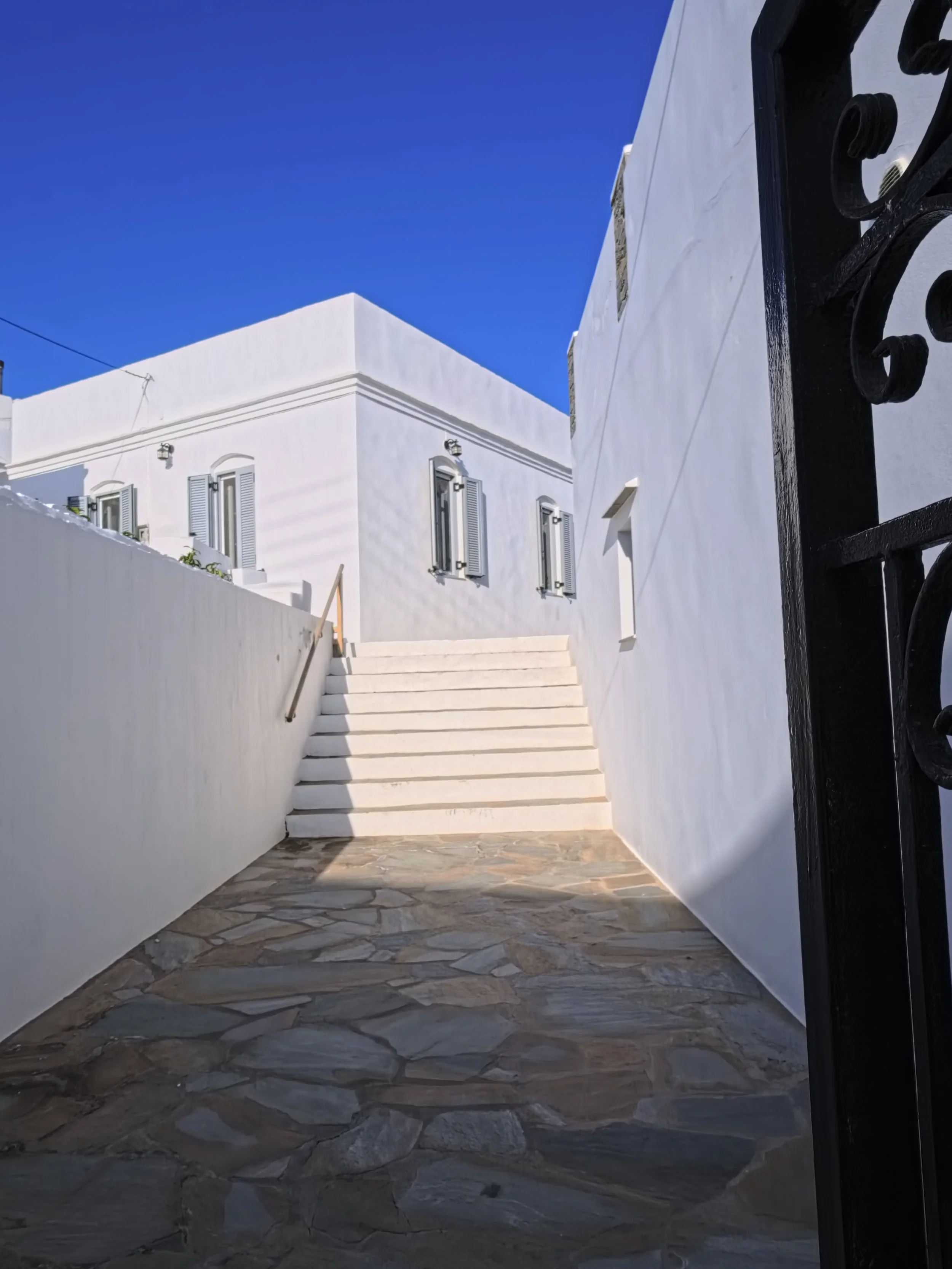
Why the Ace Pro 2 Works as a Hybrid Travel Camera
Decent stills and video in the same compact yet robust package? The thesis sort of writes itself for travel use, doesn’t it. It may not be the absolute best at both, but it’s not bad either. It’s durable enough that you’re not too stressed taking it to the beach, on a boat, or even for a swim -but not with the grip mounted! On that last note, a follow-up article from this trip on the Ace Pro 2 as a scuba-diving camera is coming soon! I’m definitely not doing that with the other two cameras…
Vespas and blue-domed Churches, must be Greece, Insta 360 Ace Pro 2
Church of the Seven Martyrs, Kastro, Sifnos, Greece, Insta360 Ace Pro 2
Home with a view, Kastro, Sifnos, Greece, Insta 360 Ace Pro 2
“If you’re sharing your photos mostly on socials, the output is often adequate and needed minimal editing if any to get to a point I was happy with.”
Where the Ace Pro 2 Struggles for Travel Photography
Image Quality: Resolution, Fringing and Blooming
This camera is not for the pixel-peepers, but is it fair to call that a struggle? In the occasional arms-race that is camera specs, it can dissuade some people, and if you like to print your photos, or look at them on larger screens, then this camera is not going to astound you. That doesn’t mean the images can’t be characterful, or “good”, but if low grain a lack of fringing and high sharpness are of key importance, this isn’t the tool you’re looking for.
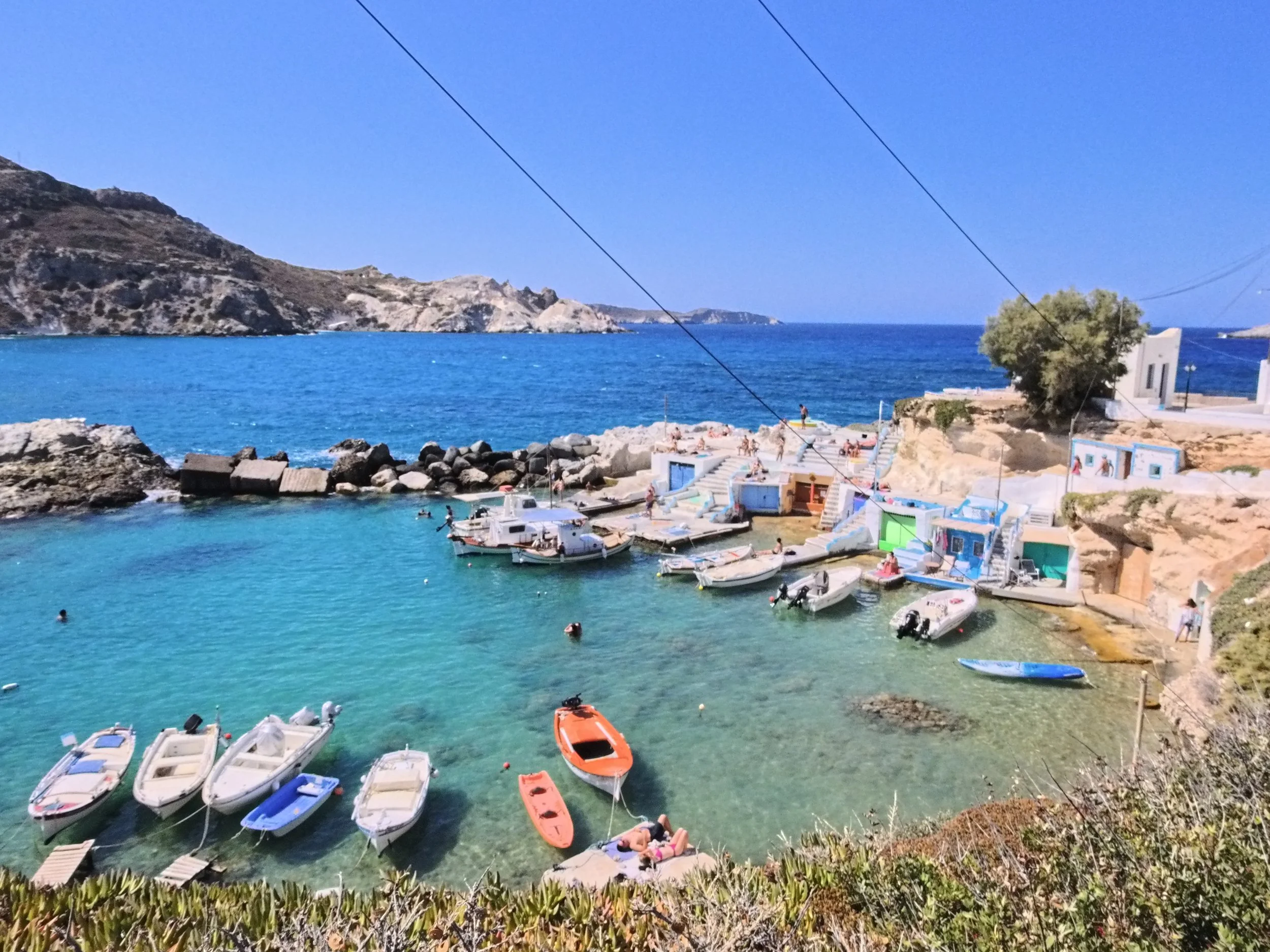
This water was surprisingly dirty, Milos, Greece, Insta360 Ace Pro 2
Lens Flare
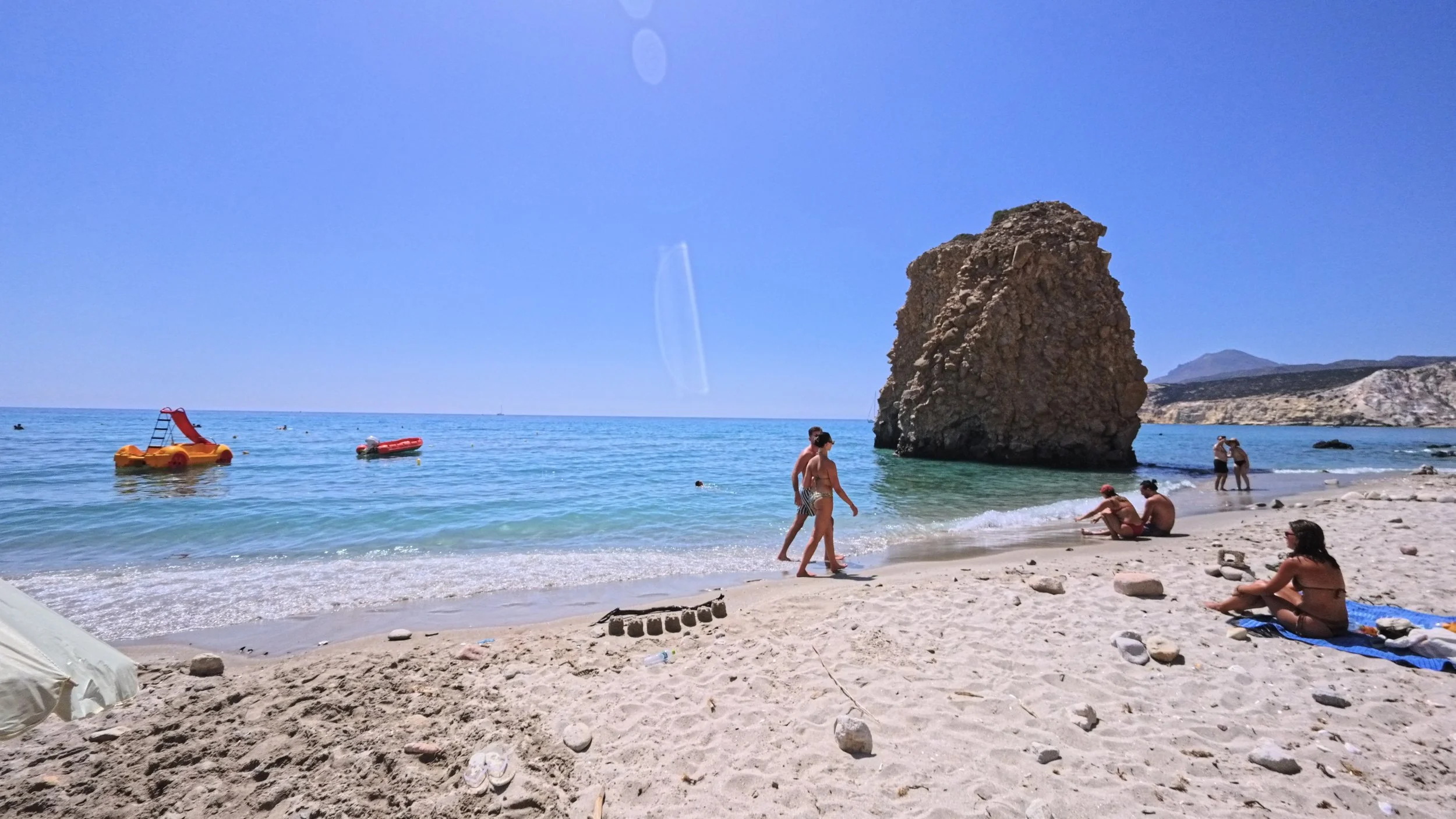
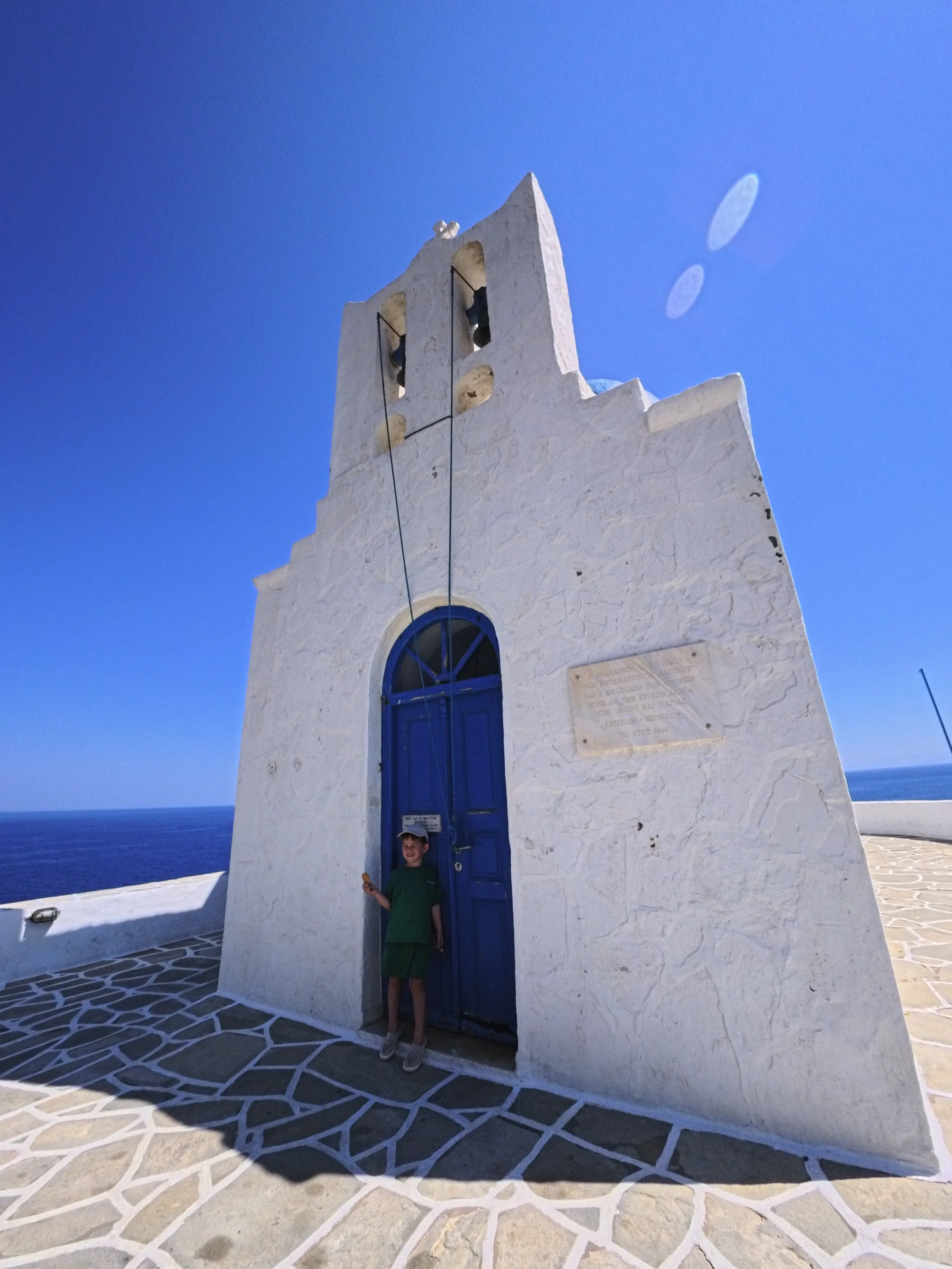
Occasionally, lens flare (where bright light enters a camera lens and reflects internally off glass, coatings, sensors etc. creating streaks or circles of light) can be used with great artistic effect, but in general most folks attempt to avoid it in their images. With the Ace Pro 2, particularly facing the sun (of course), it would occasionally create blocky or blobby unattractive streaks in the image. My guess is this is the fault of the protective lens cover rather than the lens, but it’s not the easiest component to remove/install and so once it’s on it’s generally left alone. Be mindful of your angles shooting in the direction of a bright light source and you’ll be fine, though it’s not always easy to spot it as you’re composing on your screen in bright surroundings.
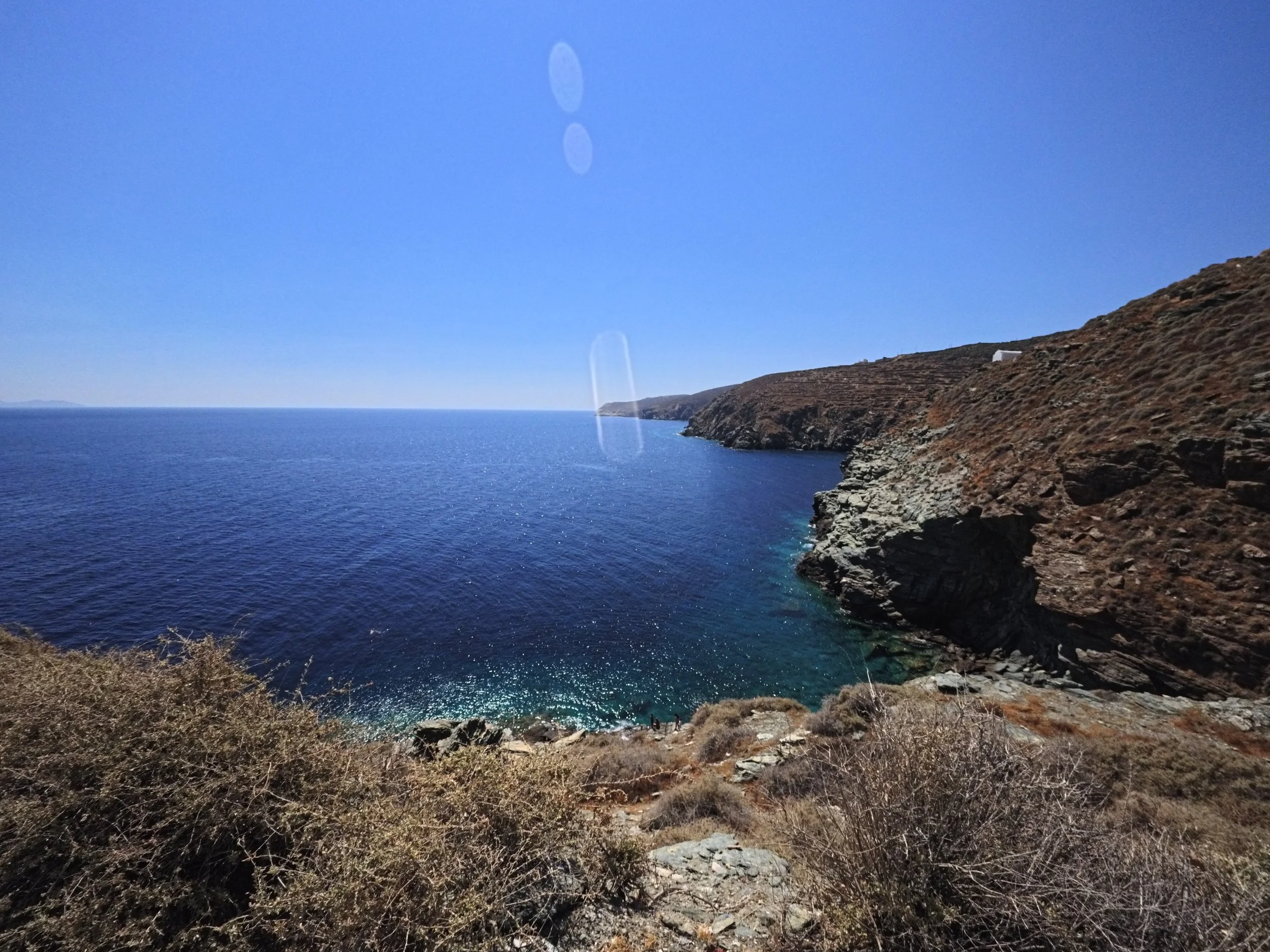
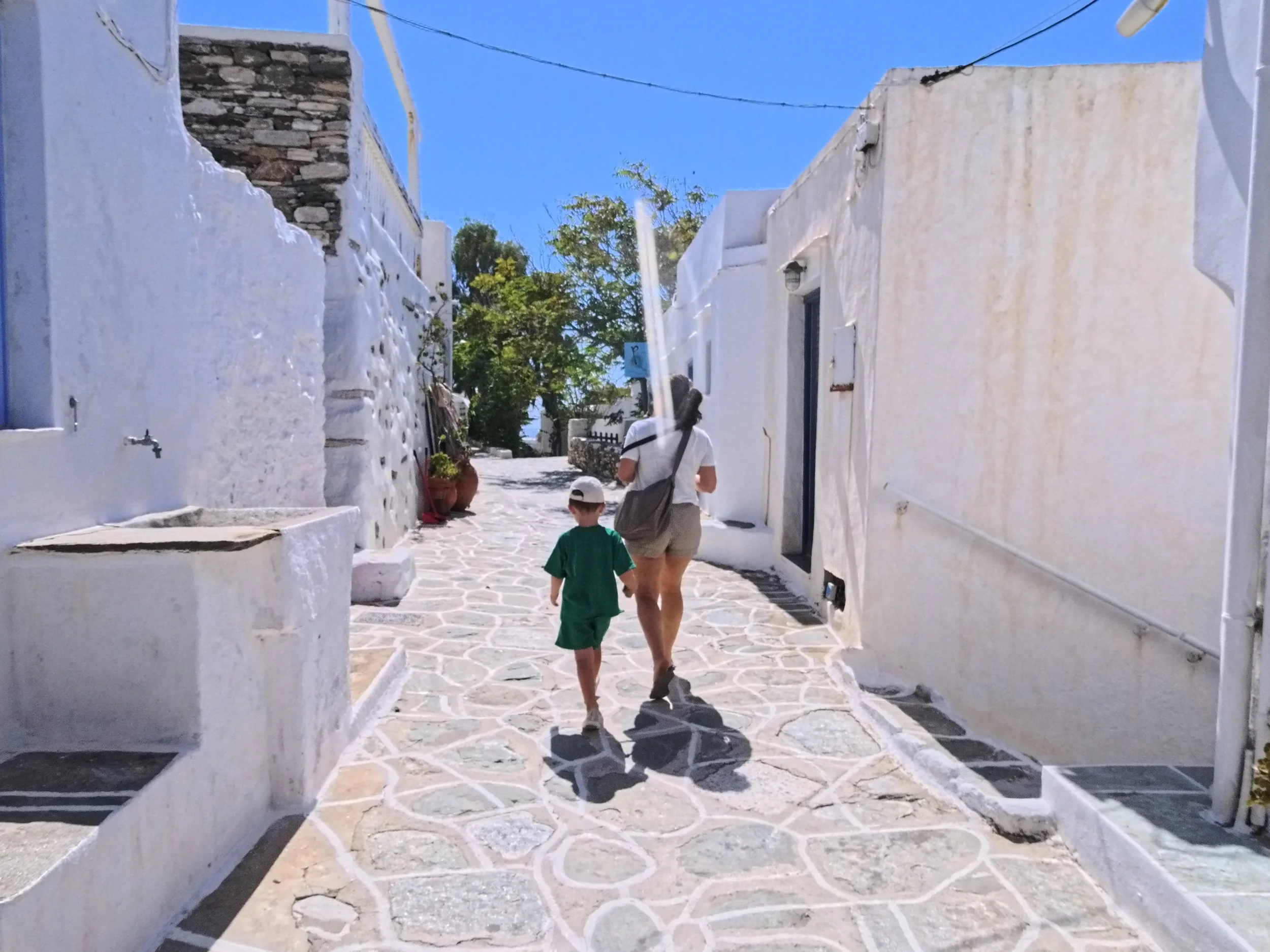
Heat!
This camera gets hot! Leaving it on (as one does) while walking around allows the camera to begin building up quite a bit of heat which is felt primarily on the back where the screen is. It was enough that it was uncomfortable to put the camera in my shorts pocket after shooting for a while, and when I did, that leg got sweaty immediately. I suspect the culprit, at least partly, is the Xplorer Grip Pro which charges the camera as you go -a setting that can be switched off if you remember to do so. It’s not going to burn you, but at a few points it got warm enough as to be a bit alarming. This was certainly exacerbated by the high ambient temperatures typical in August in Greece of course, so perhaps not an issue for a vacation to the arctic circle? The camera itself (without the grip attached) is waterproof enough to swim with, so maybe an occasional dip to cool it off is in order. But, that means you need to pack along and reinstall the tiny USB port cover-door that you remove when attaching the grip. That is a piece that one can very easily loose given it’s tiny size, and something I stressed about occasionally on the trip.
Shutter Lag and Street Photography
Admittedly I’m getting used to it now, and in the context of capturing largely still scenes (buildings, textures, vistas), it’s a non-issue. But, a part of travel photography is capturing living moments around you, and to do so well you need to be in synch with your tools. The shutter button still lags, and the buffering is still slower than I’d like, but after a few months with the camera it’s something I’ve generally begun to naturally adapt my style for when using it. Still, if Insta360 is reading this, speeding it up would do wonders!
Low-Light and Night Photography
Things get a bit weird with Ace Pro 2 image quality shooting stills after dark. Zoom in and images get a bit muddy with sharpness falling off dramatically all over and highlights occasionally producing strange artifacts. Images begin to take on an almost cartoonish quality in some instances. It took me quite a bit of sifting through my shots to choose a few to share here, which I think is telling. Certainly, shooting in dark conditions will challenge any camera, but it felt particularly inappropriate to try too hard with this one. I eventually stopped taking it with me in the evening, unless I wanted to shoot some video, where it dramatically outperforms it’s low light still capability, and certainly the other cameras in my bag.

Everybody hold still please.
Foreground objects are decent, but what’s going on with the people walking on the right?

Enough light to sharpen things up, but there’s some lens flare again.
Is the Insta360 Ace Pro 2 a Good Travel Camera?
Would I travel with the Ace Pro 2 again? Absolutely. Would I travel with only the Ace Pro 2 if photography mattered? No. As a videography neophyte, the approachable nature of the Insta360 Ace Pro 2 when it comes to video makes for a compelling case to pack it along for the next adventure. It would undoubtedly always be paired, however; with a dedicated stills camera to capture the type of photos that resonate most with me. Saying that, and looking at this next image below, I can imagine a project or two that leverages the grainy, saturated, nostalgic quality that this little camera can produce. The thing about quirks is, once you get to know them, you can figure out how to leverage them. If you can do so reliably, then perhaps it becomes a tool with a very specific stylistic purpose (remembering of course, that there are other Leica JPEG profiles built-in to the camera to explore that aren't featured here ).
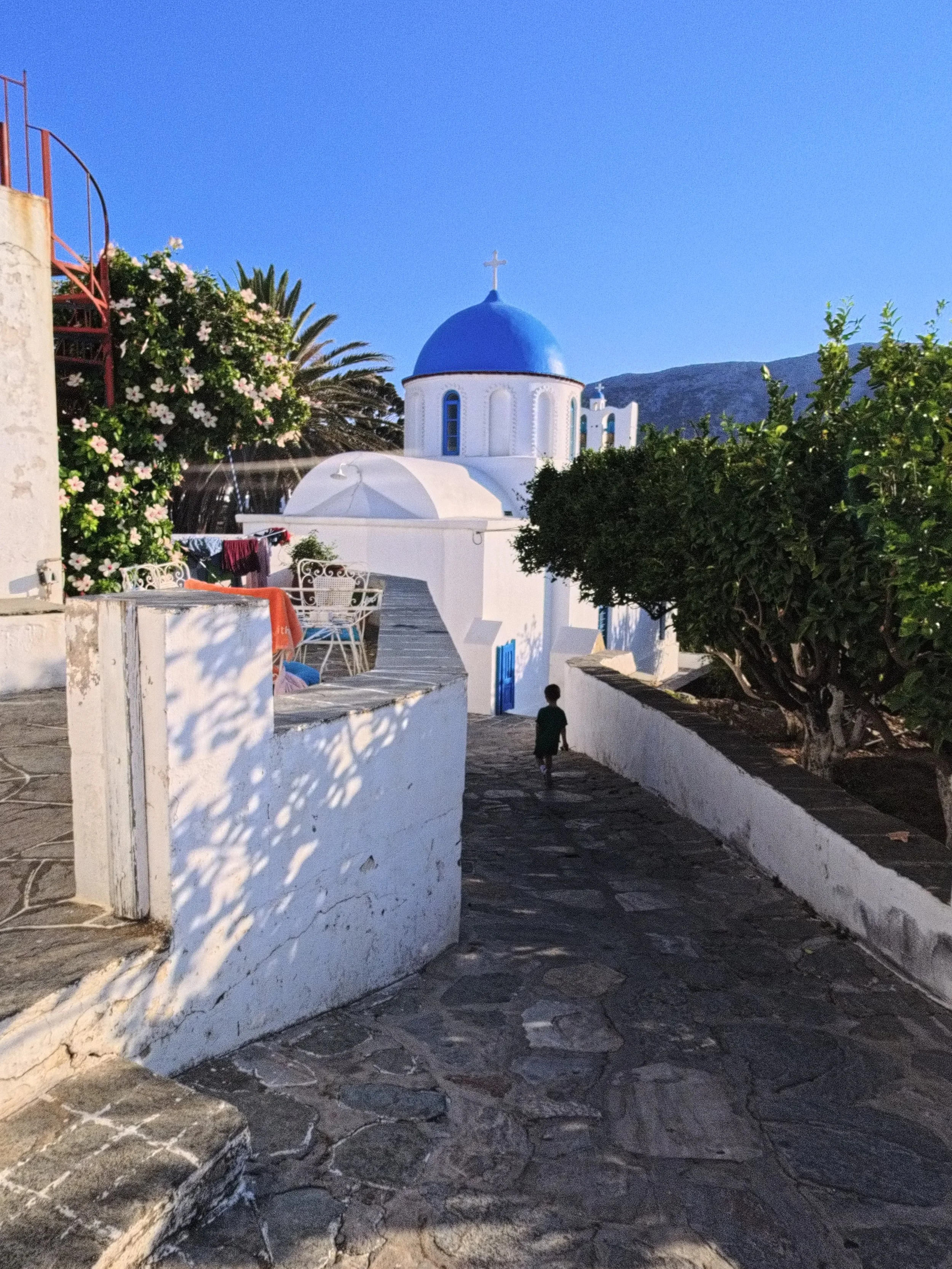
Quirky and Characterful (the camera and the kid), Ano Petali, Sifnos, Greece, Insta 360 Ace Pro 2
The Ace Pro 2 continues to grow on me, despite its limitations as a stills camera. The more you use it the more you begin to understand when to use it, and when to leave it in the hotel room.
Reflecting on it’s use during this trip:
It’s not going to win any image quality awards, but it will occasionally produce images you keep coming back to, pictures with a bit of emotion built-in that perhaps you’ll even print (in a small format)
It’s easy-to-use and non-”pro” nature encourages the silly shots, the texture shots, the photos you may not otherwise think to take but for a notion: “I wonder how this might look if…”
It’s not the only camera you bring, but you may miss it if you don’t
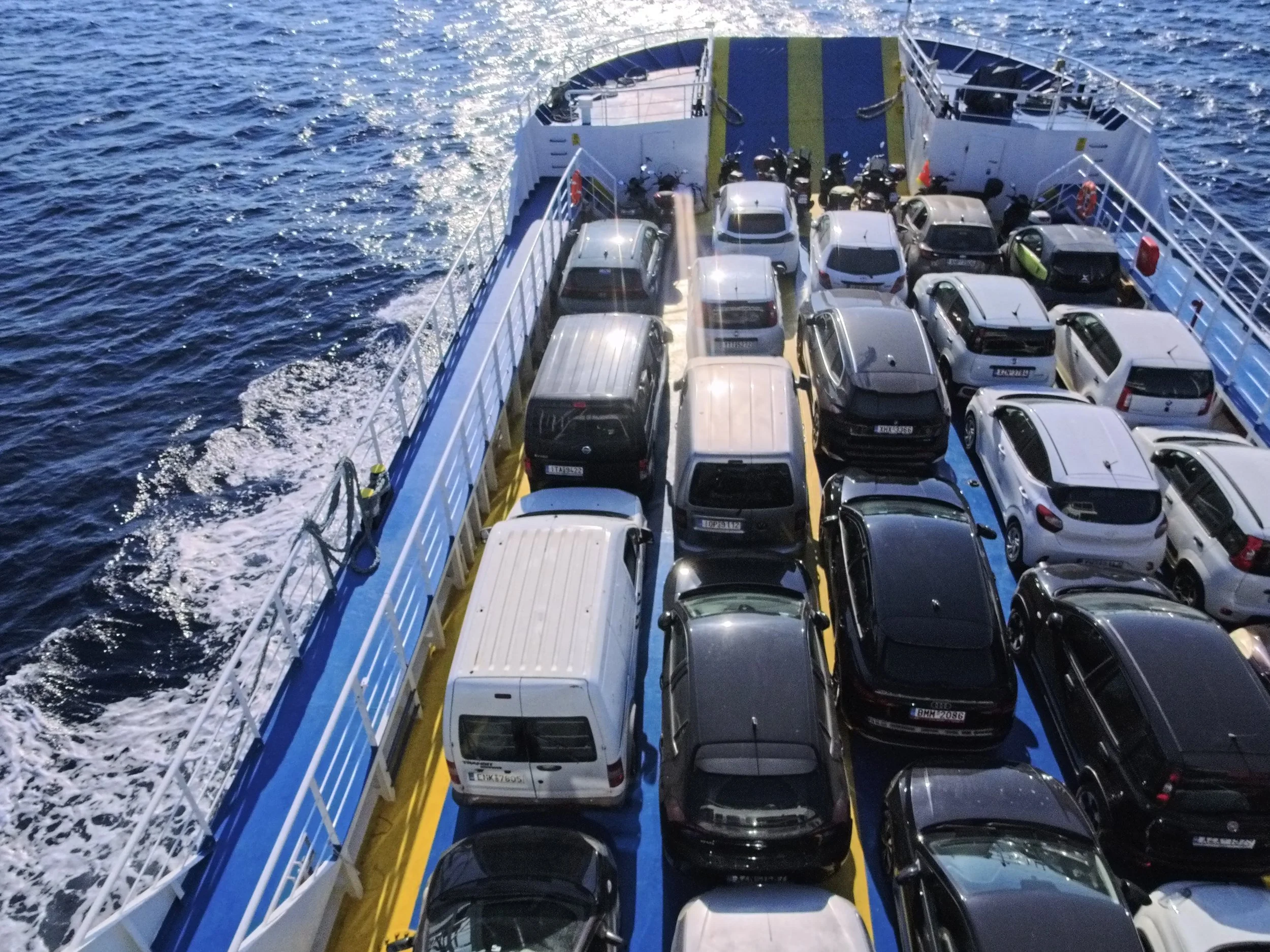
Packed in like sardines on the Ferry, Insta 360 Ace Pro 2
Taking in the life in Kastro, Sifnos, Insta 360 Ace Pro 2
A moment of calm at Sarakinikos, Milos, Greece, Insta360 Ace Pro2
First Impressions of the Insta360 Ace Pro2 as a Stills Camera
The Insta360 Ace Pro2 showed up on my radar a couple of months ago as I started to research replacements for my aging GoPro Hero 8 Black. While my original use case for it stemmed from its core niche (action videos of mountain biking, snowboarding, motorsports, diving etc.) I was increasingly drawn to it for its much-touted broader capability set.
Toronto street corner, Leica Eternal, Toronto, ON, Insta360 Ace Pro2
Can an Action Camera Really Shoot the Street?
The Insta360 Ace Pro 2 landed on my radar while looking to replace my aging GoPro Hero 8. Initially, it was about action video—but the broader pitch pulled me in: vlogging, modular accessories, and, intriguingly, still photography. I had no expectation it would replace dedicated cameras like my Ricoh GR III, but it raised a question:
Could this be a one-camera solution for short trips, business travel, or quick weekends where I want both video and stills—without carrying much?
I decided to find out.
Update: Several months later I took the Ace Pro 2, to Greece for two weeks to answer that question properly. You can read my full Insta360 Ace Pro 2 travel camera review here.
Early Use
After some quick setup, I took it out on a mountain bike ride. I crashed. Both I and the camera survived. Footage looked solid—already a step up from my old GoPro.
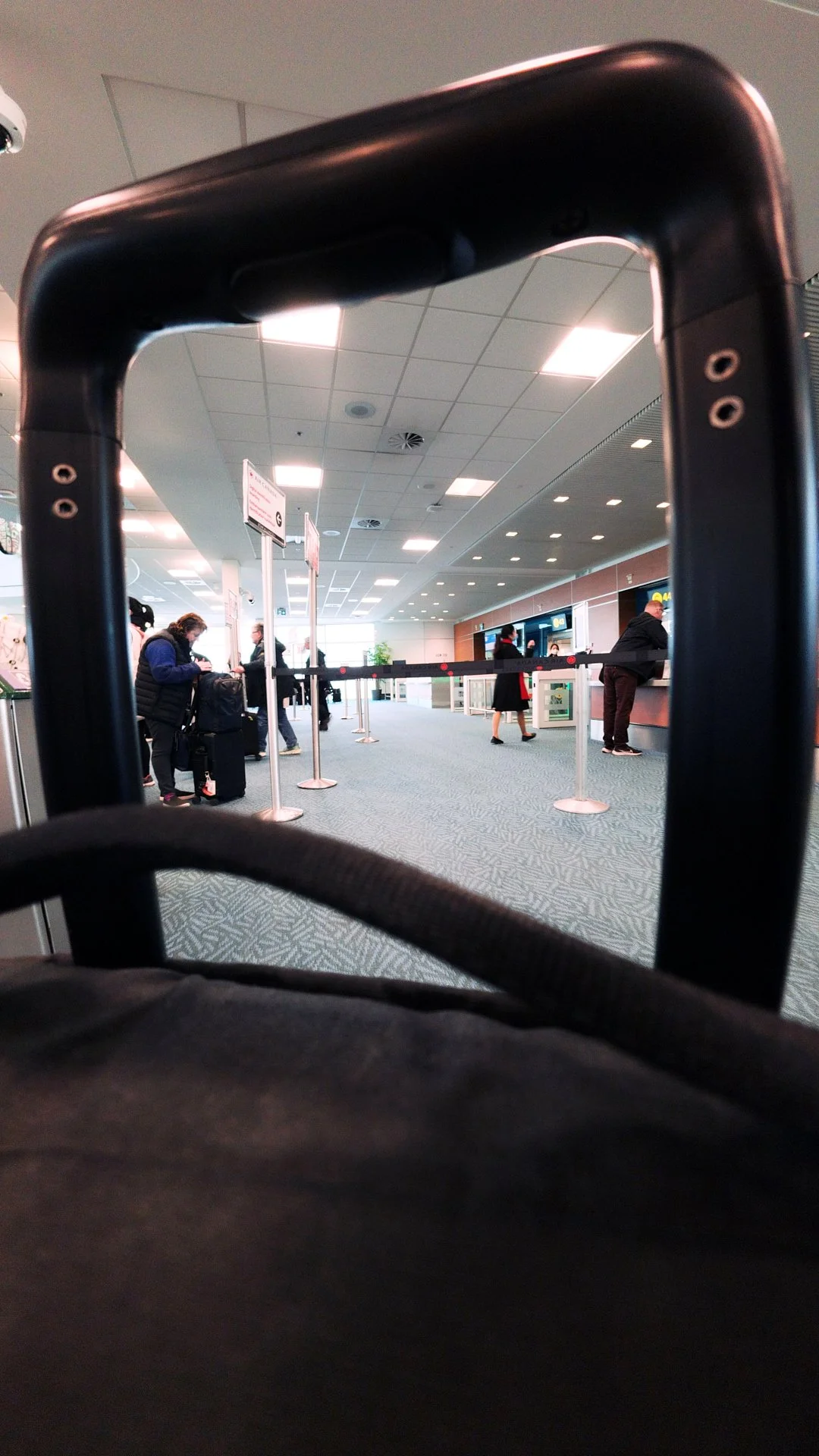
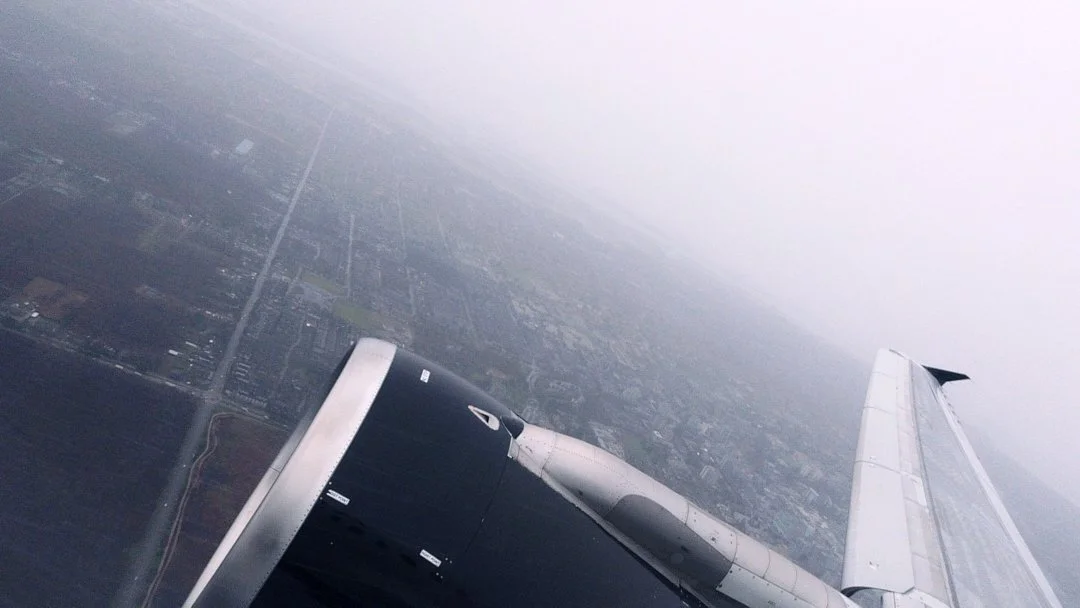
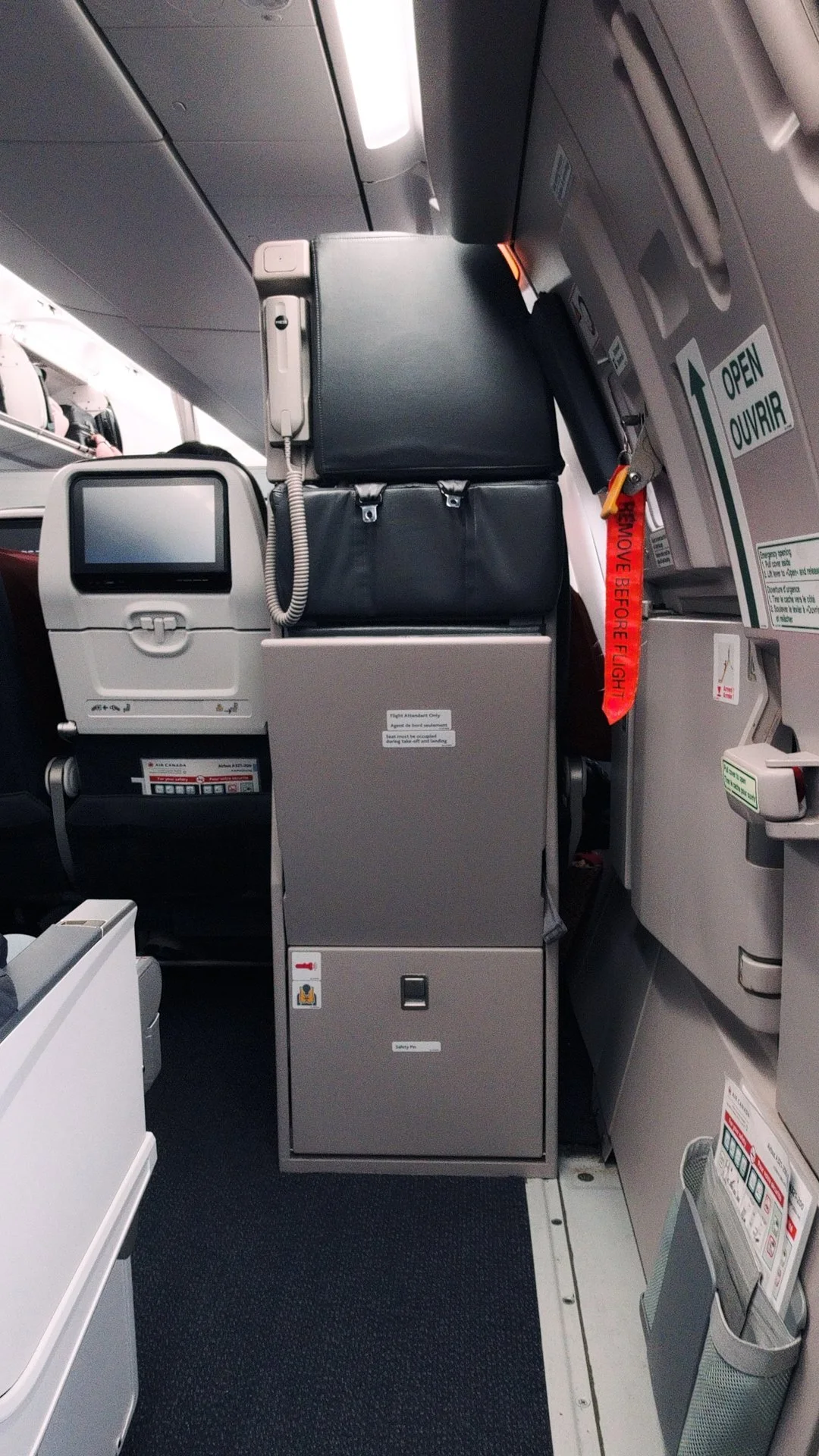
Next test: a short business trip to Toronto. These trips are typically tight—24-48 hours, packed meetings—but with small windows for street photography or a quick vlog. Most of my shooting ended up happening in the evening, making this a good test for low-light performance.
Like any new piece of gear, it was fun to experiment with—different JPEG profiles, fields of view, and modes which create a myriad of combinations to explore. But a few limitations showed up quickly.
Where it Struggles
Shutter Lag (the big one)
For street and candid photography, timing is everything. Here, the Ace Pro 2 struggles.
The Xplorer Pro Grip shutter triggers on release, not press, of the button - which certainly messed with my flow
There’s a noticeable delay (~0.5s) before capture
Buffering slows consecutive shots
For still subjects, it’s fine. For moving scenes, it’s a problem.
Using the on-screen shutter button improves responsiveness, but doesn’t solve shot-to-shot delay. Ironically, the Xplorer Pro Grip—intended to enhance stills—feels like it is holding the camera back on this one..
This camera forces you to slow down. That’s not always bad—but it limits confidence when shooting anything dynamic. You can adapt, but the question is whether you should have to (or want to).
Samples shot at “normal” pace vs consciously slowing down to account for lag:


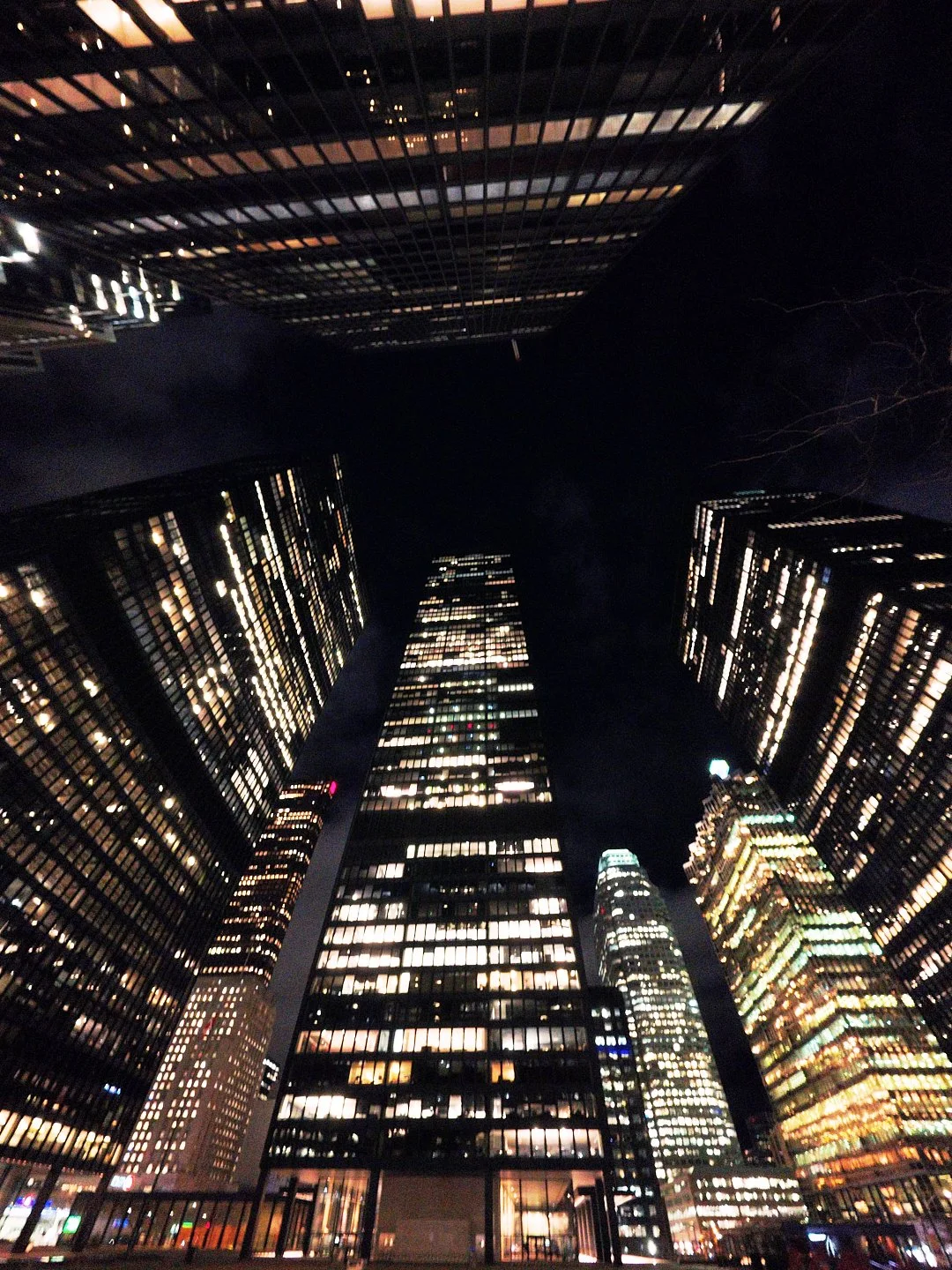
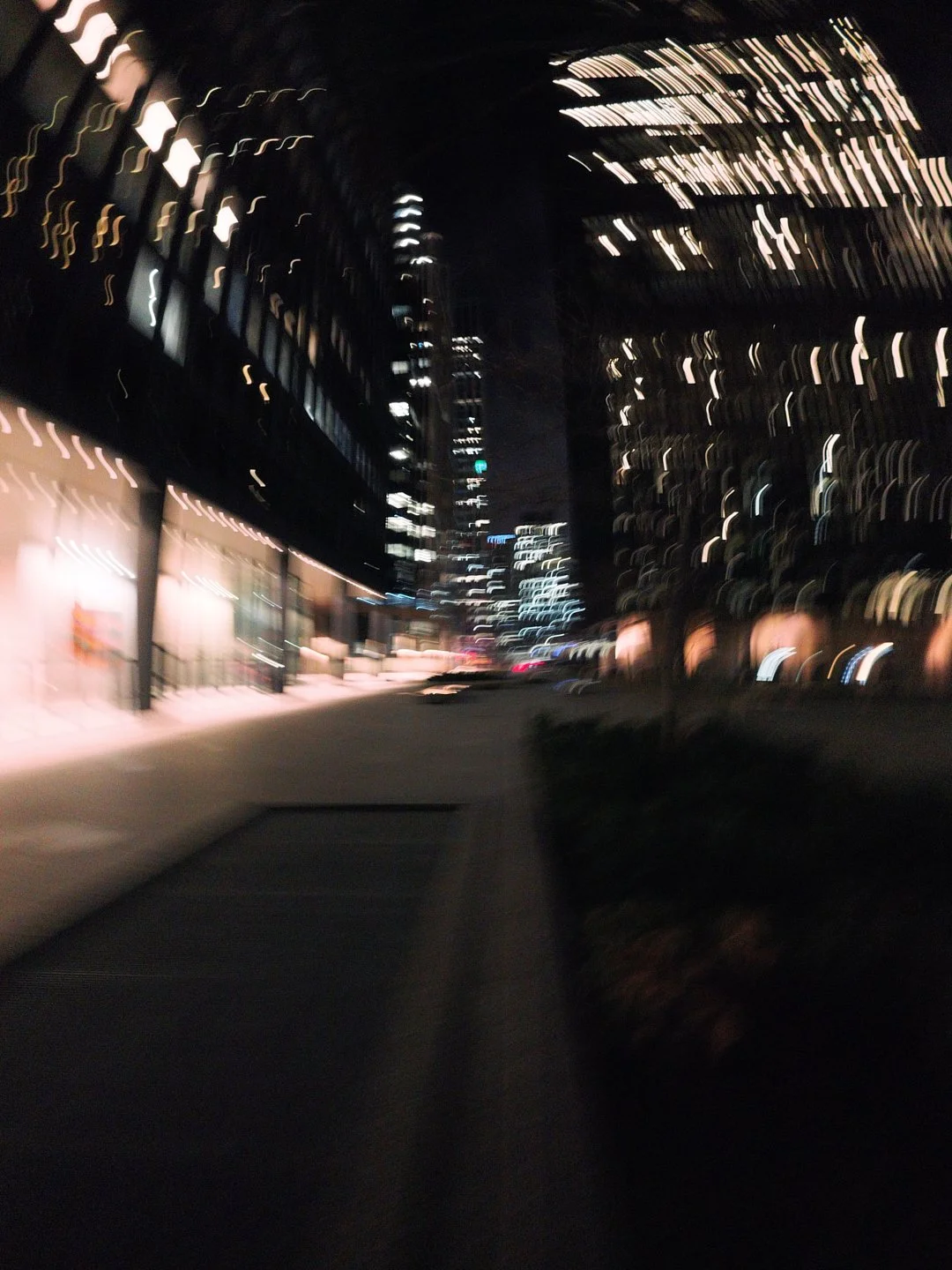
2. ISO & Image Behaviour
The way the camera handles in auto mode is a bit perplexing, particularly when it comes to ISO.
Manual ISO caps at 1600 (despite auto going higher)
Auto tends to favor lower ISO + slower shutter in dim scenes
JPEG grain can get heavy in low light
Pureshot helps the grain considerably, but requires deliberate switching. Kudos to Insta360, though, for having an automated icon pop-up when the camera believes Pureshot is called for. - That’s well thought out and a helpful reminder in the moment.
3. Ergonomics
It looks cool, but for a “pocketable” camera it is surprisingly heavy and thick with the Xplorer Pro Grip attached. Perhaps that’s the price we pay for the extra battery capacity, and no doubt I’m spoiled by the featherweight Ricoh GR iii that typically accompanies me on street shoots (with two spare batteries in my bag owing to it’s poor battery life). Here are some thoughts on the form factor after a couple days of use:
Thumb dial is overly sensitive → accidental changes are common (for me) from the slightest nudge in a natural grip position. A cold-shoe mounted thumb rest could potentially solve this.
Grip is bulky → less “pocketable” than expected (think jacket, not jeans)
No included lens cover → constant low-level anxiety for smudges and scratches
I’ve already lost the shutter button → The screw-in button has managed to disappear having backed-out unbeknownst to me. I’ve substituted a spare that happened to be in my gear drawer, but I can’t say I’ve ever had this happen on another camera.
It’s by no means a large camera, but with the grip attached it’s heavy enough that you’d notice it quickly on a selfie stick, say if you were doing dual-duty for vlog and stills on the run.
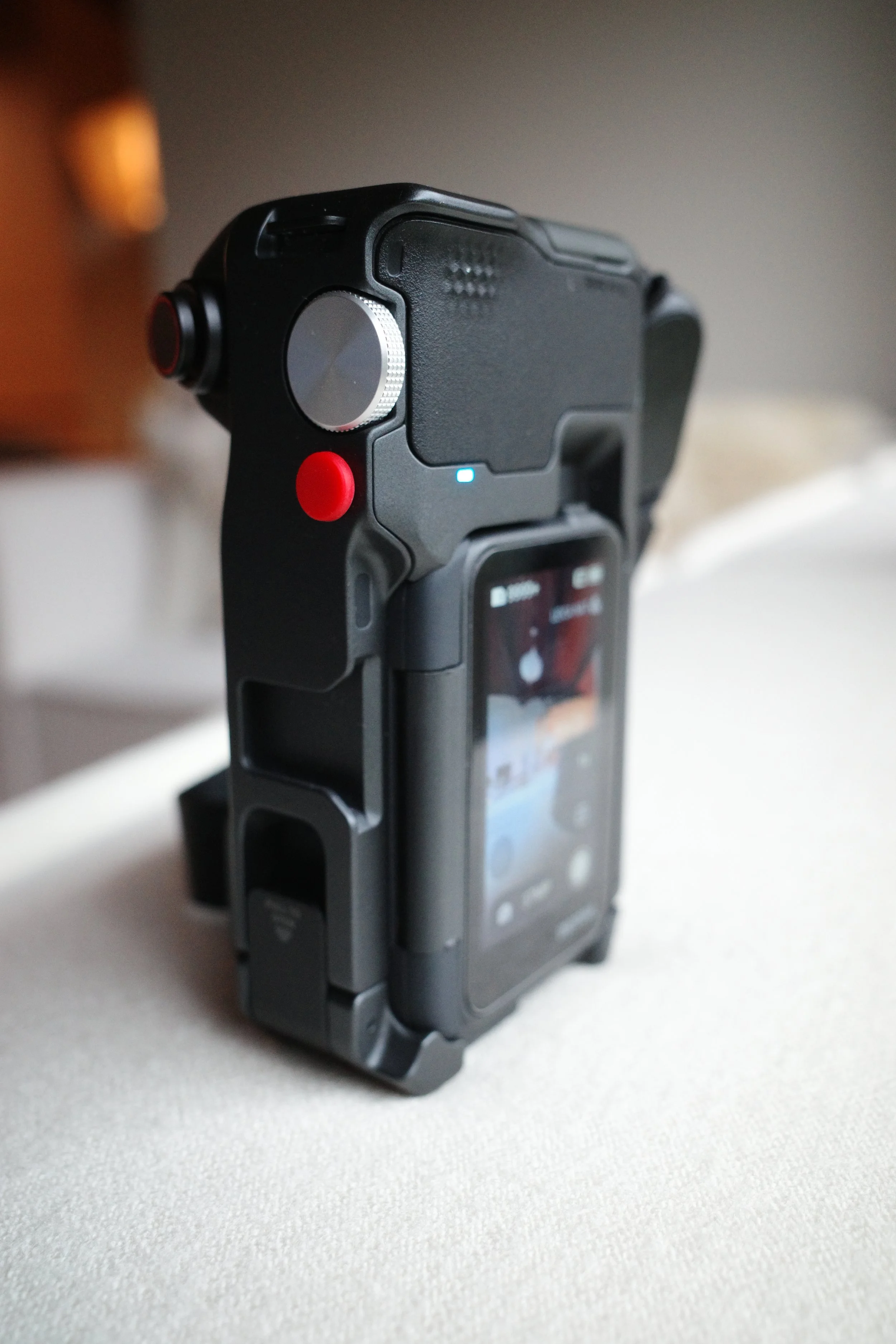
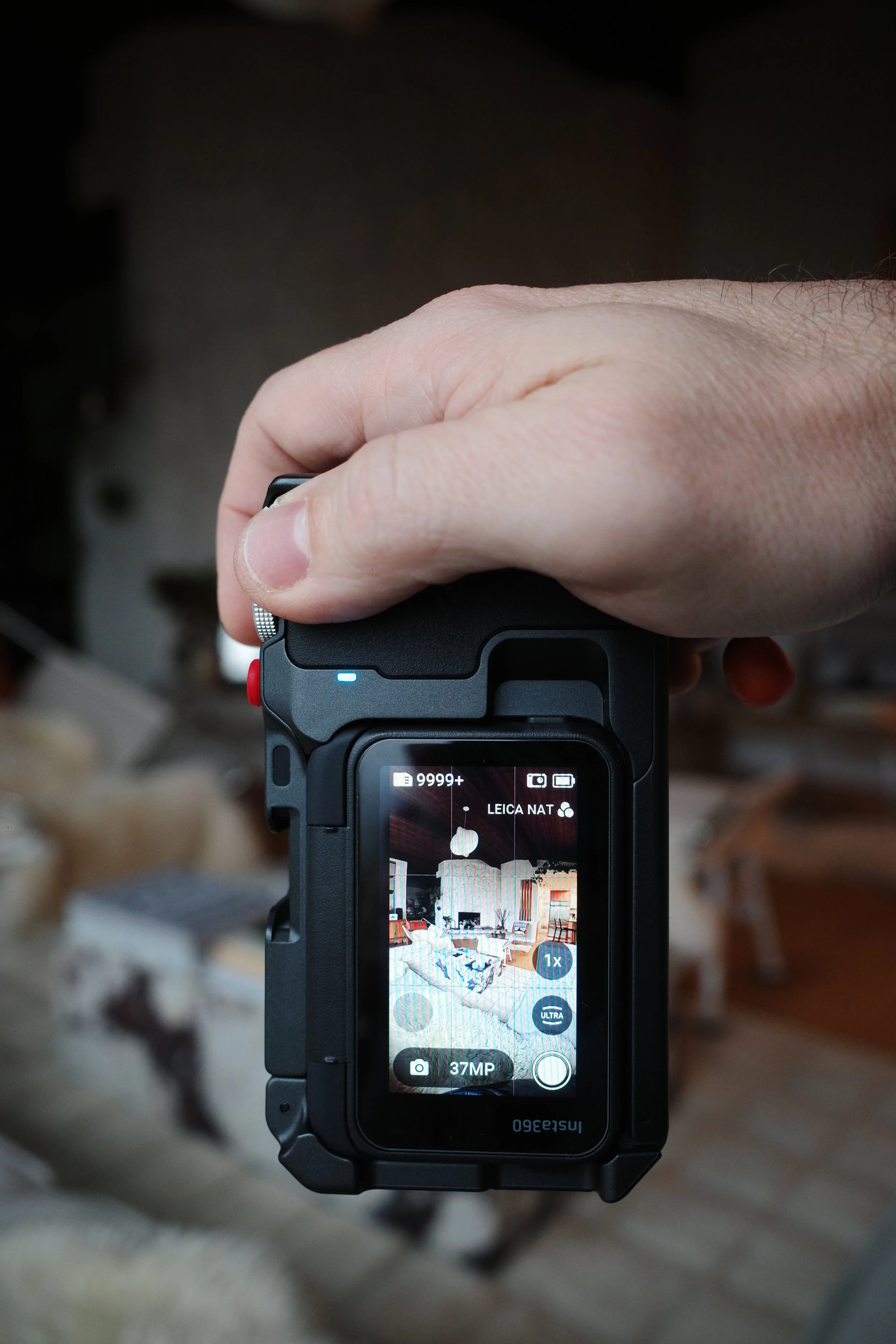
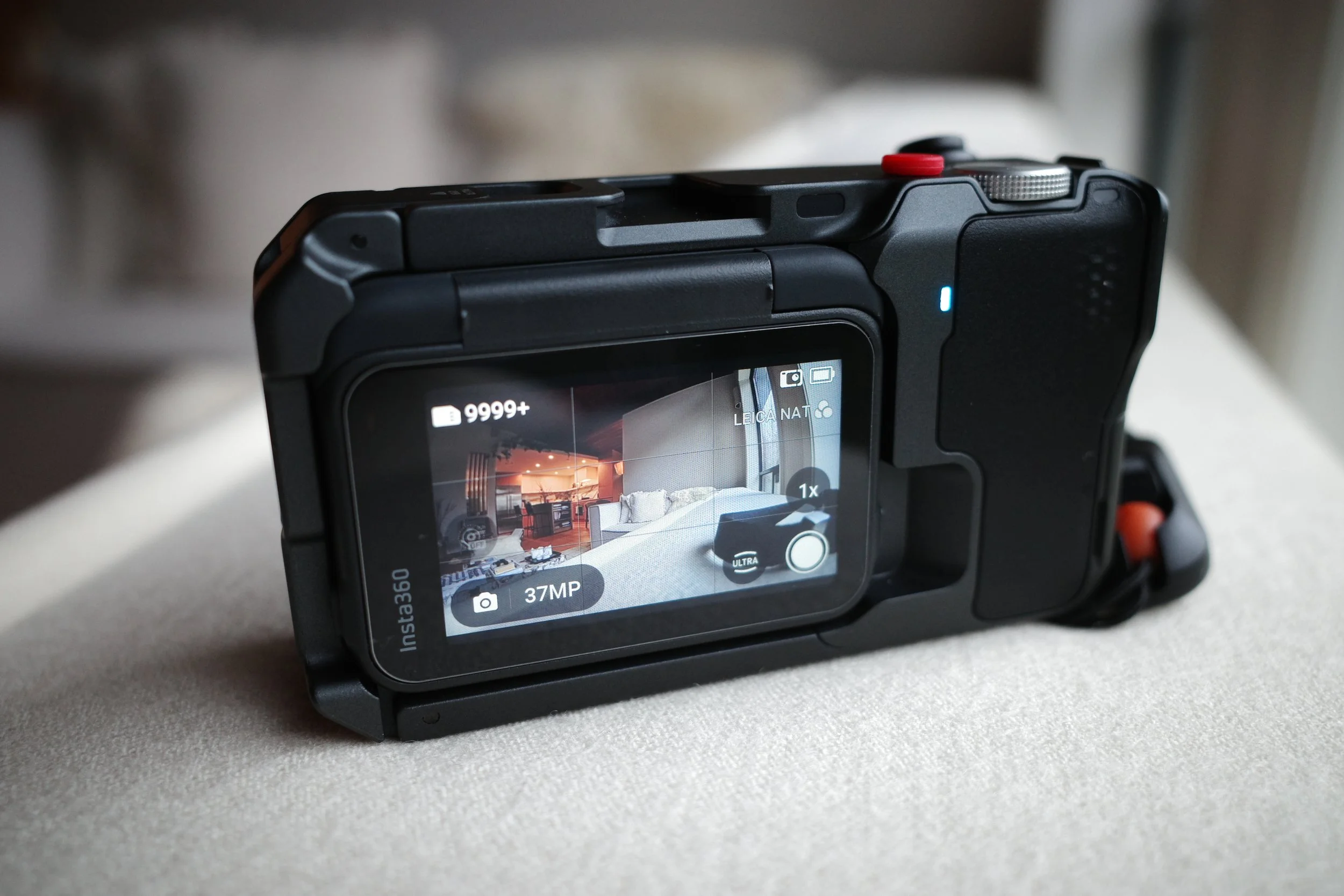
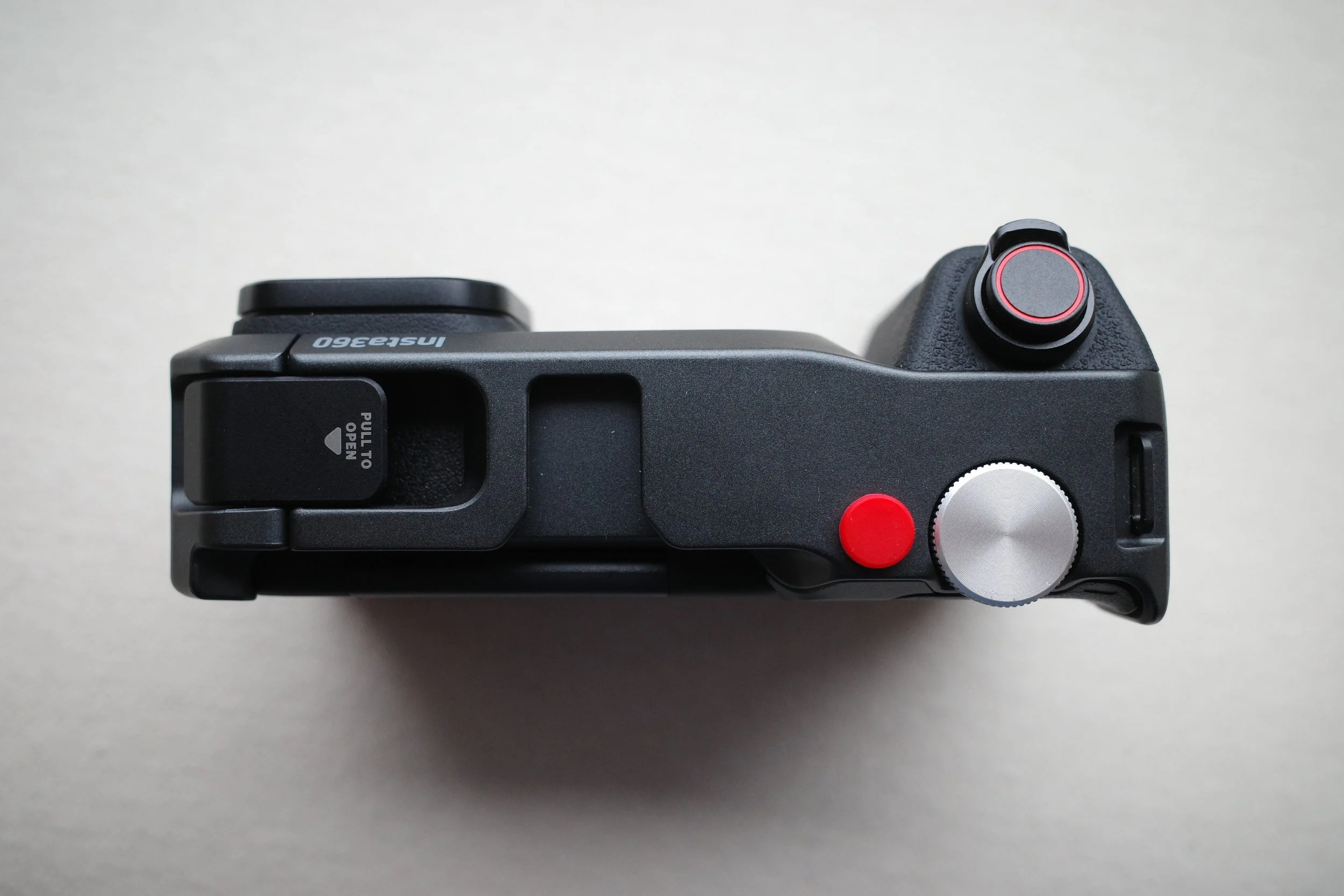
“...it feels like the Xplorer Pro Grip, despite its intent as an enabler for stills, is actually holding this camera back.”
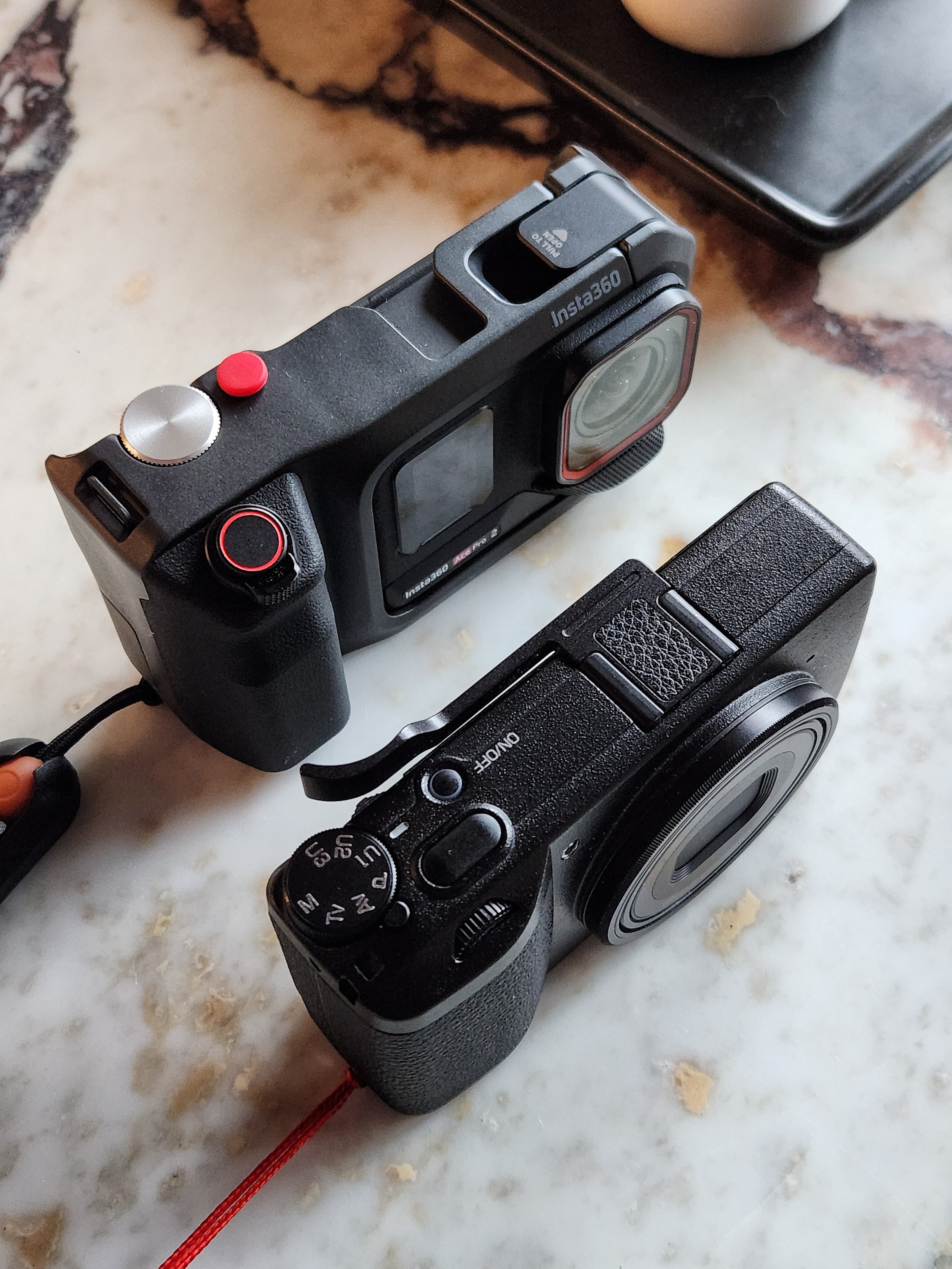
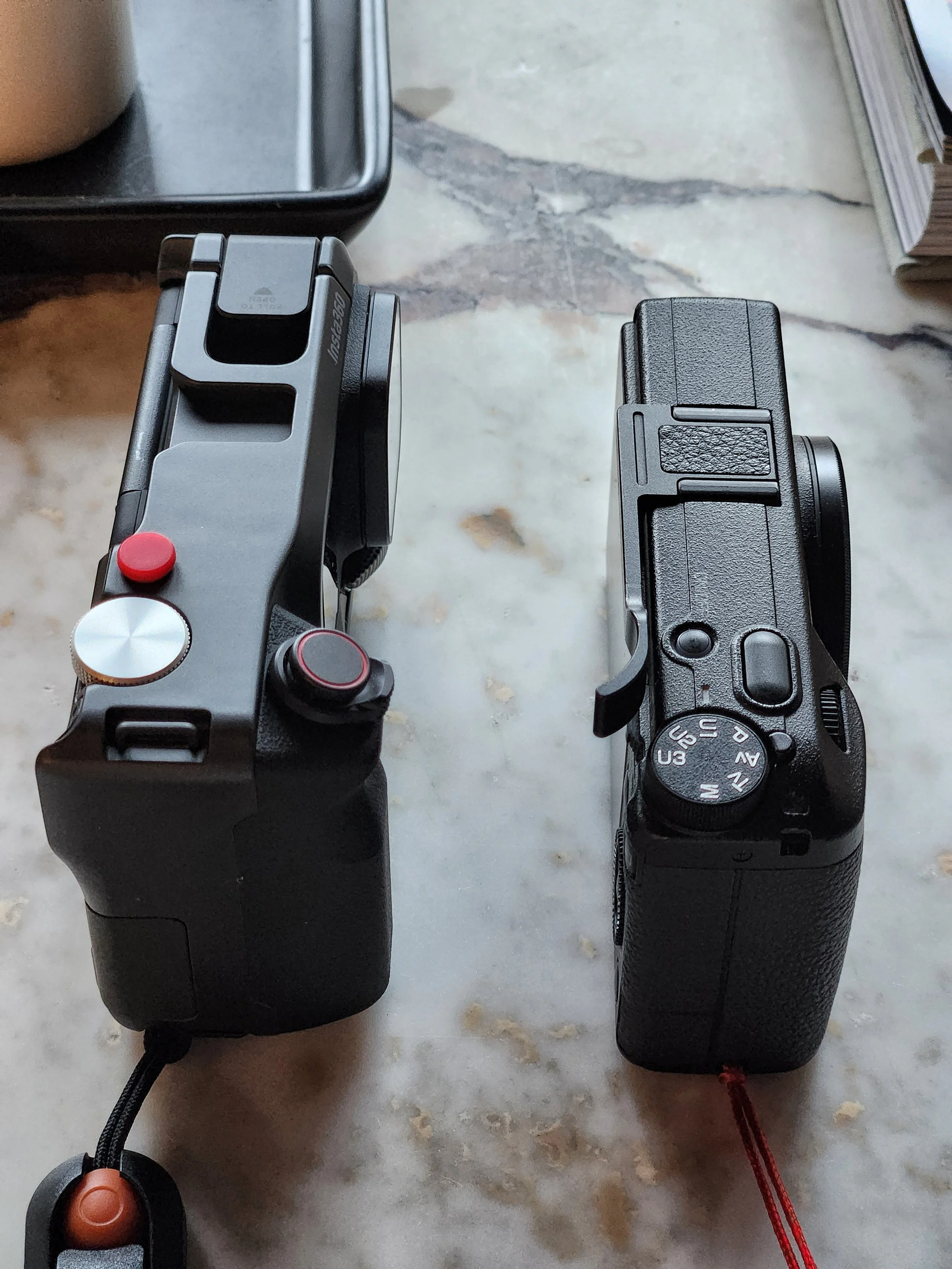
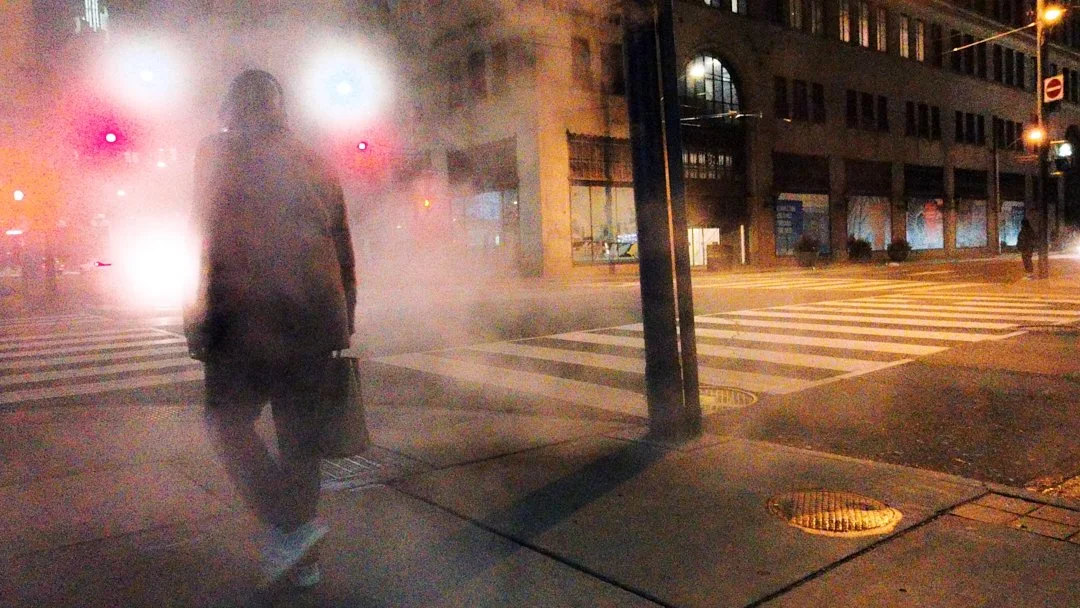
Gap in the steam, Leica Eternal, Toronto, ON
What Works Well
JPEG Profiles
The JPEG profiles are strong out of camera and feel very useable. There are a lot of options and I’ve only begun to scratch the surface with them. There’s something for everyone from subtle to over-the-top effects here.
The Leica profiles—especially Eternal—stand out. Dark, contrasty, and stylistically relevant. With light editing, you can get compelling results.
Desolate UP Express stations, Leica Eternal

Shot taken from the UP Express, Leica Eternal
Taken without using Pureshot, heavy grain is evident but I don’t mind it here, Leica Eternal
Attempting a panning shot with the Insta360 Ace Pro2, Leica Eternal
Downtown Toronto, Leica Eternal, Insta360 Ace Pro 2
2.Field of View
There is lots of flexibility, especially with accessory lenses. This gives it a leg-up on a lot of traditional point and shoots with fixed prime lenses or limited zoom capabilities. This combined with the many Jpeg profiles expands on the creative potential of the Ace Pro 2 - I don’t think I’ll get bored of it any time soon!
The Downside:
FOV isn’t recorded clearly in metadata
Ultra-wide setting even without an accessory lens can literally capture your fingers on the grip, and so could prove problematic for handheld shooting.
Union Station, Toronto ON
Union Station, Toronto ON
“Another surprising finding was that in Ultra Wide mode the lens actually picks-up my fingers on the grip!”
Finger visible on the grip on right side of frame, Insta360 Ace Pro2, Ultra FOV
3.Lens System
The cinematic lens is excellent—well-built and genuinely expands creative potential.
The ability to change lens attachments to achieve a multitude of looks and expand capabilities is one of the camera’s strongest advantages. Not to mention other accessories such as the dive-case, which I just recently ordered. (stay tuned for the undersea review!)
Still captured in the Insta360 Video Editing software, Cinematic Lens Attachment
4.Durability
Well it’s already survived a crash, so top marks for that!
Compared to something like the Ricoh GR series, this feels far more robust. Add-in the Insta360 replacement program, and it’s a strong point when considering this platform. The lack of lens cover for the standard lens is the downside here. With the grip mounted some watertightness is evidently lost due to removing the usb-c cover and plugging in the rubber-housed grip connector plug, but it seems more than capable even then of handling a downpour.
So—Can It Replace a Point & Shoot?
Not yet.
Image quality is certainly good enough for casual use and social content, but the responsiveness issues hold it back for serious (or perhaps I should say reliable) stills work. If results matter—or if you’re shooting anything dynamic—you’re better off with a dedicated camera (or even a modern smartphone). This may seem a likely or even obvious conclusion to seasoned or dedicated hobbyist photographers, but I don’t think that’s who this camera is targeting.
Final Take
The Ace Pro 2 is impressive—but not as a stills-first camera.
Where it shines is versatility:
video
rugged use
creative experimentation
For stills, it’s capable—but constrained.
That broader question—whether a piece of gear genuinely earns its place on the journey—is also at the heart of my IWC Pilot’s Watch UTC review.
So where did that leave me? A few months after these initial impressions, I took the camera to Greece for a two-week real-world test of the Ace Pro 2 as a travel camera, curious to see whether more familiarity—and a few firmware updates—could change my mind.
Reflecting on the Insta360 Ace Pro2
West Maui in Monochrome — Kaanapali, Napili & Kapalua (Part 1)
When I booked a week away to the Island of Maui, a project dawned on me to abandon the temptation to capture the vivid colours of the island and seek instead to document it as I first saw it through the monochrome images shared by explorers and tourists generations before me.
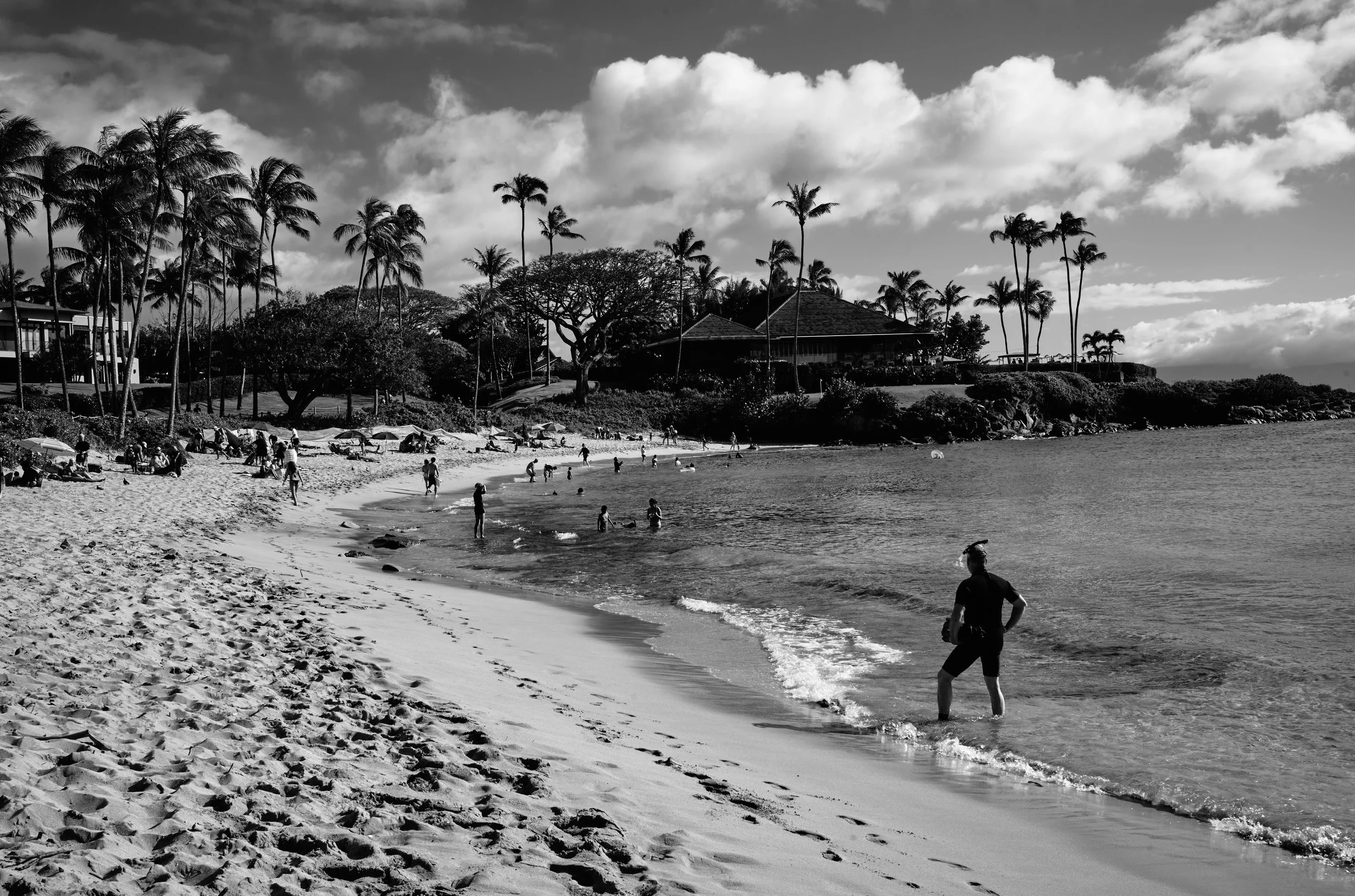
Kapalua Beach, Maui, Hawaii, Leica M10R, 35mm Summicron
Aloha
Growing up, I was endlessly fascinated by old books and magazines I’d find at my grandmother’s house describing the far off places of the world. National Geographic magazines and Readers’ Digests, some decades old even at that point, were filled with novel images and captivating stories of wild coastlines lined by swaying palm trees, towering volcanoes, thatch-roofed villages, and strong men paddling through giant waves. Some images showcased vibrant landscapes, while others in grainy black and white evoked the excitement of discovery and left the color pallette to the imagination and to me these were somehow the more engaging images. So, when I booked a week away to the Island of Maui, a project dawned on me to abandon the temptation to capture the vivid colours of the island and seek instead to document it as I first saw it through the monochrome images shared by explorers and tourists generations before me.
Aston Papakea, Kaanapali, Maui, Hawaii Leica M10R
Aston Papakea, Kaanapali
Regular readers of my blog might find this destination a bit surprising, especially as a place we’ve now visited twice, and at the same property no-less. While it’s neither wild (well, wait until the next story for that) nor posh, it is, to me, eminently relaxing and to that effect sometimes I don’t mind being able to just put my feet up, not think too hard about what to do next, and arrive and leave rested from a trip. To me, Kaanapali retains an enjoyable balance between curated and quaint, with resort properties large and small lining the coast as well as a small towns and hamlets along the coastal road.
We stayed here once before, around ten years ago, at the same property in fact, the Aston Papakaya Resort. Kaanapali is one of the core resort areas on the west coast of Maui, with the seaside facing the islands of Moloka’i and Lanai. It was largely sparred by the wildfires that devastated Lahaina the year before, the remnants of which we caught glimpses of along the way. There’s everything from simple homestays to extravagant hotel properties to stay at depending on the vibe you’re looking for. Our apartment within the Papakea property was well appointed with a full kitchen, lanai (balcony), and an upper loft area that acted as our “in-law suite”. There was ample room for the five of us which included my in-laws who we brought along in hopes of a bit of babysitting support. The buildings on this property certainly aren’t new, but generally appeared in great condition, with our own suite likely renovated recently judging by the lack of wear and tear. It was a nice bonus that our lanai faced almost due west and allowed a lovely view of the inner courtyard with its ponds, palms, pool and the ocean beyond with Moloka’i rising in the distance. Exuberant songbirds and a steady breeze greeted us as we stowed our bags following the roughly hour long drive in from Kahului airport.
Aston Papakea, Kaanapali, Maui, Hawaii Leica M10R, 35mm Summicron
I find the architecture and layout of this resort interesting. At first glance it doesn’t particularly stand out, but as you begin to wander it’s paths there’s an element of Spanish fortress meets brutalism that feels oddly out of place and at the same time rather playful. I could imagine myself as a kid running along the winding paths, playing hide and seek around sharp corners and verdant bushes, and imagining all sorts of foes attempting to storm this seaside citadel.
Aston Papakea, Kaanapali, Maui, Hawaii Leica M10R, 35mm Summicron
Aston Papakea, Kaanapali, Maui, Hawaii Leica M10R, 35mm Summicron
Aston Papakea, Kaanapali, Maui, Hawaii Leica M10R, 35mm Summicron
Honokowai Beach Park, Kaanapali, Maui, Hawaii Leica M10R, 35mm Summicron
The downside to this resort is the lack of direct beach access. While the sea is certainly immediately adjacent, it’s a sub-optimal setup for any lounging on the sand or snorkelling as only a thin strip of sand separates sea and seawall and even then only at low tide. The good news is there are fantastic options for beach-time both walking and easy driving distances away.
Napili & Kapalua
Napili and Kapalua Bays are located just 7km north of the Aston Papakea. They are essentially adjacent, separated by a spit of land that juts into the sea. If you’re driving, street parking is likely your best bet for both though there is a small parking lot nearby Kapalua. It’s hard to pick a favourite between the two, and in fact looking back at my photos I can struggle a bit to remember which is which! The sand here is soft and warm, though shade is at a premium with the few coveted palm trees spots claimed quickly in the mornings. The snorkeling at both is excellent, and I quickly regretted not bringing my dive camera along to capture some of the beauty. Turtles, of course, are delightfully abundant, but as are many other fish and creatures. I even caught a fleeting glimpse of a barracuda swimming past in the deep blue as I swam out to the outer reaches of one of the bays. The shape of the bays shelters them to some degree from the waves, making swimming and play bye the shore safer for young ones, though still worthy of careful attention. Just a bit further up the coast the north facing beaches are clearly pounded more by the surf and less ideal of a snorkel or casual swim. For food and drinks on the beach your best options are Sea House on Napili and Merriman’s just next to Kapalua. As usual, happy hour is where your money will go the farthest.
Napili Bay, Kaanapali, Maui, Hawaii Leica M10R, 35mm Summicron
Napili Bay, Maui, Hawaii Leica M10R, 35mm Summicron
Kapalua Bay, Maui, Hawaii Leica M10R, 35mm Summicron
Ka’anapali Beach
If you head south from the Aston Papakea there’s a roughly 3km stretch of beach from the Hilton to the Royal Lahaina that offers quick and easy access to the sea, warm sand and a myriad of dinning and shopping options. A trail just above the beach runs the entire length of this strip of sand and allows access to the various vacation properties. These beaches are more exposed than the bays of Napili and Kapalua and thus less optimal for snorkelling or swimming, but nonetheless are excellent spots for laying on a sun bed or towel and soaking in the warmth.
Ka’anapali Beach, Maui, Hawaii Leica M10R, 35mm Summicron
Ka’anapali Beach, Maui, Hawaii Leica M10R, 35mm Summicron
Ka’anapali Beach, Maui, Hawaii Leica M10R, 35mm Summicron
Ka’anapali Beach, Maui, Hawaii Leica M10R, 35mm Summicron
Ka’anapali Beach, Maui, Hawaii Leica M10R, 35mm Summicron
Ka’anapali Beach, Maui, Hawaii Leica M10R, 35mm Summicron
Our favourite restaurant in this particular area, Monkeypod Kitchen (a more casual sister-restaurant to Merriman’s), was actually a bit further south between the Westin and Whaler hotel’s in a dense shopping area. Lively and akin to a Cactus Club for my Canadian readers. Their Mai Tai is excellent. Honorable mention to Duke’s for its vintage surf vibe.
Figuring out the menu at Monkeypod, Maui, Hawaii, Leica M10R, 35mm Summicron
Adventure Time
Most regular visitors to Maui attempt the Hana Highway once, and call it done. Even for the driving enthusiast this tight and winding route, often filled with timid tourists, can become exhausting, and while spectacular, always feels a bit like a test of luck and resilience. To go beyond Hana is of course forbidden -or so they insist at the rental car counter. We’d done this trip before, and clearly forgot -or let’s say, misremembered- how long of a day, and challenging a route it could be. With this being the in-laws first visit to the island we felt remiss not taking them on the journey. How did that go? Was it worth a second try? Where did we stop along the way? Did we go the full lap ‘round (and should you)?
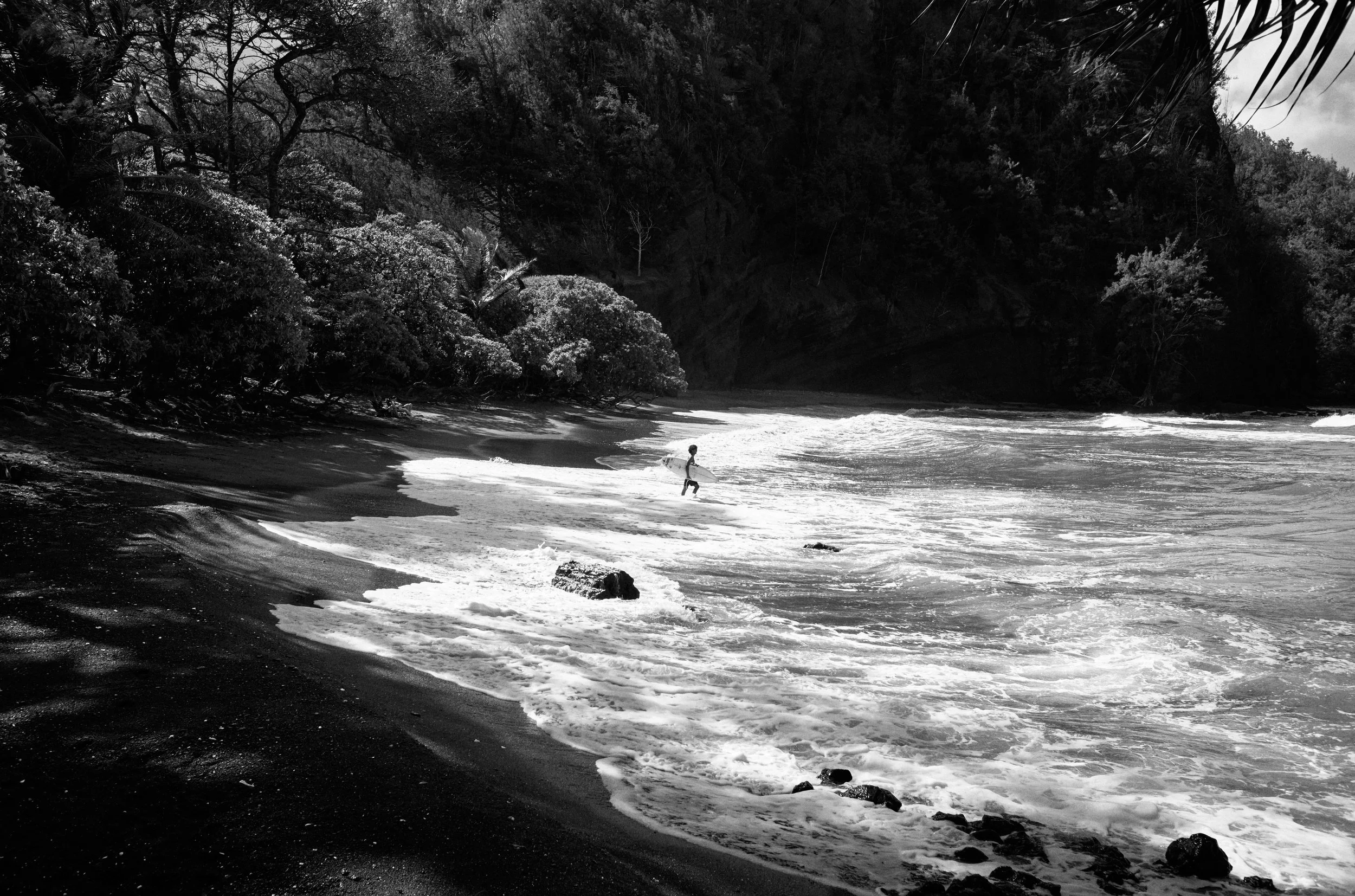
The wilder side of Maui, Hawaii, Leica M10R, 35mm Summicron
A relaxed Palm Springs getaway featuring mid-century architecture, great restaurants, boutique hotels, pool days, and desert sunshine.