
Blog
From cobblestoned Portuguese alleys navigated one-handed with a stroller to reef dives in Fiji, this is where the trips live. Told through words and whatever camera happened to be with me.
I shoot film and digital and travel with family in tow. These posts are part travel journal, part photography log, and part love letter to the places that made an impression. I hope they make you want to go see them for yourself.
Latest Articles







IWC Pilot’s Watch UTC - Why Don’t More Watch Brands do This?
For me, the question is not simply whether a piece of gear is good, but whether it earns its place on the journey. With compact proportions, an intuitive home-time display and an attainable pre-owned price, the overlooked IWC Pilot’s Watch UTC makes a compelling case as a true travel companion.
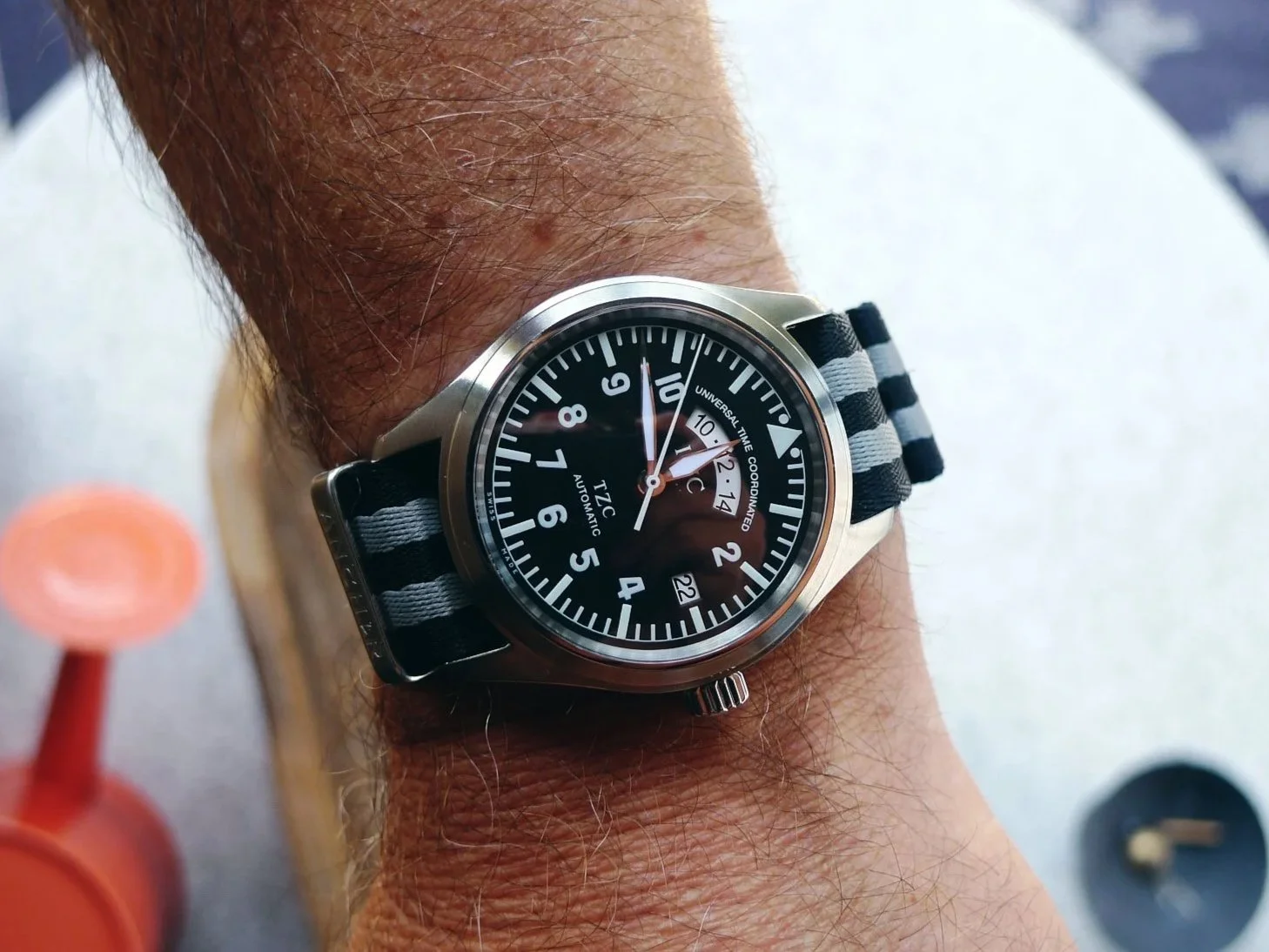
IWC Pilot’s UTC on an Anchor Straps NATO.
IWC isn’t necessarily the first brand that comes to mind for those seeking a GMT or UTC timepiece—I’m going to use those terms loosely and interchangeably from here on, watch-nerd caveats acknowledged—but this one has a trick on its dial that makes it arguably more user-friendly than much of its more hyped competition, from both large and microbrands.
Pair that with an attainable price on the current pre-owned market and you have a tempting value proposition in a luxury tool watch. But I bet this little pilot isn’t on your radar.
Should it be?
The Use Case
For me, the question is not simply whether a piece of gear is good, but whether it earns its place on the journey. I’ve applied the same test to cameras too, most recently asking whether the Insta360 Ace Pro 2 could earn its place as a one-camera travel solution. I travel a great deal, both for work and leisure, and that is reason enough for any watch collector to solve a “problem” with a shiny piece of metal on the wrist. The problem in question is how to set and track a second time zone easily while on the move—and, for the discerning enthusiast, how to do so without disrupting the watch’s flow of time.
Enter the traveller GMT, or in this case UTC, concept. In simple terms, it allows you to change the main hour hand to local time without stopping the seconds hand, while simultaneously displaying the time back home.
There are compelling options across the spectrum, from the relative unobtanium of the Rolex GMT-Master II to offerings from Seiko, Parmigiani Fleurier, Vacheron Constantin, Formex and many more. How does one choose in such a crowded market?
Budget is a good starting point -there’s a serious spread in the aforementioned brands, for example. From there, I think serendipity has a lot to do with the piece you ultimately find. And so, as any serial hobbyist would, I set off on several months of online research.
The Timepiece
I stumbled across this little IWC while doomscrolling through a local watch community on my phone during a 90-minute late-night Uber ride from YYZ to a conference in Niagara Falls.
The IWC Pilot’s Watch UTC, bearing the TZC—or Time Zone Corrector—designation on its dial, admittedly wasn’t on my radar at all, despite being a pilot’s watch. Awful pun; it needed to happen.
In fact, the brand as a whole had largely escaped my attention, aside from a few earlier and smaller chronographs in its back catalogue that I had earmarked for “maybe one day.” The current lineup, including today’s 46mm ceramic Timezoner, would simply dominate my 6.5-inch wrist, making me feel like a kid wearing his dad’s watch. Sadly, I face a similar problem with Panerai and other large watches whose designs I nonetheless enjoy.
Serendipitously, this particular watch was listed for sale in a community not far from Niagara. Seeing as home was far away in British Columbia, I took this as a sign that I was meant to have a look. A few DMs later, I had arranged to see the piece between meetings the following day.
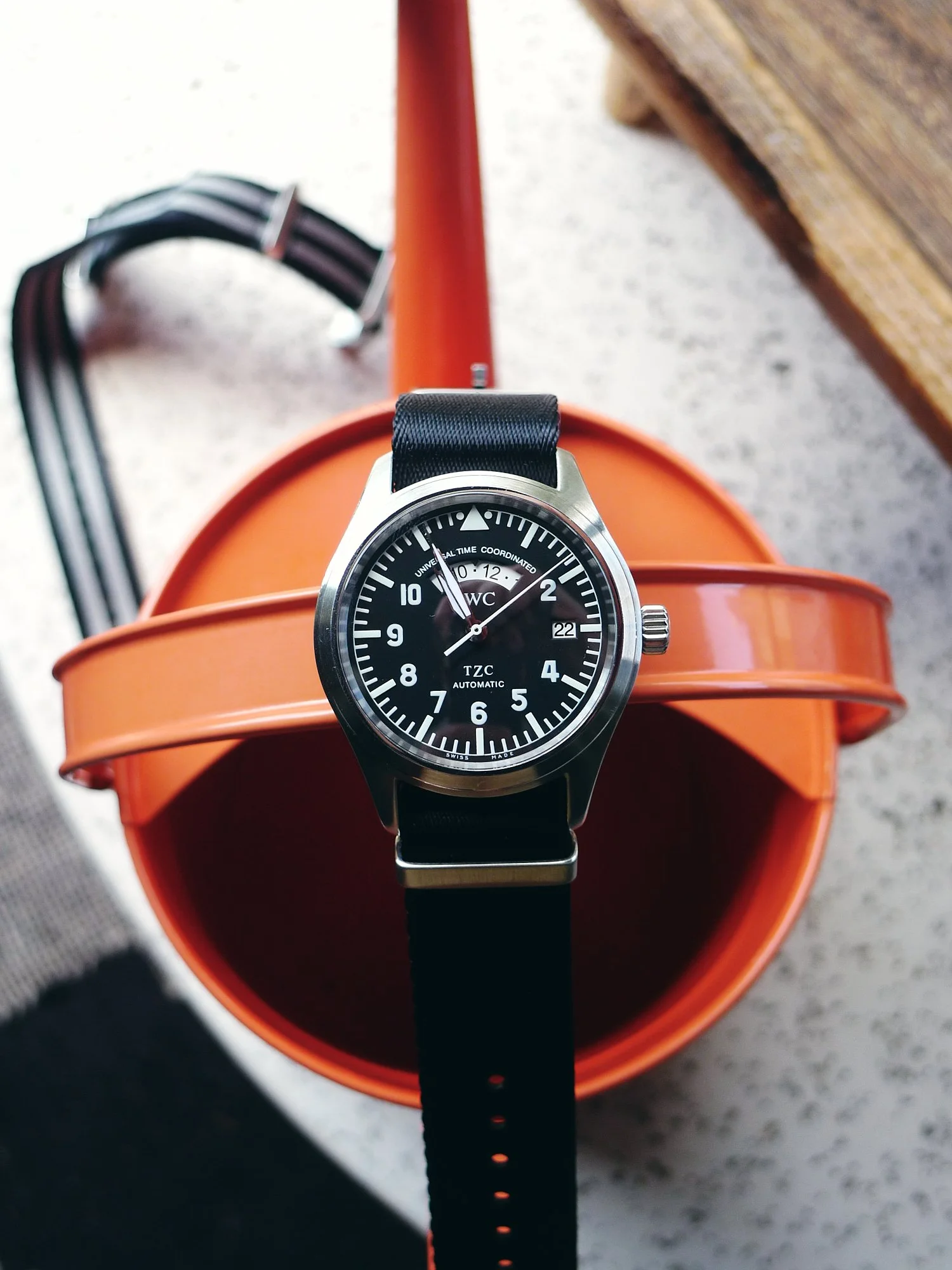
Black NATO straps compliments the dial, creating a perception of a deeper black tone.
My criteria for purchasing used watches are simple but limiting. I’m typically looking for something close to pristine or new-old-stock, so that I can put my own dents and scratches into it. I’m the same with cars—and, well, almost anything really.
Luck was on my side here. The watch was close to NOS and came complete with its stainless-steel bracelet, which barely had a mark on it. It looked even better in person than it had in the photographs and, following some mild negotiation, it was on my wrist for the trip home.
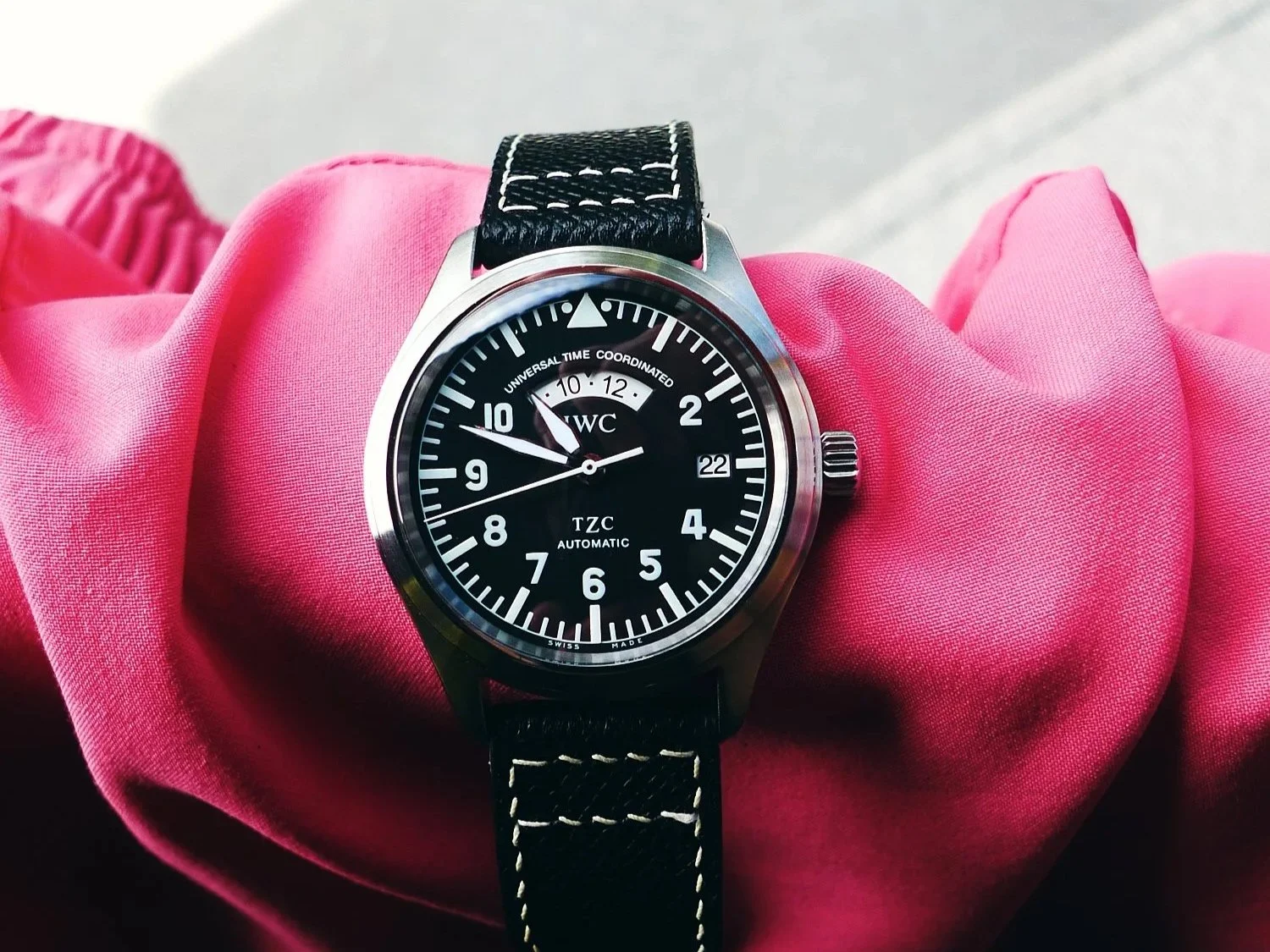
On a Wristwatchme black leather strap for a dressier look
The Specs
Model: IWC Pilot’s Watch UTC
Reference: IW3251-02 — stainless-steel bracelet configuration
Production era: Approximately 1999–2003
Case: Stainless steel
Diameter: 39mm
Thickness: Approximately 13mm
Lug width: 20mm
Crystal: Sapphire, secured against displacement caused by sudden drops in air pressure
Caseback: Solid stainless steel
Water resistance: 60 metres when new
Magnetic protection: Soft-iron inner case
Dial: Black with luminous Arabic numerals, hands and pilot’s triangle
Bracelet: Stainless steel
Movement: IWC calibre 37526, based on the ETA 2893-2
Winding: Automatic
Frequency: 28,800 vibrations per hour
Jewels: 21
Power reserve: Approximately 42 hours
Functions: Central hours, minutes and seconds; date; independently adjustable jumping local-hour hand; and home time displayed on a rotating 24-hour disk. The date moves both forward and backward with the local-hour hand when crossing the International Date Line.
Design
The UTC is an enigmatic blend of understated elegance and function-led design, wrapped in a small but commanding package.
The first standout is the domed sapphire crystal, which is an absolute magnet for reflections. This makes photographing the watch challenging—occasionally infuriating, in fact—but in practice it does not meaningfully affect readability.
The case is extremely comfortable, with lugs that curve down and hug the wrist. There is enough weight to remind you it is there without incessantly demanding your attention.
The more time I spent with it, the more I noticed some of its finer details. An impossibly thin polished chamfer runs from lug tip to lug tip along each side of the case, complemented by a polished edge on the otherwise brushed bezel. The signed crown is small enough not to disturb the back of the hand, yet still easy to grip. That said, I find it much easier to operate with the watch off my wrist.
Bespoke epsom leather strap by Wristmatchme
The dial has a lot going on, so let’s break it down.
The sword hands suit the flieger style and pair well with a razor-thin, white-painted centre-seconds hand that matches the rest of the dial printing. The triangle and dots at 12 help ensure that you don’t put the watch on upside down, while reinforcing the vintage flight-instrument aesthetic.
The Arabic numerals from 2 through 10 are present, save for the 3, which is replaced by a white date window—useful for a traveller, of course. The IWC wordmark sits subtly but proudly above the centre of the dial.
Above it rests the watch’s defining feature: the UTC window, a quarter-circle cutout displaying home time. It is here that the genius of the design becomes evident. Black numerals are printed on a rotating white 24-hour disc, while a small triangular marker at the top of the window establishes the reading point. This means your home time is always displayed in the same place on the dial. With more conventional GMT designs, your eye must first find the additional hand and then interpret its position against a separate scale. In practice, the IWC is more immediately readable—and by a meaningful margin.
Not that readability is a race, but why this approach hasn’t caught on more widely, I’m not sure. My guesses include the general desire to pay homage to the “king” of the category and the abundance of affordable movements designed around a conventional GMT hand.
The IWC approach also consumes a fair amount of dial real estate—but then so does something else, which brings me to my primary gripe with the watch.
Can’t un-see that big Z
Quirks
Time Zone Corrector is already a fairly unusual descriptor, but the TZC acronym—with its enlarged “Z”—looks a little goofy sitting above 6 o’clock on such an otherwise purposeful watch. Perhaps it suited the fashion of its day, but reducing that letter by about 0.5mm would do the design a world of good. Removing the acronym entirely and leaving “Automatic” to stand alone at the foot of the dial might be even better.
It is a matter of taste, of course, but it feels out of character with the rest of the watch.
The other element that mildly triggers my OCD is the “Universal Time Coordinated” script above the UTC window. I don’t mind the window being labelled, as it makes sense to distinguish it from something like a date display—and yes, there is a certain Hamilton to which this bears a passing resemblance. However, the wording appears just slightly off-kilter from a symmetry perspective, which occasionally makes my eye twitch.
Those details aside, the one functional improvement I would make is to the lume. If the UTC disc were lumed and therefore legible in the dark, it would be even more useful on long overnight flights, when curiosity about the time back home tends to arise again and again.
The lume overall is about average in initial brightness and well below average in duration—no doubt at least partly an age-related factor at this point.
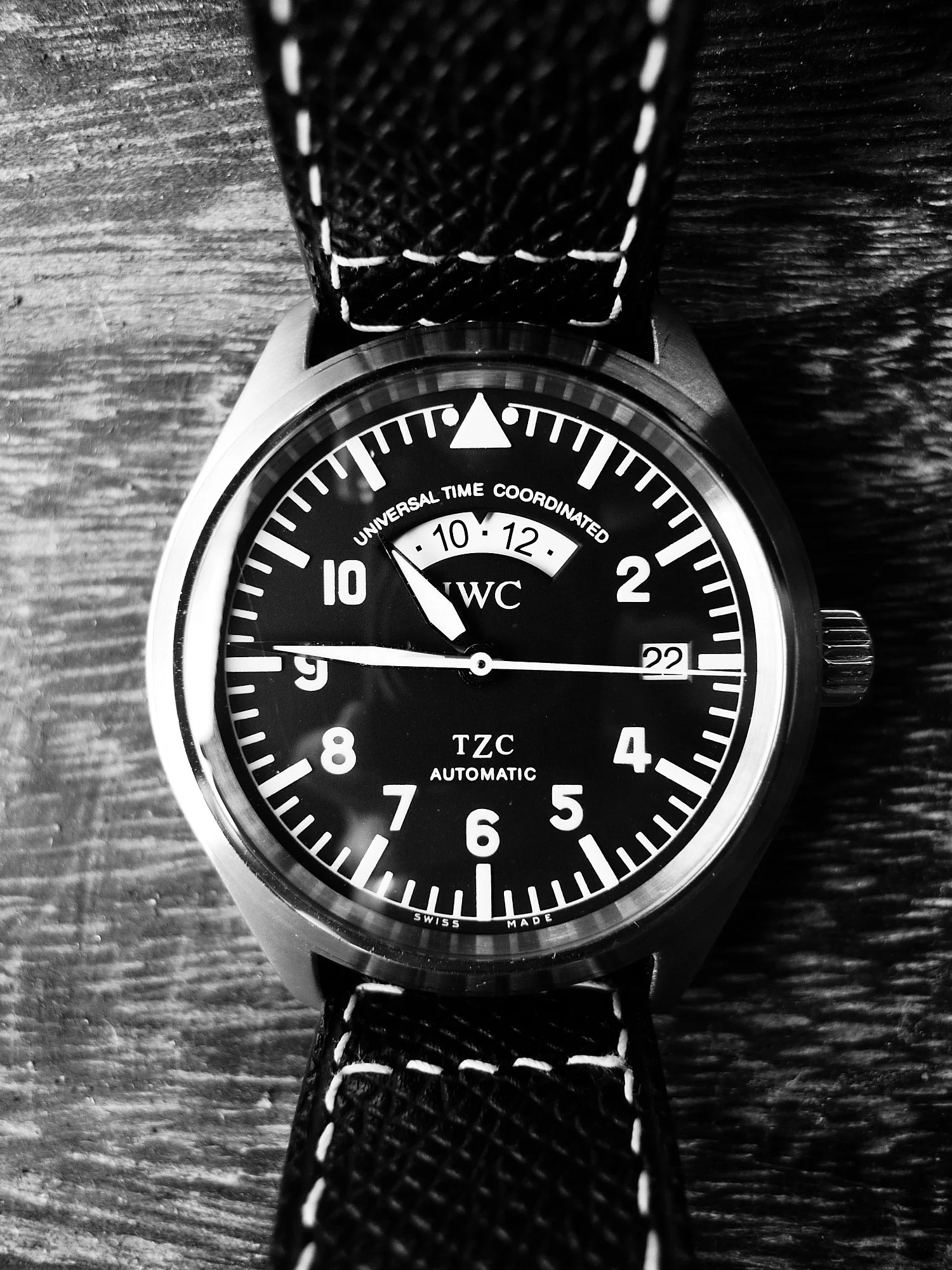
Why is the “Z” larger than the T and C? If you know, comment bellow!
The Bracelet
IWC bracelets are renowned for their comfort and solid construction, but I find that their slightly blocky design contrasts with the otherwise organic, softly curved lines of the brand’s flieger cases. This one fits beautifully and feels great, but visually it just doesn’t suit the watch—for me.
I wore it on the bracelet for the first month. While it was delightfully comfortable and easily adjustable once I had watched a few videos explaining the mechanism, it never looked quite right.
On to a NATO strap, then—but not before disaster struck.
The end links are so precisely fitted, and the gaps through which to access the spring bars so narrow, that it is surprisingly easy to damage the shoulders of the spring bars and render them nearly impossible to remove. What I expected to be a five-minute job turned into several hours of mounting panic as I made the problem progressively worse while trying to free the end link.
The debacle ended with a trip to my favourite watchmaker, who needed to use a diamond drill to release the end link from the case. The underside of the bracelet suffered a tiny amount of damage in the process, but the case emerged no worse for wear. Lesson learned. The bracelet now lives in my watch drawer.
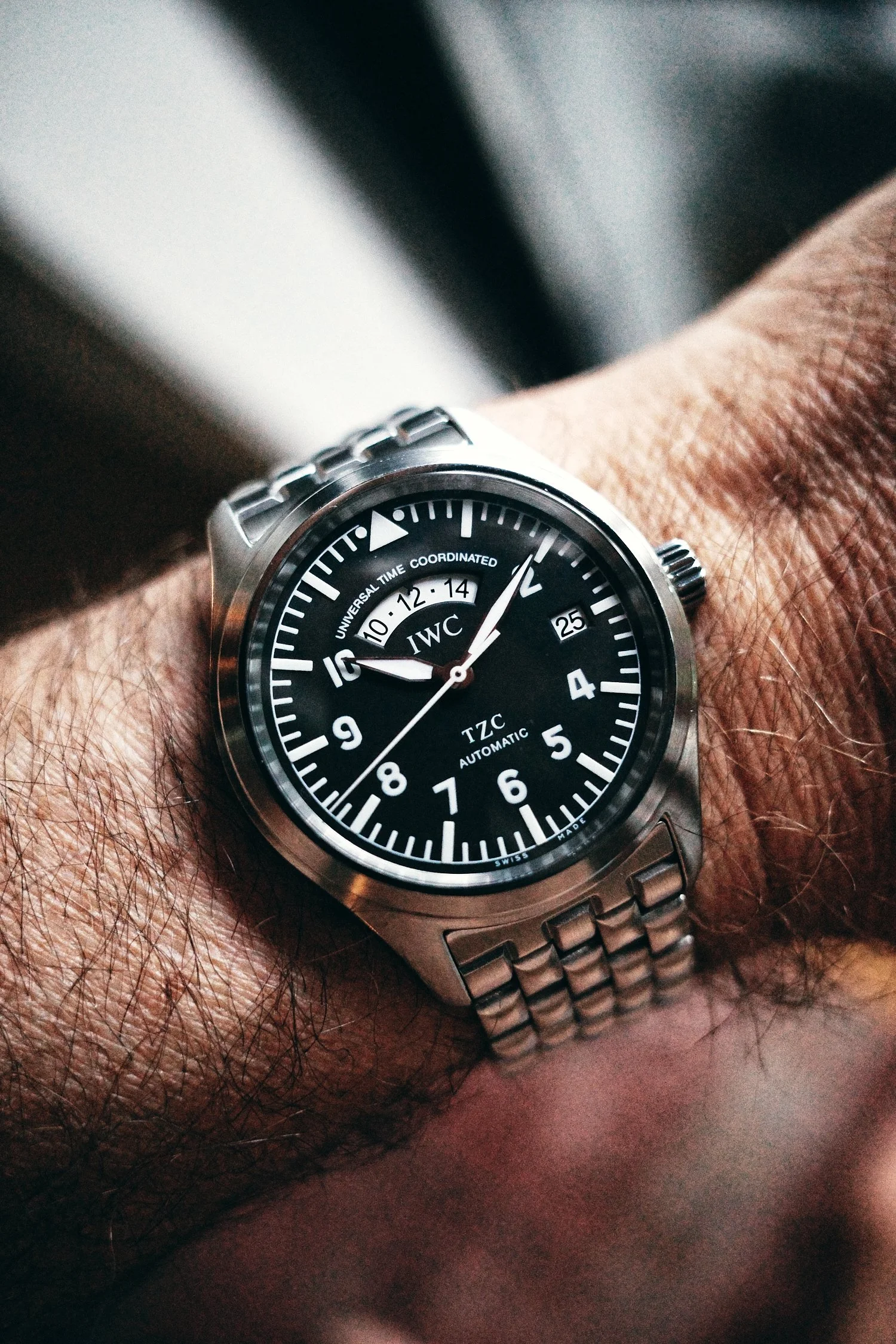
One and only shot on the bracelet, I’m afraid to reinstall it in case it gets stuck again…
The Pilot’s Watch UTC is an absolute strap monster, easily transitioning from casual to dressy depending on your choice of NATO, rubber or leather. A custom pilot-style Epsom leather strap by Wristwatchme is my favourite way to elevate the look, while black, Bond and grey NATOs all suit it well.
IWC Pilot UTC on bespoke Wristwatchme epson leather strap.
I chose Le Petit Prince blue for the underside because it’s IWC—and why not?
As a Travel Tool
A travel watch should do more than display another time zone. It should make life on the move slightly easier without introducing another object to worry about—and this is where the IWC makes its strongest case.
The independently adjustable local-hour hand works exactly as a traveller wants it to. In-flight, pull out the crown, jump the main hour hand forward or backward to local time, and continue on without stopping the seconds or disturbing the minutes. The date follows the local-hour hand in either direction as you cross midnight, which sounds like a small detail until you arrive somewhere exhausted and several hours removed from the time zone your body still thinks it occupies.
The UTC display is even more useful in practice than it appears in photographs. Home time remains fixed in one location at the top of the dial, rather than moving around it on an additional GMT hand. A quick glance tells me the hour back home without requiring me to find and interpret another hand against a 24-hour scale. When travelling for work, that makes it easier to judge whether it is a reasonable time to message a colleague or check in with family.
It also moves comfortably between the different versions of oneself that travel tends to require. On a NATO strap, it feels appropriate in an airport, walking through a new city or spending a casual day outdoors. Put it on black leather and it is restrained enough for meetings or dinner. At 39mm, it fits beneath a cuff, remains comfortable over a long travel day and never feels like another cumbersome piece of equipment.
Its discretion may be an even greater advantage. This does not look like an obviously expensive watch to anyone who is not already interested in watches. It avoids the recognition—and potential anxiety—that can accompany better-known luxury travel watches. There are destinations and situations where that matters more to me than prestige.
It is not perfect. The weak lume limits the usefulness of the UTC display in a dark aircraft cabin, and the 60-metre water-resistance rating—when new—does not inspire the same carefree confidence as a modern sports watch. I’m not stressed about some light swimming and beach-time with this watch, but it’s not going on any dives with me, which means I’m packing along a second (or third) piece for trips where I want to see under the sea -lot’s more to come on this topic in future articles. Its age also means I am somewhat more conscious of impacts, general moisture and the condition of its seals than I would be with a new tool watch.
Still, as an actual travelling companion, the IWC succeeds because its cleverest feature is also its most practical one. It is compact, discreet, versatile and unusually quick to read. Rather than merely looking like a travel watch, it meaningfully improves the experience of moving between time zones.
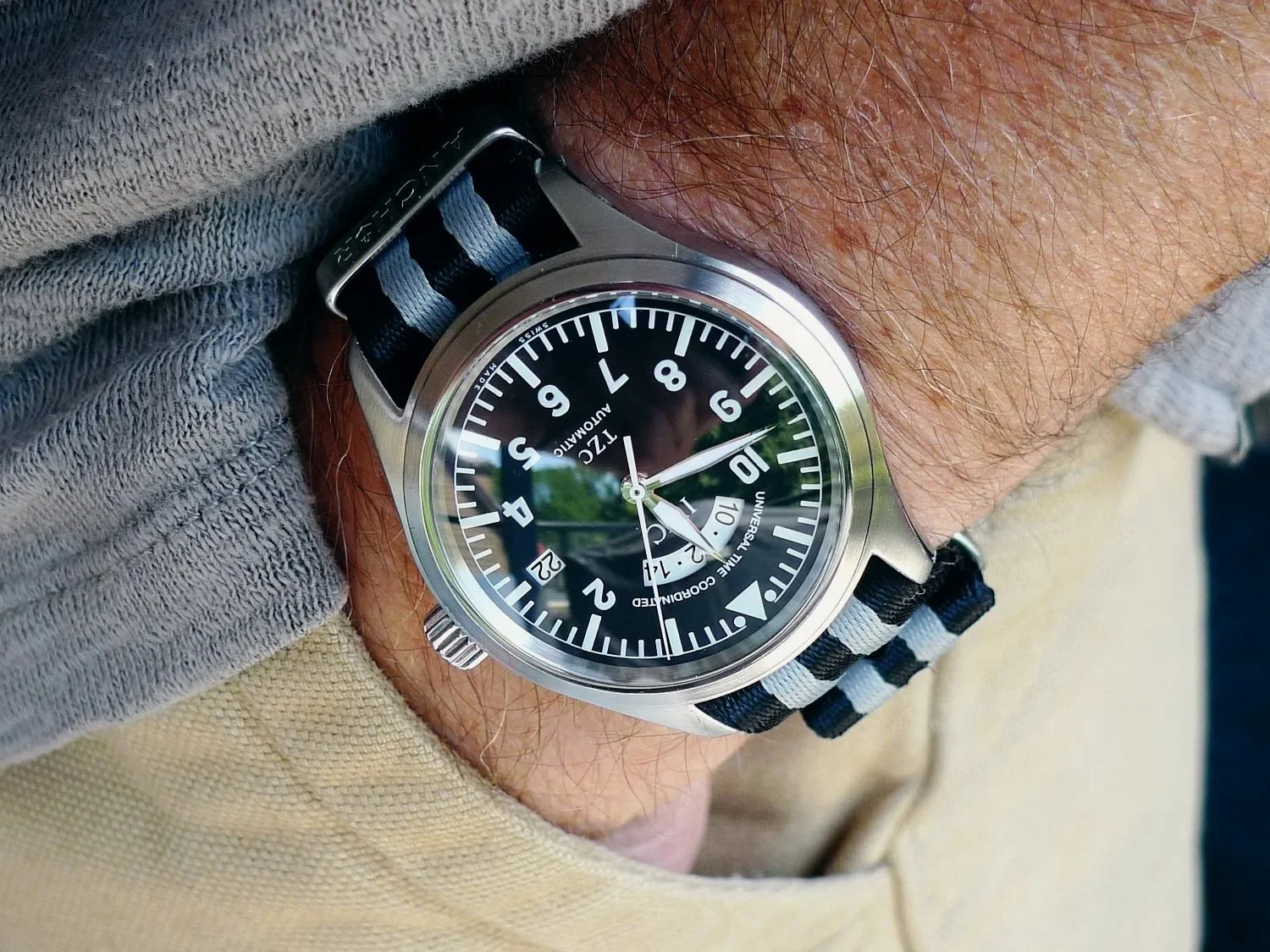
IWC Pilot’s UTC on Anchor Bond NATO
Should you get one?
The IWC Pilot’s Watch UTC is not the obvious choice—and that is much of its appeal. Travellers whose priorities include immediate brand recognition, modern specifications or a watch that can move from the airport directly into the ocean without a second thought will find better options elsewhere. I’m always on the lookout for the latter myself. But if discretion, compact proportions and an unusually intuitive approach to displaying home time sit higher on your list, this largely forgotten IWC deserves far more attention than it receives.
Its classic aviation aesthetic, strap versatility and overall subtlety have sufficiently charmed me into becoming a very happy owner several months on from purchase. I even wear it as my GADA watch at home, despite a fair bit of competition in the watch box. Perhaps that is the strongest endorsement I can give it: designed for crossing time zones, yet compelling enough that I keep reaching for it even when I’m going nowhere.
A relaxed Palm Springs getaway featuring mid-century architecture, great restaurants, boutique hotels, pool days, and desert sunshine.