
Blog
From cobblestoned Portuguese alleys navigated one-handed with a stroller to reef dives in Fiji, this is where the trips live. Told through words and whatever camera happened to be with me.
I shoot film and digital and travel with family in tow. These posts are part travel journal, part photography log, and part love letter to the places that made an impression. I hope they make you want to go see them for yourself.
Latest Articles



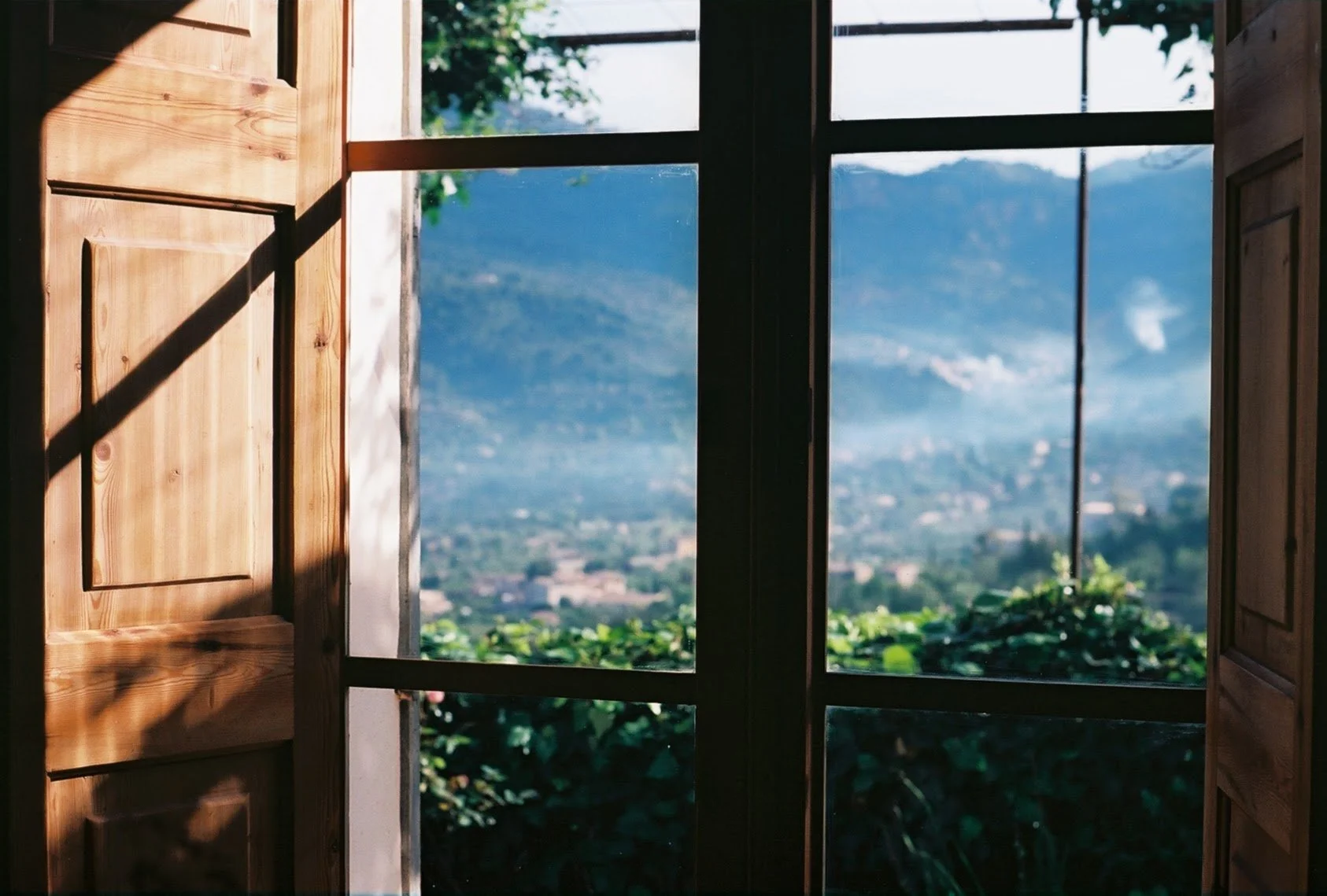


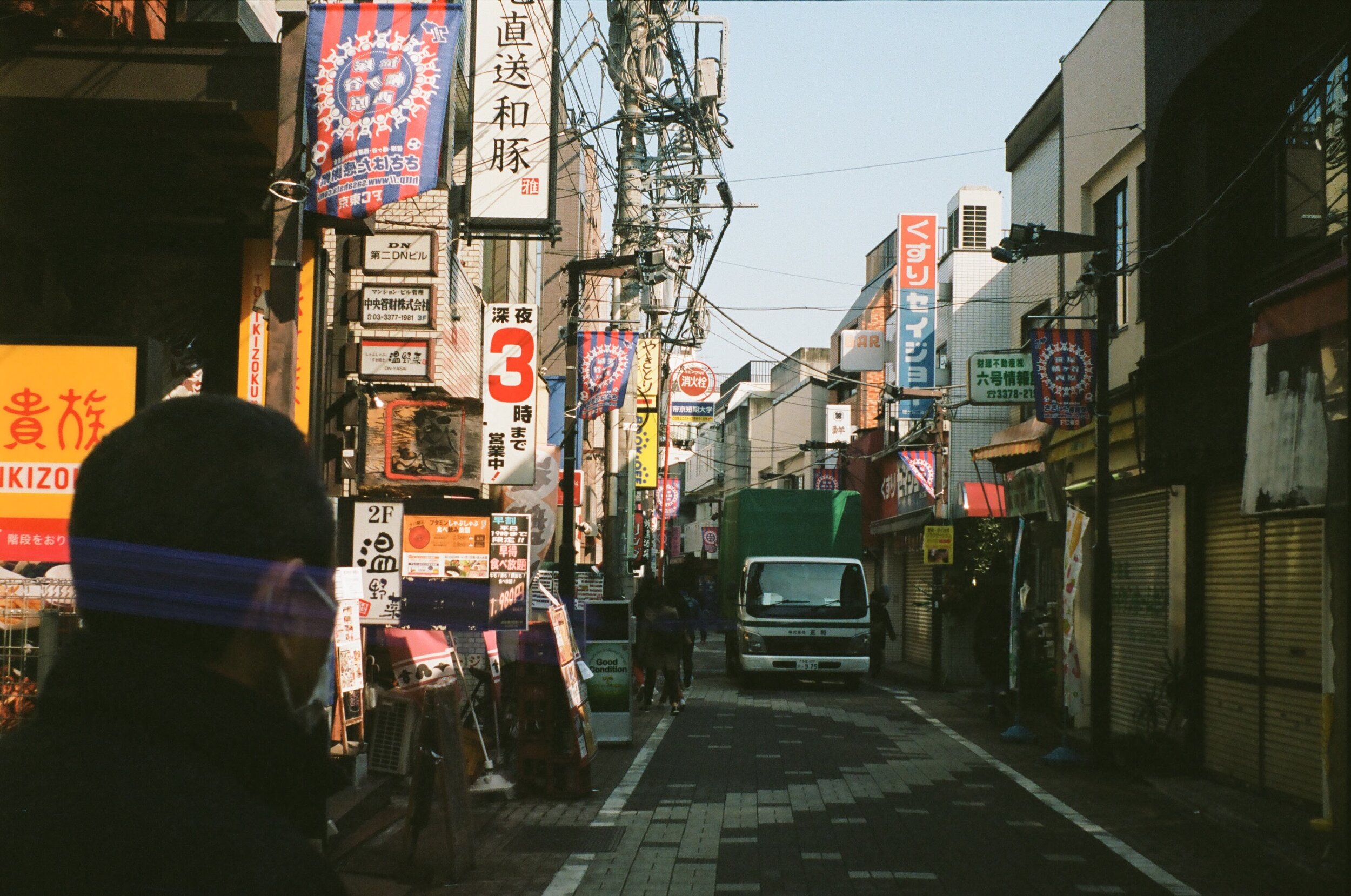


Portugal - Cabanas do Lago
As we approach the area the dam becomes visible towering over a small valley. The road soon changes from paved to dirt, but nothing most cars can’t handle. We snake along it’s winding path and turn off onto a steep sided valley that surrounds one of the hundreds of coves around the perimeter of the lake. At the end of the road we see the large main house appear through the trees and are immediately greeted by one of the smiling hosts, Filipa, as we arrive.
Albufeira da Barragem de Santa Clara, Portugal, Ricoh GRiii ISO100 1/100 f11
Change of Pace
Read Part I: Portugal - Lagos →
Back home, it’s quite common for us to book a few weekend getaways out of the city in a quiet cabin by a lake or the ocean and just relax in peace enjoying the views and explore the surrounding nature. We’re not typically doing quite the same abroad, and yet somehow this location called to us, and I’m glad it did. A bit of tourist overload in Lagos drive us to seek out our next stay a little off the beaten path. When we found the Cabanas do Lago on airbnb it immediately stood out with its 4.99 star rating and promise of simple and quiet serenity. It happened to have a pocket of availability for a few nights so we booked it as the next stop on our trip.
We had plenty of time to get there ahead of check-in, so decided to take a scenic route up along the west coast then cut back inland towards our destination. We knew we’d pass through some small towns along the way, so figured it easy enough to sort out lunch on the road, and perhaps stop at any destinations that caught our eye while we were at it. The hope was that our son would at some point nap in the car, leaving us an afternoon to settle-in to the cabin before having dinner. If you enjoy driving/riding, the roads in this area are sublime. We avoided the major highways and A roads and stuck to the windy roads that weave their way through the rolling hills. The roads are largely empty, generally cambered in your favour, and a delight of corners and short straights connecting them. A short squeeze on my arm reminded me that our econo-box Citroen was probably not at it’s best at my preferred pace, but even at a decent canter it kept the drive interesting. So would Google Maps, it turns out, as once again relying on it in this corner of Europe was not without it’s problems -read on and see why!
Approaching Praia da Amoreira (sort of), Portugal, Ricoh GRiii ISO160 1/200 f16
Praia da Amoreira
The weather was lovely on this travel day, so we decided to make a bit of a detour to stop at a beach to enjoy our first peek at Portugal’s west coast. It differs significantly from the south-facing Algarve, with broad white sand beaches, rather than the more secluded cliff-lined coves. It also faces the full brunt of the Atlantic ocean with larger waves and steady breezes. Amoreira sits where the mouth of a river meets the Ocean and we’d read that it was among the more beautiful beaches to visit in the area and was also flanked by a restaurant. Our map showed the beach as roughly 9km off our main route of travel, so not a big deal. We faithfully made our way along the revised route until we came to stop by a cliffside restaurant overlooking a beach. Our beach. Uh oh. Wrong side of the river.
While the route certainly took us to a place we could view the beach, there was no way to safely reach it from this spot, with a cliff and river between us and our beach destination. I checked my inputs into Google Maps and indeed the app thought we could access the beach from here, but no such luck. I would take 18km of driving to bring us to the beach just a couple hundred meters away. Fortunately, this little detour passed some stunning views, and with the little guy asleep in his car seat ahead of schedule, we decided to stop at a few spots on our way back to take a few photos where we wouldn’t otherwise be comfortable with him running about.
Aren’t we supposed to be over there? Lagos, Portugal, Ricoh GRiii ISO320 1/200 f16
Looking down upon Praia de Monte Clergio, Portugal, Ricoh GRiii ISO125 1/200 f16
Praia de Monte Clergio, Portugal, Ricoh GRiii ISO250 1/200 f16
Praia de Monte Clergio, Portugal, Ricoh GRiii ISO160 1/200 f16
Praia de Monte Clergio, Portugal, Ricoh GRiii ISO200 1/2500 f3.5
Eventually we made our way to the beach we intended to visit, and just in time for the weather to start to turn. We spent a scant few minutes on the beach before the clouds rolled in and the temperature dropped. Oh well, time for lunch anyway and time to get back on the road. As the detour set our schedule back a bit, we decided to skip the beachside restaurant in favour of picking something up at a shop or bakery along out main route.
Rocky formation on Praia da Amoreira, Portugal, Ricoh GRiii ISO400 1/100 f16
Praia da Amoreira, Portugal, Ricoh GRiii ISO125 1/200 f8.
Waiting while Vicky finds us some food, somewhere in southern Portugal, Ricoh GRiii ISO100 1/1250 f4
Cabanas do Lago
The Albufeira da Barragem de Santa Clara is an enormous man-made reservoir supported by a concrete dam at it’s west end. As we approach the area the dam becomes visible towering over a small valley. The road soon changes from paved to dirt, but nothing most cars can’t handle. We snake along it’s winding path and turn off onto a steep sided valley that surrounds one of the hundreds of coves around the perimeter of the lake. At the end of the road we see the large main house appear through the trees and are immediately greeted by one of the smiling hosts, Filipa, as we arrive.
The Cabanas do Lago property consists of a two storey main house and a pair of smaller cabins, all nestled into the side of a steeply sloped terraced hillside. The ground floor of the main house is communal and contains the kitchen and a living/dining area as well as a patio dining area with a view towards the lake. The family that owns and operates the property lives on the second floor. Our cabin was just the right size for the two of us essentially two rooms; a large bedroom, and a bathroom with shower. Glass doors making up the west wall give us a view onto the valley from our bed and ensures it’s nice and bright inside. (Cabin Photo Credit: Victoria Petriw on the XPro2)
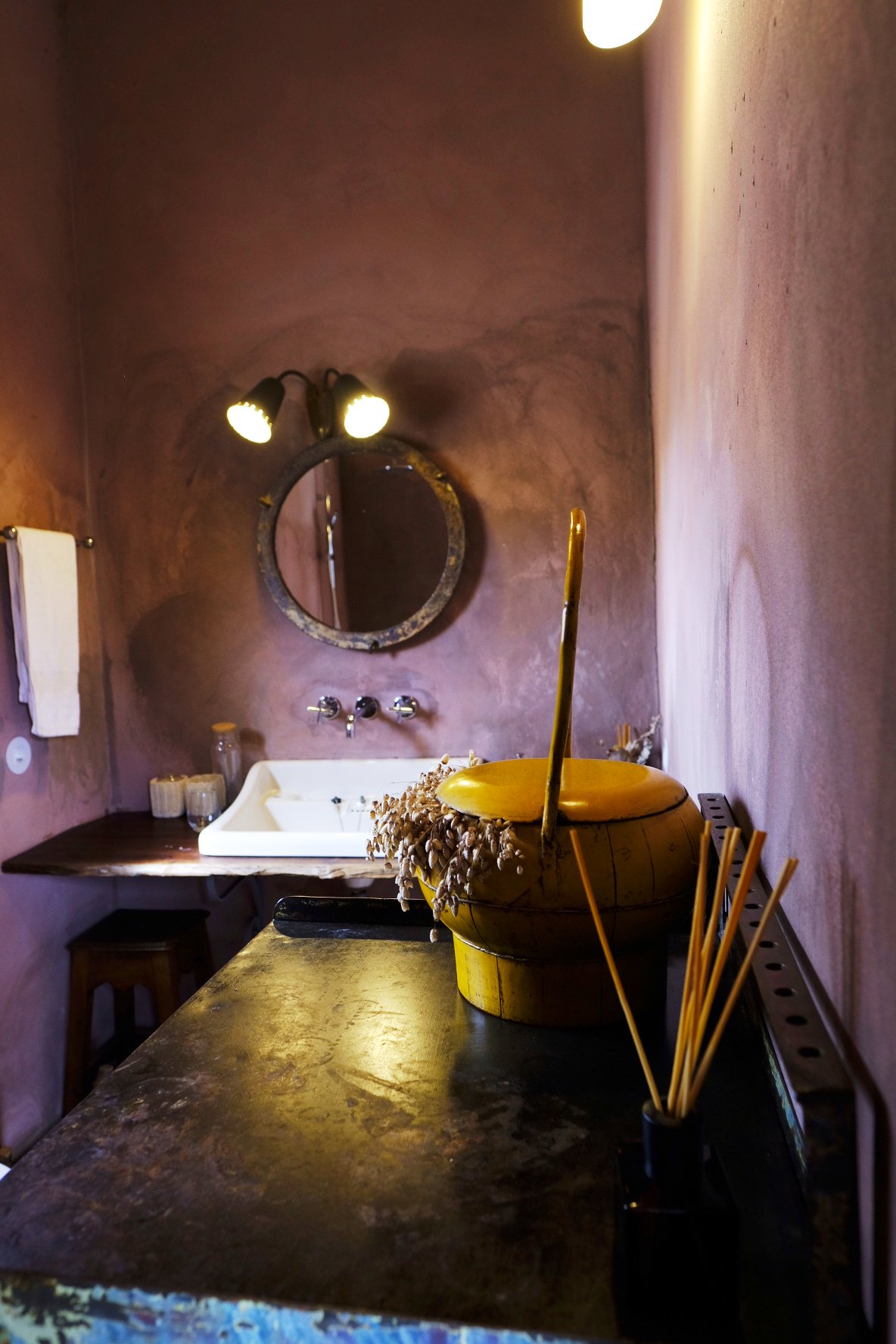
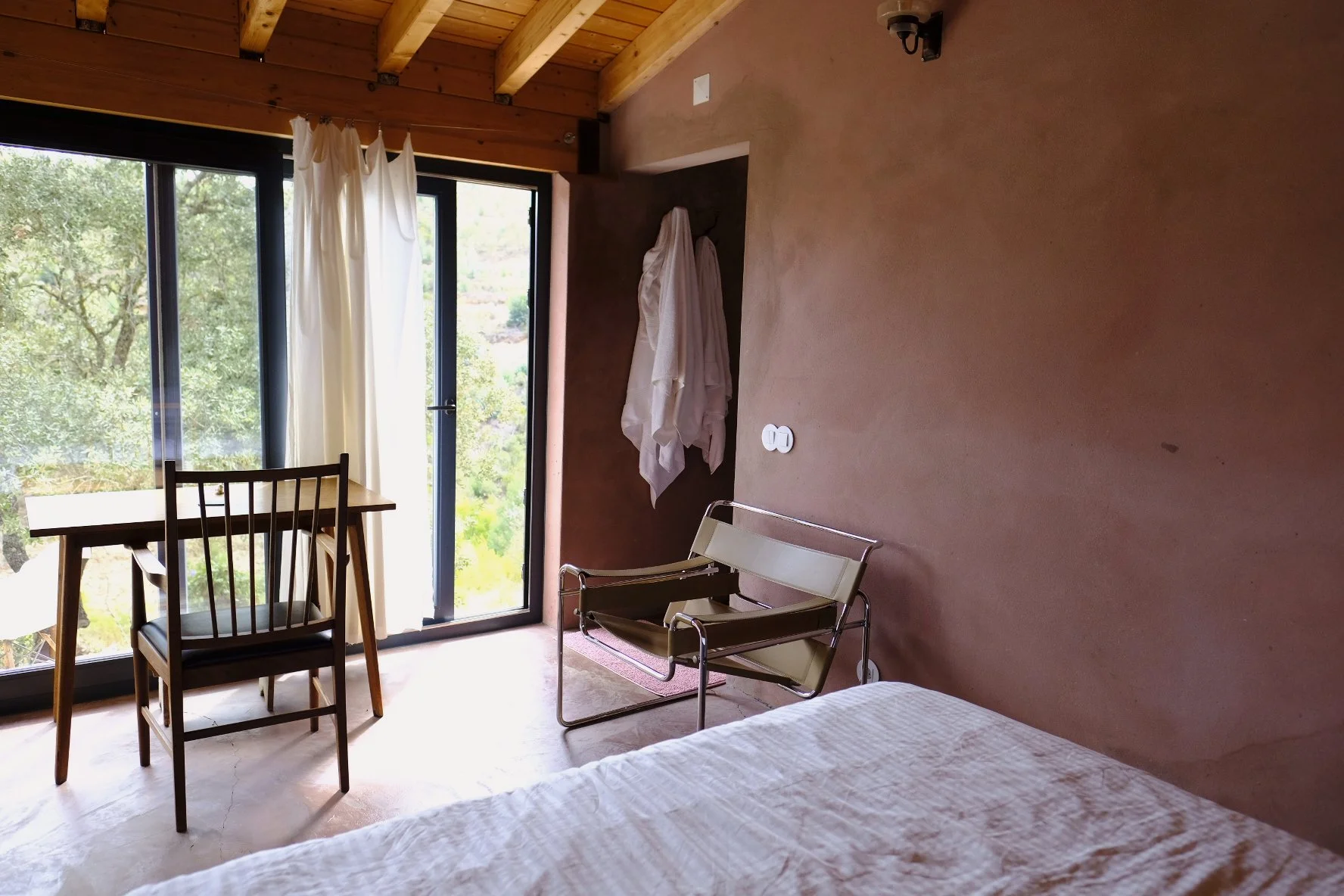
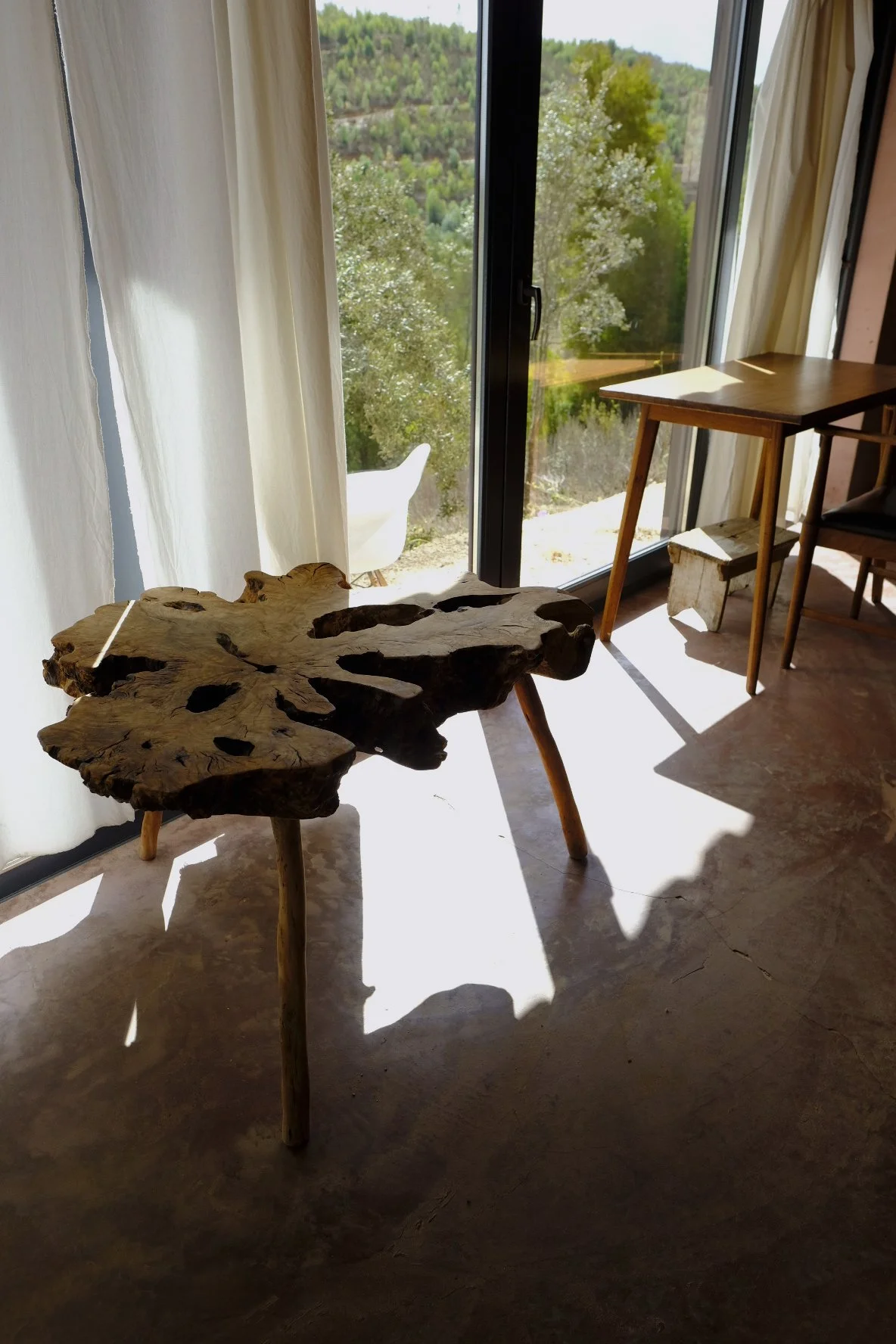
Within minutes of arriving Filipa and her husband Luis make you feel at home and like friends of the family. The wine and beer flows and Filipa prepares an amazing meal for us to all share together on the first night. This would very much be the theme of this stay, particularly in the evenings with us hanging out with Filipa and Luis into the late hours of the night, learning about life in Portugal and how they decided to relocate their family here from busy Lisbon a few years prior. As you might suspect, other guests we met here tended to be fairly like-minded travellers as well, and we enjoyed hearing each others stories and plans for what’s next. Most days and nights we cooked meals for ourselves in the communal kitchen area and enjoyed the relaxing surroundings, but did also make one excursion out for dinner to Casa Nirvana, about half an hour’s drive away, for a change of pace. Speaking of food, the little hamlet of Santa Clara a Velha sits near enough for quick grocery runs if needed and has a couple of restaurants as well.
A nice view with breakfast, Cabanas do Lago, Samsung S20FE, ISO40 1/1600 f1.8
Looking towards the main house from the garden, Cabanas do Lago, Ricoh GRiii ISO 400 1/8 f5
View from the main house patio, note the water line, Cabanas do Lago, Ricoh GRiii ISO250 1/100 f11
Like staying at a friends’ house, Cabanas do Lago, Portugal, Ricoh GRiii ISO4000 1/25 f2.8
The approach to the main house, Cabanas do Lago, Portugal, iPhone XR ISO25 1/400 f1.8 (Credit: Vicky Petriw)
Activities in the area are naturally lake-centric and I was a bit hesitant to take the camera out most days for fear of dropping it in the water. An excursion on a canoe allowed us to visit the dam and enjoy a designated swimming area near it’s base, as well as a lovely food truck (bus) parked next to it with a rooftop patio of it’s own. It was at a point about 4 meters from shore, however; that we realized our son does not like canoes and was instead seemingly prepared to jump out of it at the first moment of inattention from one of us. “He’ll get used to it” was followed by 90 minutes or so of yelling and crying. Luckily, stuffing him full of empanadas helped, and the trip back was more relaxed.
There was an interesting tower near the dam, standing starkly with it’s brutalist design against the more organic landscape. It sat high and dry as a forgotten sentinel of a time when the lake was full to the brim. Remarkable to see it has a scale for water depth painted on the side, the bottom of which is many meters above the waterline. Another favorite activity for me was getting out on a paddle-board a bit before sunset and just exploring across the lake at random. Our hosts provide a variety of options for getting on the water and you’ll definitely want to give them a try. Stargazers also take note, it’s properly dark here in the evenings, setting the stage for beautiful night skies. The highlight for our son, (definitely not the canoe), was trying to track down the loudly croaking frogs that occasionally hopped around the property in the evening.
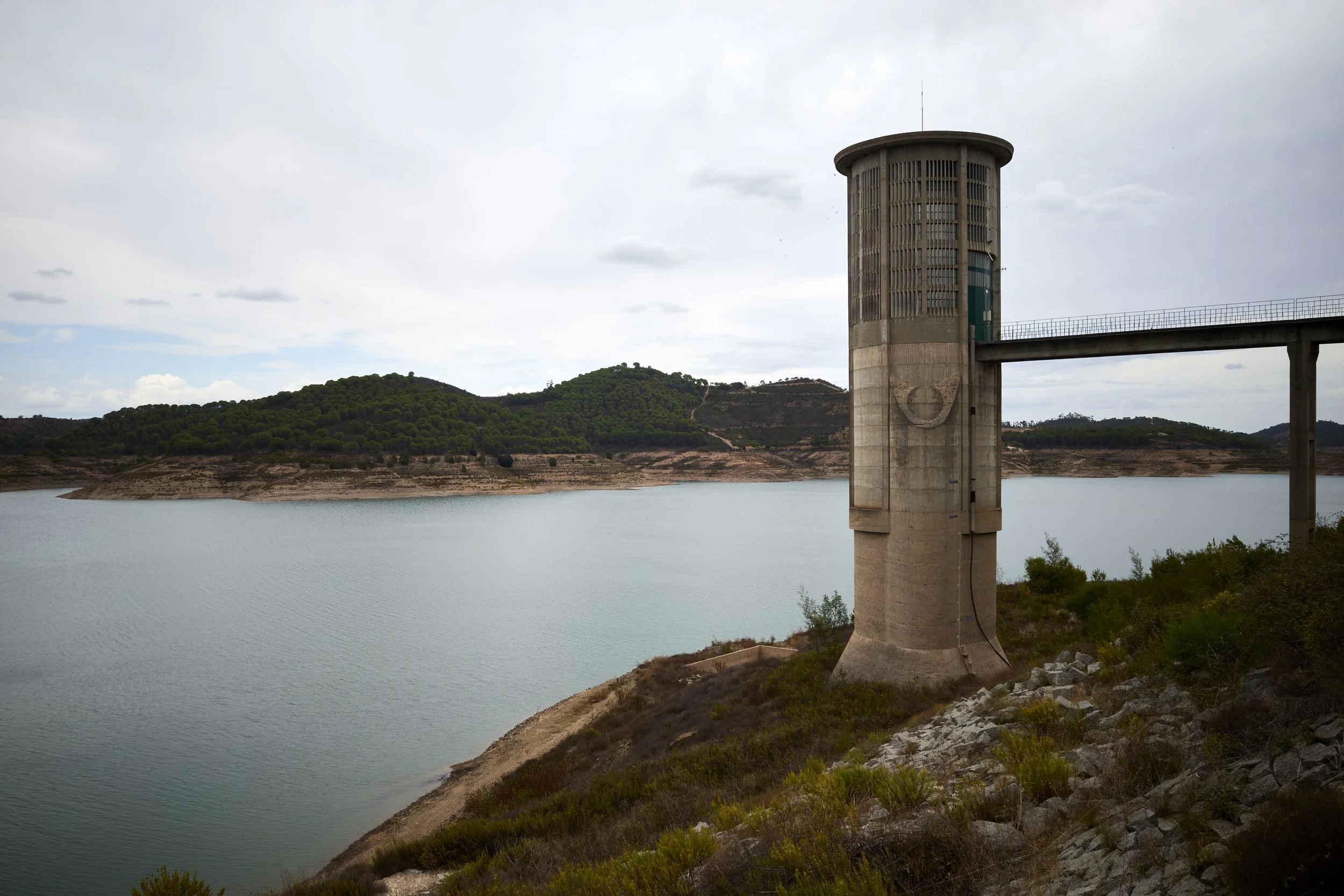
Tower on the Albufeira de Barragem da Santa Clara, Portugal, Ricoh GRiii
Back to Beaches
I definitely recommend this spot for those looking for a peaceful little detour and opportunity to meet and connect with some amazing people on your next visit to Portugal. Our hosts graciously shared an abundance of recommendations for the remainder of our journey, offering a multitude of dining options to explore, landmarks to see en route to Comporta, our upcoming stop, and activities to engage in within Lisbon and its vicinity during the later part of our travels. Our time at the lake ended all too quickly, but by the end we felt refreshed and ready for more exploration ahead.
Nice place for a sit, Cabanas do Lago, Portugal. Ricoh GRiii,

Portugal - Lagos
The Algarve seemed the logical choice for starting our trip to Portugal. It was well recommended by friends, and since we were arriving in early September, the timing gave us the best chance of experiencing some beach-worthy weather to kick off the relaxation.
The Algarve, Lagos, Portugal, Ricoh GRiii ISO 200 1/125 f16
Change
Setting off on our Portuguese adventure, we knew things would be a touch different this time around. Everyone raved about Portugal being family-friendly, charming, and warm – just what we needed with our little whirlwind in tow. With our child now a toddler, we knew this wouldn’t be as easy as the last the last trip, but were up for the challenge all the same. As per our usual modus operandi, we booked this trip last minute, just a couple of weeks before takeoff, leaving a few nights open for those spontaneous "let's figure it out as we go" moments. Some things never change, even with a two-year-old sidekick.
One thing that did change, by design, was my camera game. This Portugal series will mark a shift on the Yarko On The Go blog – my first trip captured primarily digitally. Say hello to the Ricoh GRiii, the latest addition to the Ricoh GR family of “point & shoot” cameras celebrated by photographers like Daido Moriyama. It's compact, practically weightless, and boasts a 24MP APS-C sensor in a magnesium body that's so small, you need to hold it to believe it. Paired with a crisp 28mm lens, it seemed like the perfect choice for on-the-go parents. I'll spill the beans on this little beast (the camera, not the kid) in a dedicated post after the Portugal series – and whether I think it was the right decision.
Ricoh GRiii with Peak Design Cuff Strap
Why the change? Well, for starters, I wanted more family photos both as we explored new places and in general at home, and doing that with a manual film camera in this day and age is an impractical and expensive proposition. I wanted more “keepers”, and I wanted to know I had them. Sure, I packed the Olympus XA with a few rolls of film out of habit (and I love that camera), but I didn't want to end up with a sore back from lugging around cameras and lenses when I already had a toddler and all the kid gear weighing me down. The goal is to return with memories, not back pain, right? Let’s see what happens.
Stroller & Shoot, Lagos, Portugal, Ricoh GRiii ISO 160 1/250 f8
Lagos
The Algarve seemed the logical choice for starting our trip to Portugal. It was well recommended by friends, and since we were arriving in early September, the timing gave us the best chance of experiencing some beach-worthy weather to kick off the relaxation. We flew into Faro, picked up our rental car and made the roughly 1 hour drive to Lagos. Once in Lagos, you’re reminded that driving in older European towns can take a bit of getting used to for those of us from North America. In the Lagos Old Town, where our accommodation was located, roads were narrow, with sharp blind turns, one way streets, and buildings just tall enough to throw off our phone’s GPS. It took two loops of Old Town (predominantly one way streets) to realize I’d have to stop on a sidewalk a few blocks over from the apartment and walk our things over, before finding parking elsewhere. Once I got used to the layout of the town, navigating it became a non-issue, and ultimately we were comfortable exploring the surrounding area both on foot and by car.
Our rental Citroen. Not exciting to drive, but just big enough to fit all our stuff, and still fit the roads! Ricoh GRiii ISO200 1/2000 f4.
In Lagos we stayed at the Salty Lodge, which is an apartment hotel located in the heart of the Old Town. We chose one of the smaller apartments and found the accommodations quaint and well appointed with a little kitchenette if you feel like cooking-in. It’s ideally located as a jumping off point to wander the town or surrounding beaches. It’s also in a relatively quiet corridor of the city, whereas many alternatives closer to the bars are likely rather noisy well into the night. There is a rooftop patio with panoramic views, and the staff are friendly, knowledgeable about the area and helpful. Toughest challenge here (and likely with most accommodations in the Old Town) is parking. There’s really no parking within the city walls, and the most reliable spot I found was about 700m & a 10 min walk away. Not a big deal normally, but on cobbled streets it can be a chore to roll your bags (or stroller) this distance. Of course the full onload/load only happened on arrival and departure, so ultimately it was manageable.
Looking east from the roof of the Salty Lodge, the canal and Duna Beach in the background. Lagos, Portugal, Ricoh GRiii ISO640 1/30 f4
View southward from the Salty Lodge roof. Lagos, Portugal, Ricoh GRiii ISO640 1/20 f5.6
Balcony/patio view (courtyard) from the Salty Lodge, Lagos, Portugal, Ricoh GRiii ISO400 1/400 f8
Roaming Lagos
Most of our exploration of Lagos was in the vicinity of the old town and adjacent canal promenade. It’s a characterful place, and while it has it’s share of venues catering to those who want the taste and sound of the familiar everywhere they go (read: Pubs, Thai massages, souvenir shops), there are more distinctly local options here as well which the staff at our accommodation were happy to tell us about. The old town is easy to walk with very few viable routes for cars, but pushing a stroller can be challenging on some lanes where the mosaic streets are rough. Despite being here in the early shoulder season (September), the town center was bustling with tourists and generally quite busy, but you could find quiet nooks if you ventured off the beaten path.
Making my way to the Salty Lodge, Lagos, Portugal, Ricoh GRiii ISO 100 1/200 f8
Plaza near the Salty Lodge, Lagos, Portugal, Ricoh GRiii ISO200 1/200 f4
Casa Mae, tempting place to stay next time. Lagos, Portugal, Ricoh GRiii ISO160 1/200 f8
Preparing for the lunch crowd, Lagos, Portugal, Ricoh GRiii ISO400 1/250 f8
Renault 4’s seem popular in Portugal, Lagos, Portugal. Ricoh GRiii ISO100 1/200 f8
Wandering around Lagos, Portugal, Ricoh GRiii ISO125 1/250 f8
Wall Hats, Lagos, Portugal, Ricoh GRiii ISO200 1/250 f8
A few places stood out as memorable for dinning in Lagos. The first, Abigail’s Cafe, is an absolutely delightful stop for breakfast and easily my favorite spot in town. The food is delicious -try the pancakes and thank me later- the atmosphere is relaxed and it’s a beautifully designed space inside as well as a quiet and quaint lane to enjoy if dining outside.
Studying the menu at Abigail’s. Lagos, Portugal, Ricoh GRiii ISO1600 1/400 f11
Another other favorite spot was Nah Nah Bah, a funky casual burger joint in the Old Town. It’s a popular spot, so you may find yourself waiting on the stoop for a little while if you haven’t made reservations. I seem to recall them making a claim to having one of the top rated burgers in the world, and as a self-professed burger aficionado, I had to confirm the assessment. (Confirmed)
Nah Nah Bah Burger Restaurant, Lagos, Portugal, Ricoh GRiii ISO4000 1/4 f11
Finally, The Green Room proved a lively and tasty option if you’re craving a bit of South American food, particularly Mexican. Hot Enchiladas and a cold Sagres? Yes, I’ll have another please.
Up way past bed time at The Green Room. Lagos, Portugal, Ricoh GRiii ISO3200 1/40 f2.8
Beaches - Praia da Luz
The first day or two in Lagos were a bit chilly for dedicated beach time, but eventually the warmth came and we took full advantage. Gauging the movements of the clouds from our rooftop patio, we decided to chase the sun and head west out of town a bit to Praia da Luz for our first beach day. It’s a quick and easy drive from Lagos, and relatively easy to find parking just before the main promenade through the village. We were greeted by a broad sandy beach with plenty of room to find a space to ourselves. Sunbeds are available for hire as usual, but it wasn’t quite hot enough to warrant it, so we grabbed some sand near the sea and setup our towels for a few hours of relaxing.
The waves here were fairly strong, and the water quite cool, so swimming was relatively brief but refreshing. Too rough though, for the little guy, who had to settle for getting his feet wet whenever a big wave washed further up the sandy shore. It was good for a giggle, as was digging a moat bellow our towels to defend against rogue waves. This proved useful as the tide was coming in and at least one wave surprised us and many other beach goers by making it’s way some distance and almost up to our feet. I’m not sure if the surf is always like this here, but worth checking if you’re planning on visiting for a swim.
Praia da Luz, Portugal, Ricoh GRiii ISO200 1/125 f8
Praia da Luz, Portugal, Ricoh GRiii ISO200 1/250 f8
Step this way senhor, Praia da Luz, Portugal, Ricoh GRiii ISO640 1/320 f11

Sunbeds on Praia da Luz, Portugal, Ricoh GRiii ISO320 1/320 f8
Going his own way, Praia da Luz, Portugal, Ricoh GRiii ISO320 1/800 f7.1
There’s a scenic promenade that parallels the eastern edge of the beach which we decided to explore once we’d had our fill of the sand for the morning. One side opens to the beach while the other is lined with shops, cafes and tapas bars with seating perfectly setup for enjoying the view as well as people-watching along the path.
Walking along the Praia da Luz promenade, Praia da Luz, Portugal, Ricoh GRiii ISO250 1/250 f8
Her patience wearing thin, Praia da Luz, Portugal, Ricoh GRiii ISO200 1/250 f8
Intricate tile-work pervades the entire country. Praia da Luz, Portugal, Ricoh GRiii ISO320 1/250 f8
Beaches - Praia Dona Ana, Camilo, & Ponta Piedade
If you draw a line due south from Lagos Old Town it’ll cross most of the more famous beaches in the area, terminating at Ponta de Piedade. The distances aren’t too great to walk, and indeed we did walk to a few of them from our apartment, but for the further points we drove just to make it easier on the little guy. This area is elevated a few hundred feet above the sea, so inevitably making your way to the beach will involve some stairs and in some cases a lot of very steep stairs. Not a deal breaker, but with a toddler on your arm you are going to get a workout!
These beaches all face east and are generally sheltered bays and coves meaning much calmer seas for swimming. The tall cliffs dramatically backstopping the beaches do however mean that you’ll loose the sunshine earlier in the afternoon than say at Praia da Luz or Praia do Porto Mos, so visit them in the morning if you can to maximise the sun. The rocky outcroppings and striated stone formations are the hallmark of the area and change character throughout the day as the sun moves across the sky. Some of the beaches connect to other coves and hidden spots by way of tunnels through the cliffs, so be sure to scout around a bit to find your ideal spot. The sand is soft and warm, but there seemed to be quite a bit of seaweed on some of the beaches which significantly limited useable area and access to the sea in some cases. I’m not sure if this is a seasonal phenomenon or more of a regular occurrence. Also of note, there are surprisingly few restaurants or kiosks in this area, and those that we found were typically lined up, so pack your snacks and drinks!
Praia do Camilo, Lagos, Portugal, Ricoh GRiii ISO100 1/2500 f2.8
Abundant seaweed on Praia Dona Ana, Lagos, Portugal, Ricoh GRiii ISO320 1/320 f8
Praia Dona Ana, Lagos, Portugal, Ricoh GRiii ISO640 1/200 f11
Views of the Algarve, Lagos, Portugal, Ricoh GRiii,
View northwest from the Ponte Piedade trail, Lagos, Portugal, Ricoh GRiii ISO100 1/400 f8
Ponte Piedade trail, Lagos, Portugal, Ricoh GRiii ISO125 1/125 f8
At the southernmost point, Ponte Piedade is less about beaches (there are some but the routes to them seemed a touch perilous) and more about views and light hiking for more views. No doubt a great spot to visit at dawn or dusk and enjoy capturing the light playing on the cliffs and beaches east and west of you. There are also kayaking tours that let you get to hidden beaches in the area as well as under natural stone arches and into tucked-away bays and coves.
Wooden walkway at Ponte Piedade, Lagos, Portugal, Ricoh GRiii ISO100 1/1000 f4.5
Natural arch near Ponte Piedade, Lagos, Portugal, Ricoh GRiii ISO320 1/125 f16
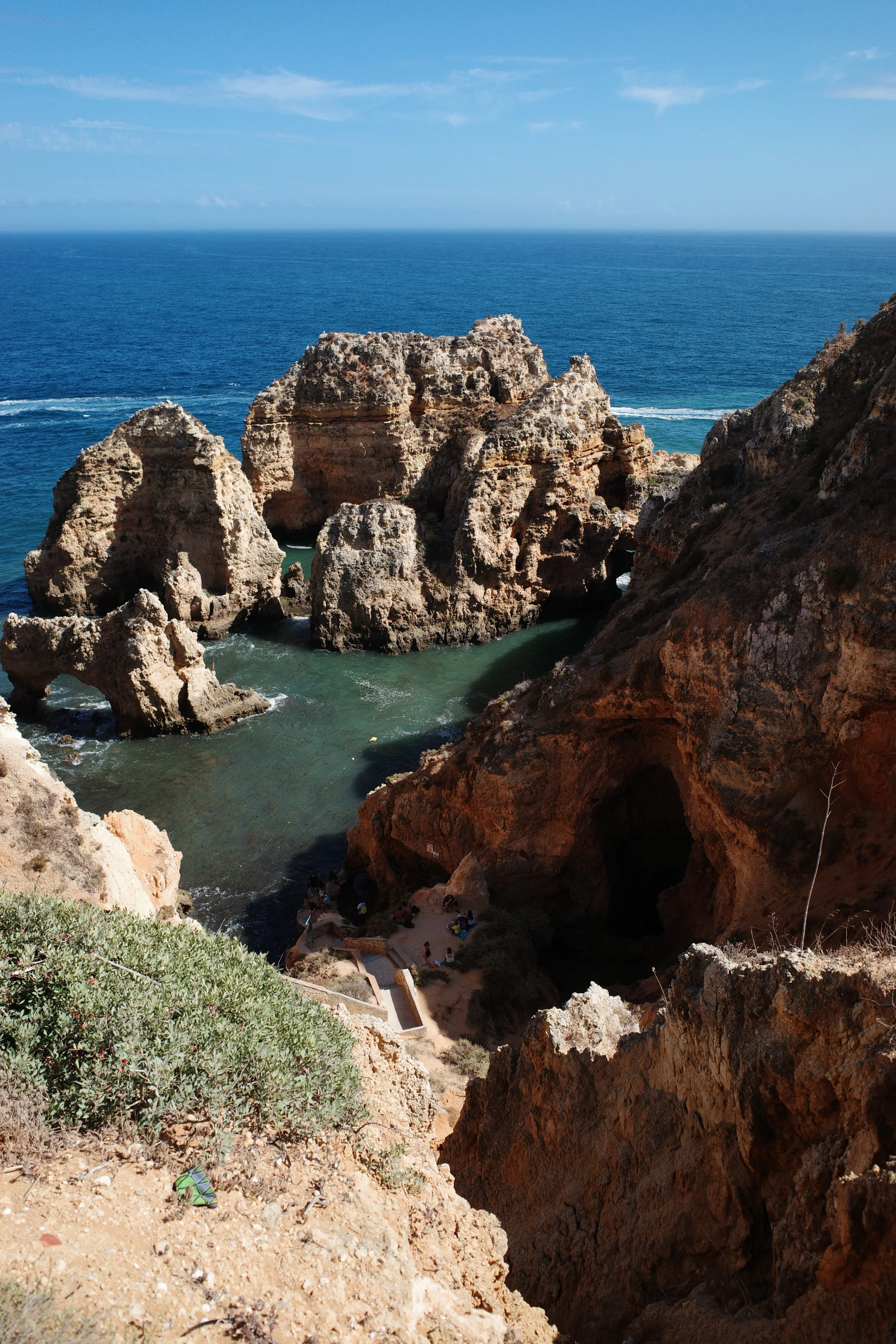
Near Ponte Piedade, Lagos, Portugal, Ricoh GRiii ISO200 1/1600 f3.2
Praia Canavial and Praia de Porto Mos in the distance. Lagos, Portugal, Ricoh GRiii ISO200 1/125 f16
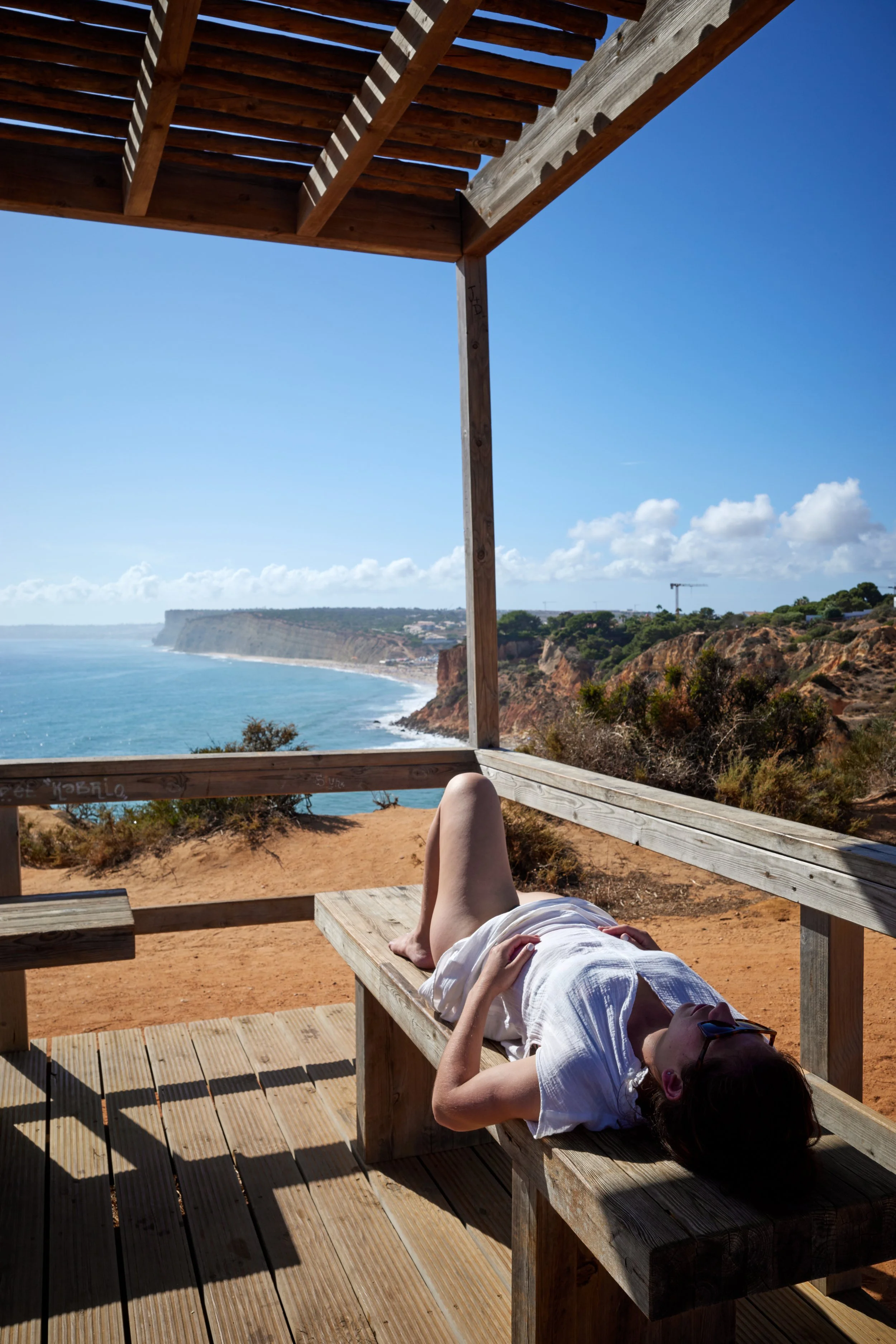
It was a hot day. Lagos, Portugal, Ricoh GRiii ISO100 1/400 f8
The Ricoh - A Quick Note on Color
You’ve no doubt noticed in this post that there are some notable differences in saturation, white balance and color temperature between some photos. While the slightly variable weather had a hand in some, chalk it up to my learning curve working with the Ricoh GRiii and getting used to digital cameras in general once again. Prior to the trip I’d learned about “Ricoh Recipes”, an app that allows you to pre-program and save to user customizable settings various alterations to image parameters, not unlike the film simulations on Fuji cameras and others. What I didn’t realize at the time was that doing so actually permanently impacted the RAW files. Oops. I don’t mind the results, but in the future I’d much prefer to apply such changes of character (if I felt like it) in post processing. Lesson learned, get to know your gear! Now back to our regular programming.
Sailboat passing through the canal. Lagos, Portugal. Ricoh GRiii, ISO250, 1/250, f8.
Where to next?
We didn’t have anything booked for the 4-5 days between the Algarve and our stays further north, and so we spent a few evenings while in Lagos looking online for our next destination. We debated finding another seaside town versus something a little different, quieter and off the beaten path. The latter won, owing to a general desire for a change of pace after a fairly busy and tourist-heavy stay in Lagos. We booked an AirBnB with stellar reviews much further inland on Albufeira da Barragem Santa Clara, a man-made lake (Europe’s largest at the time it was created) in the rolling hills a couple of hours north of Lagos. We planned a route that took us to the western coast, with a few scenic stops along the way (and likely enough time for our son to nap), before cutting back eastward to arrive in the early afternoon at our next destination. Stay tuned for the next post on living with the locals in rural Portugal!

Happy Accidents
Five hours into a backcountry hike north of Vancouver, standing in a crystal-clear glacial stream with camera in hand, I watched my beloved Olympus XA sink straight to the bottom. As it turned out, the water had its own ideas about how these photos should look and some of them are better for it.
The Moraine, British Columbia, Olympus XA, Agfa Vista Plus 200
“Oh Shit.” I exclaimed, for all the birds and squirrels to hear. There I was, standing over a stream of waist-deep, crystal-clear glacier water, watching my Olympus XA camera sink to the sandy bottom. It had taken around 5 hours for us to hike to this spot, a lesser known wilderness hut located a few hours north from Vancouver. I had taken about a half roll of photos along the way up with my favorite compact film powerhouse, the Olympus XA. The weather was warm, and felt doubly so with my backpack on, so stepping into the cool glacial stream right in front of the hut seemed like a great idea to help cool off. Better still that its backdrop seemed particularly photogenic, so why not keep the camera in hand and snap off one or two shots?
Splash, that’s why. I’ve no idea how I lost my grip, but I felt my stomach sink well before the camera hit the surface of the water. A steady stream of bubbles emitting from the body on the way down confirming that it was by no means waterproof. I lunged after it, fumbled a bit, and finally lifted it out of the stream. Now what? Was one of my favorite classic cameras now a desk ornament?
The Fateful Shot, Olympus XA, Agfa Vista Plus 200
Hoping to avert film camera water damage, I hustled back to the cabin, opened the battery hatch and immediately removed the cell within. I gently shook out the water, and used some of our packed toilet paper to soak up what I could. It was a sunny day, and I thought perhaps placing it by the window of the cabin in the sun might warm things up and allow the water to slowly evaporate. I pondered my error, and began to wonder; a. if it would ever work properly again, and b. what of the photos already within?
The Hut, Olympus XA, Agfa Vista Plus 200
The rest of the trip was incident free, but I didn’t take any photos on the way down for fear of doing more damage. When I got home, I rewound the film, left the camera with open back sitting in a bag of rice for a few days and decided to take the roll to my local lab to see what would develop. I warned the tech of my misadventure when I dropped it off and he said he’d try his best. So fingers crossed for a day or two and I’d see the result (or not).
Mountain ridges and glacial pools, Olympus XA, Agfa Vista Plus 200
To my delight a couple of days later I received my customary email notification that my roll had been developed and scanned with a .zip file of the images attached. I opened it and started peering through the images, curious with what I would find. As you can see in the images here it was a mixed bag with, I think, some delightful surprises. First of all, none of the images were utterly destroyed, a relief as I really had no idea what to expect so was leaning towards the worst. Second, the impact of the water varied a fair bit, from spots most easily noticed in the lighter parts of the images to ghostly silhouettes and ripples of lighter color. In the image immediately bellow, I quite like the “phantom mountain” the effect produces.
Phantom Mountain effect, Olympus XA, Agfa Vista Plus 200
Somewhere in the woods, Olympus XA, Agfa Vista Plus 200
If I wanted to do something more with these images, certainly some of them could be retouched to remove imperfections and artifacts. Bellow is a rather crude example to illustrate the point. (Re-touching is not really a skill in my toolbelt!) But in the case of this set, I think the blemishes and strange silhouettes simply help to tell the tale, and certainly instantly bring back fond memories of that weekend in the mountains.


Looking towards the hidden hut, Olympus XA, Agfa Vista Plus 200
Nearly there, Olympus XA, Agfa Vista Plus 200
Ultimately the Olympus survived without issue. An almost imperceptible bit of particulate made it’s way into the viewfinder, but I’ve shot loads of rolls since this and it functions exactly as it should. A happy accident indeed then, and a lesson too -there’s a wrist strap on the camera now. I hope you enjoy these quirky images as much as I enjoyed capturing/saving them!

Mallorca - Palma
The sun came out for us in Palma and we got a taste of the heat that makes Mallorca such a popular destination for travellers. It’s here we’d get a bit of real beach-time, plenty of walking, cold drinks and al fresco dining.
Looking across the lagoon to the marina, Palma, Mallorca, Nikon FE, 20mm Nikkor Lens, Kodak Portra 400
Read Part IV: Mallorca - Cala St. Vincenc →
The sun came out for us in Palma and we got a taste of the heat that makes Mallorca such a popular destination for travellers. It’s here we’d get a bit of real beach-time, plenty of walking, cold drinks and al fresco dining. Our accommodation, the Palma Suites Apartment Hotel is ideally situated in the historic city Center with easy walking to the marina, restaurants, shopping areas, etc. The rooftop lounging area, complete with a small pool, affords stunning views across the rooftops of this ancient city. Our room was a loft apartment with modern décor and plenty of accoutrement and appliances to support a comfortable long stay. Bonus points for feeling more like an apartment than a hotel room and for having quick modern elevators in a building that is no doubt quite old, an asset for anyone travelling with a kid and all the extra gear that entails. There aren’t a ton of facilities at the hotel but I will note the lobby bar looked like a fun place to start an evening with a funky vibe and layout maximizing it’s tiny footprint.
Part of the panoramic view from the rooftop lounge, Palma Suites, Palma Mallorca, Nikon FE, 20mm Nikkor Lens, Kodak Ektar 100
Part of the panoramic view from the rooftop lounge, Palma Suites, Palma Mallorca, Olympus XA, Ferrania P30
Beaches
There are a lot of options for beaches around Palma, though most require a car, bike or cab ride to get to from the city center. We chose the long strip of beach areas to the South-East beyond the airport as it seemed most likely to get the best sun throughout the day. As with most southern European beaches, the sand is free but the sunbeds take a fee, which was nothing exorbitant and well worth it for the bit of shade when you (or the kiddo) need it. There are kiosks and restaurants selling drinks and food all along the paved beach path which stretches for miles out of sight. I could see these hotels appealing to tourists who don’t have to travel too far to get here, but otherwise they’re a bit isolated from the city, and the beaches a bit sparse for a Western Canadian travelling a long way to dedicate much time to. That said, there are so many beaches further east and west of the city that it’s unfair to paint them all with the same brush just yet. Your mileage may vary, and feel free to comment bellow if you’ve found a favorite in the area!
For a day at the beach I was eager to shed some weight from my backpack and avoid getting sand in my lenses so opted to rely on the pocketable Olympus XA instead. With plenty of sun I was more confident in shooting with the low ISO Ferrania P30 within. Also, I don’t like to fly home with a half-used roll in the camera - that’s a good way to forget to develop it!- and I knew I had a number of shots left to take. I felt some slight regret at not having a camera with a telephoto lens when a sailboat race appeared in the distance, but they were far enough away that nothing in my arsenal would do them justice anyway. Here the water was still a bit cool, but the sun and air were warm enough to spend a few lazy hours relaxing on the sand. I took a short walk along the beach path to find some drinks and explore a bit, but nothing particularly grabbed my attention. I think a bicycle would be the method of choice for exploring this area and it really does stretch for miles so I’m sure there’s plenty to see if one’s a bit more mobile!
Sailboats racing while we relax on the beach, Palma, Mallorca, Olympus XA, Ferrania P30
One of many hotels along the beach, Palma, Mallorca, Olympus XA, Ferrania P30
Palma, Mallorca, Olympus XA, Ferrania P30
Wandering Palma
Exploring on foot, Palma feels like a maze. Like many cities of medieval origin, it was laid-out more so for defensibility than convenience, and certainly not with cars in mind. The narrow lanes and taller buildings also wreak havoc with phone GPS, so be ready for adventure! Direction sense in foreign places is one of my super-powers (ok it failed me once in Istanbul...but it was dark) so with a quick glance at a map I set us off in the direction of the marina.
Palma, Mallorca, Nikon FE, 20mm Nikkor Lens, Kodak Portra 400
Palma, Mallorca, Nikon FE, 20mm Nikkor Lens, Kodak Portra 400
Palma, Mallorca, Olympus XA, Ferrania P30
What’s behind the door? Palma, Mallorca, Nikon FE, 20mm Nikkor Lens, Kodak Portra 400
A favorite aspect of Mallorcan architecture for me is the beautiful alcoves tucked away behind metal gates and tall wooden doors, forming entrances and even the parking facilities to many of the buildings around us. Sometimes you’d peek through a keyhole to spot one, other times the doors or gates were wide open for you to peer inside. If I return one day I think I could dedicate an entire photo project to these beautifully designed spaces. Could you imagine hosting an event in one of these?
Entrance, Palma, Mallorca, Nikon FE, 20mm Nikkor Lens, Kodak Portra 400
Palma, Mallorca, Nikon FE, 20mm Nikkor Lens, Kodak Portra 400
Palma isn’t all secluded alleyways and quiet alcoves of course, but it was interesting how quickly you could ditch the crowds if you wanted to by just stepping a block over from the lane you’re in. Still, there’s all the busy corridors, graffiti, shops and street vendors you’d expect in a town that attracts such volumes of tourists from all over the world. At the time we were there (late April) it felt busy without being overcrowded. I can imagine in peak season it can become a challenge to navigate!
Rooftops of Palma Mallorca, Nikon FE, 20mm Nikkor Lens, Kodak Portra 400
Approaching the seaside, passing the Basilica Santa Maria, you notice the buildings becoming larger and more grandiose. Churches and Fortresses-turned-Museums surrounded by thick, tall walls dominate the landscape and speak to a history that included everything from prominence as a major trading hub to a haven for pirates. Passing through the outer walls the world opens back up to you with a panoramic view of the harbour and marina.
Looking westward you are struck by the sheer size of the marina and the many boats and ships ranging from zodiacs to mega-yachts. Beyond, row after row of hotels line the harbour ring road. These are much more modern for the most part, looking like an area that’s been built up over the last 40 years or so judging by the architecture. We wandered that way, giving our little one a chance to gaze at the many boats, but opted to turn back as the character of the area shifted towards a somewhat colder and more overtly tourist-targeting vibe.
A large farmers market along the main harbour road (located just after the viewpoint for the Pont de Sa Riera) provided an opportunity for some snacking on the go. Plenty of artisanal goods and stalls with a variety of foods from grilled octopus to fruits and veg of every sort to keep you fueled as you explore. Food in Palma was generally good, though finding a table can be a challenge, even in the off-season. Our concierge was very helpful in providing restaurant recommendations that felt unique/authentic. Of course, the various gellateria windows are certainly welcome once the sun gets high overhead.
Ancient Walls of Palma, Mallorca, Nikon FE, 20mm Nikkor Lens, Kodak Portra 400
Getting closer to the waterfront, Palma, Mallorca. Nikon FE, 20mm Nikkor Lens, Kodak Portra 400
Pont de Sa Riera, Palma, Mallorca, Nikon FE, 20mm Nikkor Lens, Kodak Portra 400
Walking the Parc de la Mar, Palma, Mallorca, Nikon FE, 20mm Nikkor Lens, Kodak Portra 400
A last Minute Idea
“It was a last minute idea” was how I opened this series on Mallorca and it turned out to be a good idea at that. As our first trip abroad with our 6 month old child, the mix of warm locals, warm weather and a not-too-busy season set the stage for a great vacation and plenty of learning for future travels. Of course a 6 month old is relatively captive to wherever we put him (stroller, playpen, etc.) so we knew this would eventually evolve, but building a practical and pragmatic understanding of what to pack, how to pick accommodations, vehicles and activities has given us some solid building blocks for future travels.
What’s caught his eye? Olympus XA, Ferrania P30
I also learned that I’d need to adapt my approach to photography in order to capture the volume and quality of images I’d like to. Coming back to my albums now, I am surprised by how few photos I actually took on this trip -remembering certain places and rooms and restaurants and thinking, “didn’t I take a photo of that”? Maneuvering a stroller through town (or carrying the little guy) and helping him get the most of his first travel experience applies a lumpy stream of demands on my focus where an hour or two can pass in a flash before I realize I haven’t lifted the camera once. When one of us is on baby-duty, the other gets the shot, or so the rule developed! On top of that I rarely have both hands free, so my manual focus film Nikon may need to be benched for a while in favor of something more compact that allows for single handed shooting. I also want more photos of our family as we evolve and continue our explorations together and I don’t want that hindered by the economics of shooting film today.
So, what tool will join my photographic toolbox next? And where will we go, for that matter? Stay tuned and find out soon! (subscribed yet?) I appreciate you stopping by and having a read and look. Do you have ideas tips/tricks to share as a fellow photography enthusiast, travelling parent, both or neither? I’d love to read them in the comments bellow. Chau!

Mallorca - Cala St. Vincenc
It didn’t seem right to do a trip to Mallorca without staying at a beachside resort of some kind, so we decided to take advantage of shoulder-season rates to stay at the Grupotel Molins, located along one of the crystal blue bays of the resort town of Cala St. Vincenc.
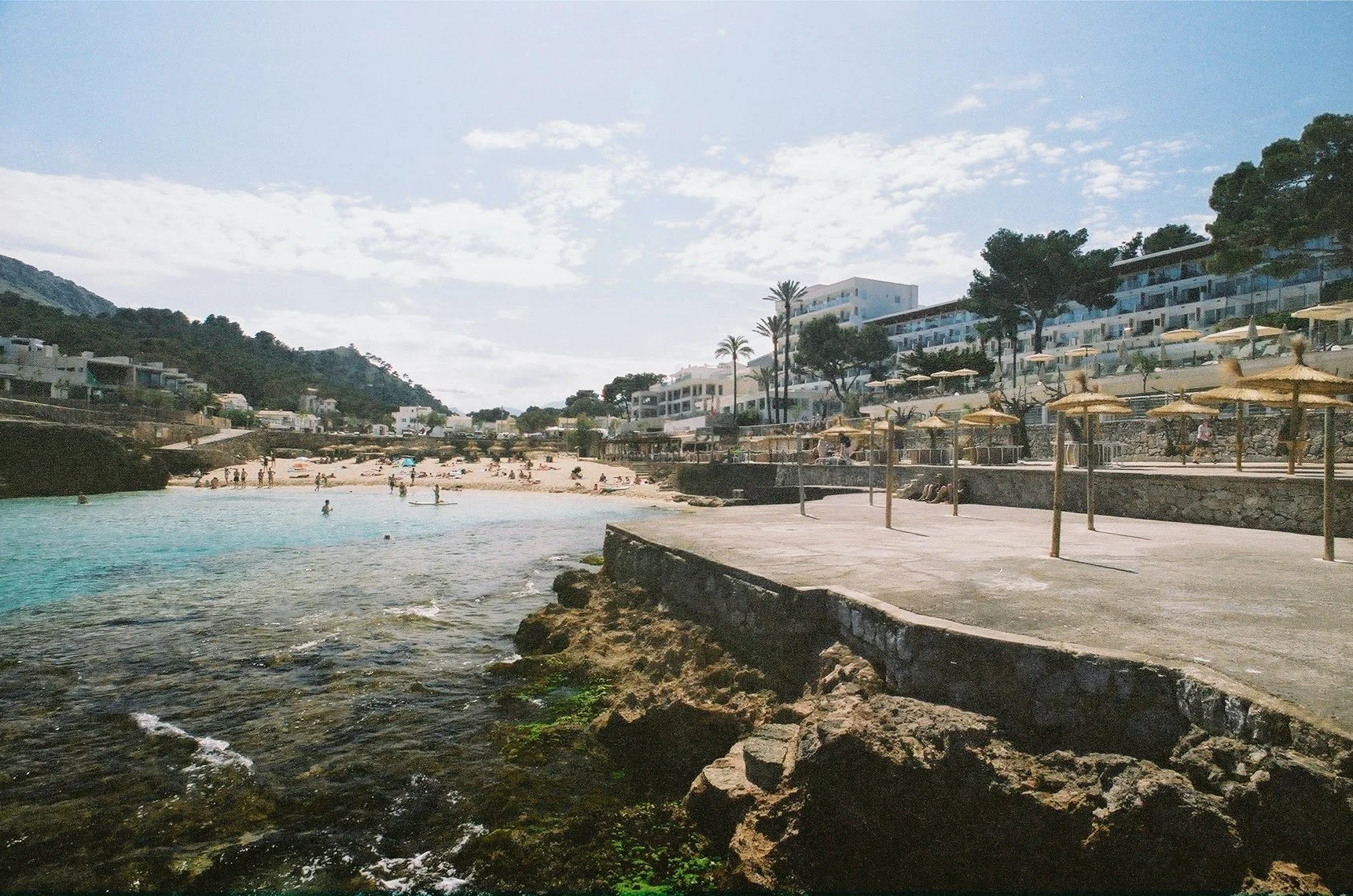
Cala St. Vincenc seen from the Grupotel Molins, Mallorca, Nikon FE, 20mm Nikkor Lens, Circular Polarizing Filter, Kodak Ektar 100
Read Part III: Mallorca - Fornalutx →
It didn’t seem right to travel to Mallorca without staying at a beachside resort of some kind, so we decided to take advantage of shoulder-season rates and stay at the Grupotel Molins, located along one of the crystal blue bays of the resort town of Cala St. Vincenc. Despite the sunny photos you see here, April is still a bit early to enjoy the beach, or at least it was on this trip, with relatively cool weather, chilly waters and even a bit of rain during our stay. Oh well, we tried anyway and it was still a beautiful spot to spend some time relaxing and exploring.
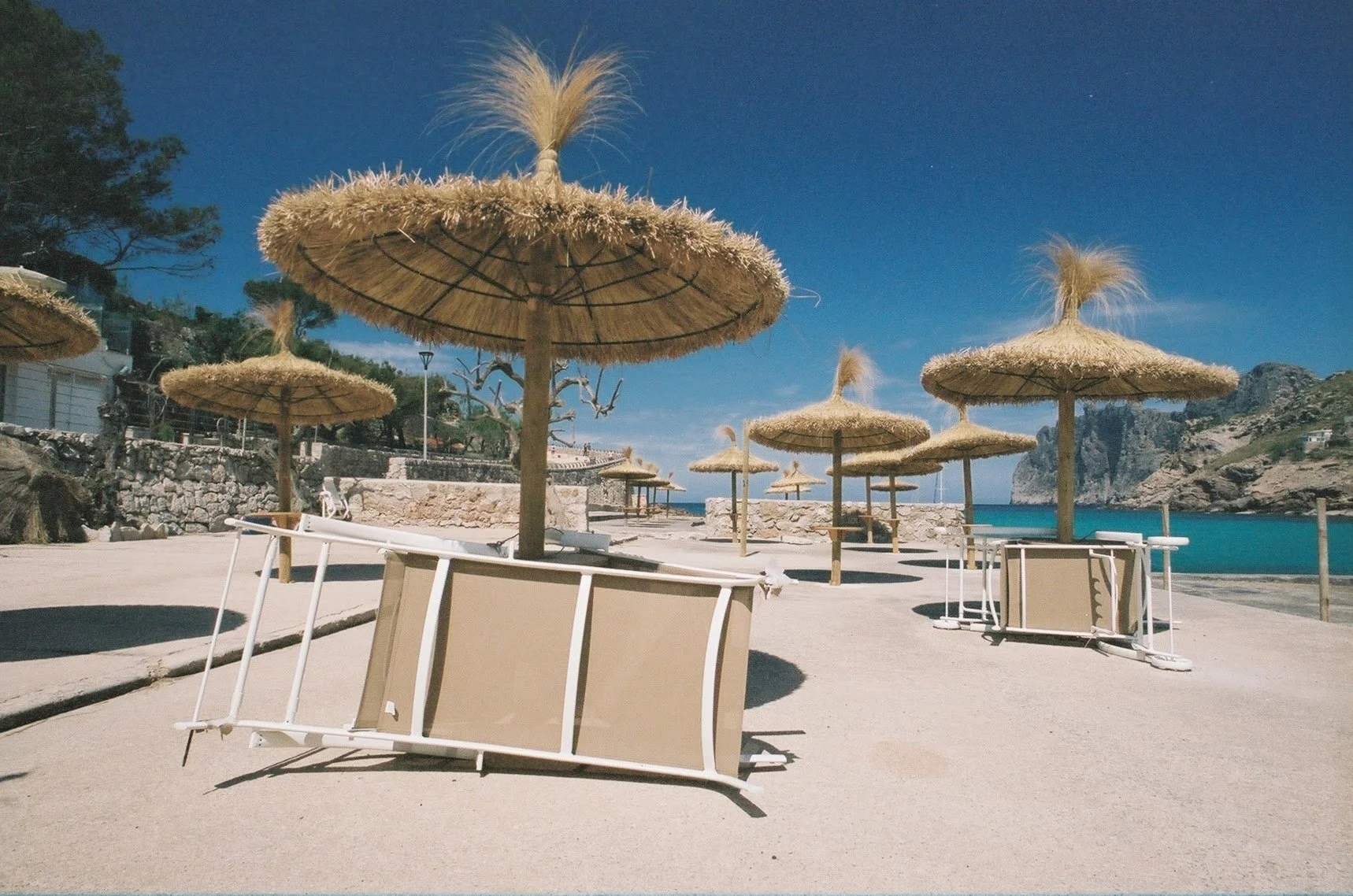
Grupotel Molins, Cala St. Vincenc, Mallorca, Nikon FE, 20mm Nikkor Lens, Kodak Ektar 100
The Hotel and Surrounds
Originally built in the 1950’s and renovated most recently in 2020, the Molins exudes Mid-Century Modern charm with an absolutely stunning location. Our room had a terrific view of the azure waters of the bay and beautiful mountains beyond. Featuring indoor and outdoor pools, tennis courts, several terraces for lounging and of course quick access to the beach, this is a tough spot to beat on this corner of the island. Our room was spartan but clean and spacious, and frankly you’re not likely to spend too much time in it other than sleeping. There’s also a rather funky bar on the ground floor, which we sadly passed on due to our little travel partner’s early bed-time.
There are a number of hikes in the area, following the jagged ridges of the mountains and no-doubt offering amazing views. Our stroller wasn’t going to cut it for these, so we opted to relax by the beach instead, even if the water was a bit cool by typical sunny vacation standards. The breakfast buffet at the Molins was our starting point each morning. It was well stocked with plenty of variety, from local fare to your more typical staples of omelette stations and the like. It somehow managed to avoid feeling chaotic as such setups often do, and it was easy enough to find something to satiate a picky near-toddler and his parents.
Grupotel Molins on the right, Cala St. Vincenc, Mallorca, Nikon FE, 20mm Nikkor Lens, Kodak Portra 400
Grupotel Molins, Cala St. Vincenc, Mallorca, Nikon FE, 20mm Nikkor Lens, Circular Polarizing Filter, Kodak Portra 400
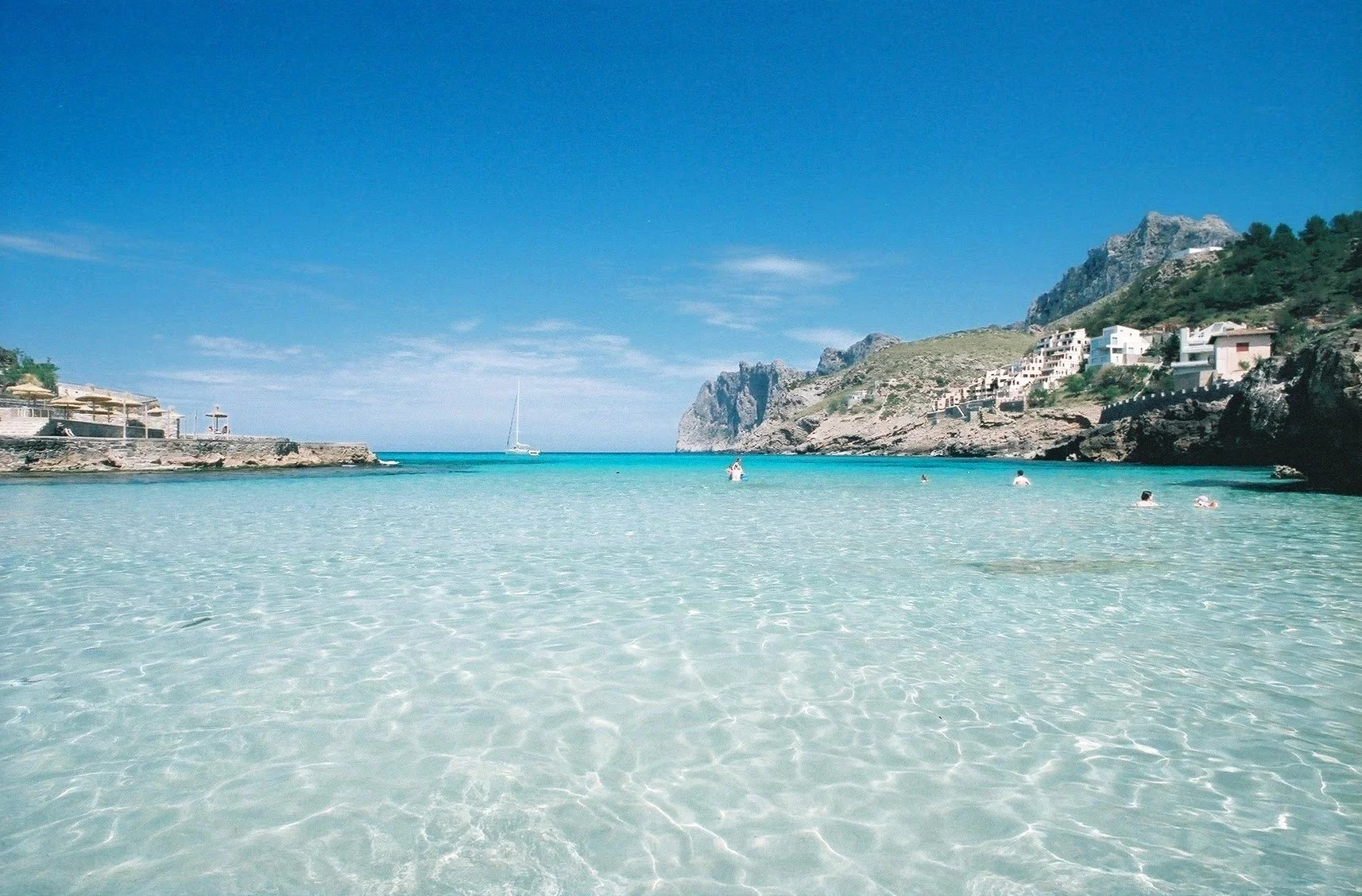
Cala Molins, Mallorca, Nikon FE, 20mm Nikkor Lens, Kodak Portra 400
Exploring the Area
On a couple of the cloudier days of our stay we decided to drive around and explore. Nearby Cabo Formentor is a frequently photographed rocky outcrop complete with lighthouse that seemed a relatively easy morning excursion. Seemed being the operative word. As alluded to in a few other posts, some of the roads here are quite old and thus fairly narrow. So, when you put a bunch of road cyclists, tour busses and cars on the same stretch, climbing a 15% grade full of blind corners for example, progress is slow. I’m sure we could have timed that drive better, but regardless it afforded plenty of opportunity to soak in the scenery and an early car-seat nap for the little one.
Unfortunately for us, the road to the lighthouse viewpoint was closed several kilometers short of the destination with no indication of this in advance. The mix of cars attempting to park on the non-existent shoulder, execute U-turns, or otherwise sit in confusion, meant it took nearly 30min to turn around once we realized we could go no further. Oh well, we stopped for a few snaps along the return journey and headed for Port de Pollenca for a walk by the marina.
Near Cabo Formentor, Mallorca, Nikon FE, 20mm Nikkor Lens, Kodak Portra 400
Port de Pollenca is essentially what you see in your mind when you read “Tourist Town”. Every block seems to have a different ‘Irish’ pub, bar, tour company and tourist trinket shop. Not quite what we were looking for, but an enjoyable walk regardless along the beachside road and past the marina to pass the time. We did find a great farm-to-table restaurant for dinner called Zarzales which served a variety of Mallorcan dishes in a quaint and relaxed setting. The paella and lamb were particularly tasty.

Port de Pollenca, Mallorca, Nikon FE, 20mm Nikkor Lens, Kodak Portra 400
Our radius of travel from the hotel was relatively small, but we still found plenty to enjoy. The town of Pollenca (not to be confused with Port de Pollenca) was a short distance away and a lovely place to wander. With the requisite restaurants and cafes and their vibrant patios spilling out onto the street, large churches with bells ringing out and shops of all sorts squeezed into tiny spaces, it just felt more “real” than the port, which I’m sure sounds funny coming from a tourist.
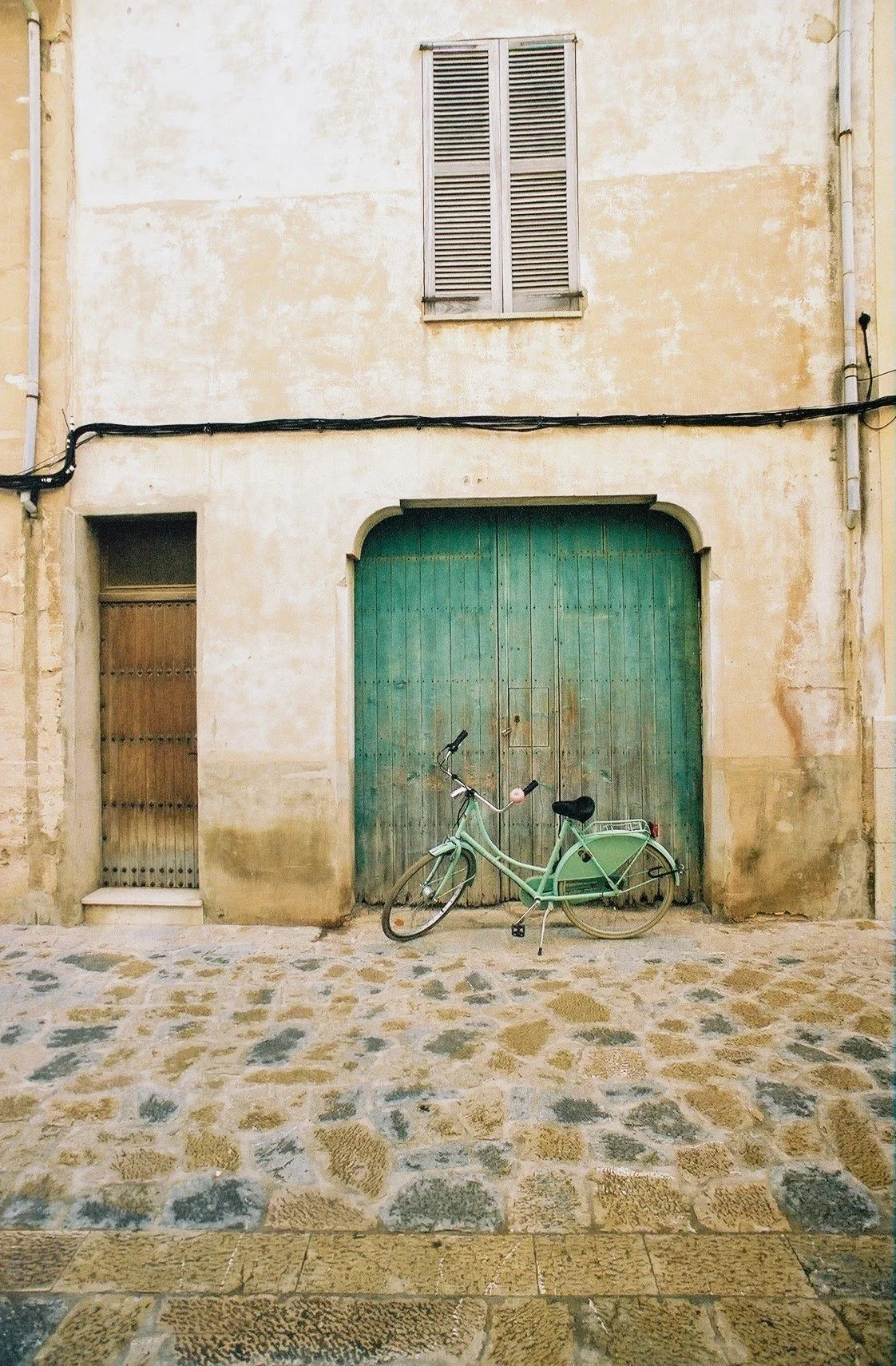
Bicycle in Pollenca, Mallorca, Nikon FE, 20mm Nikkor Lens, Kodak Portra 400
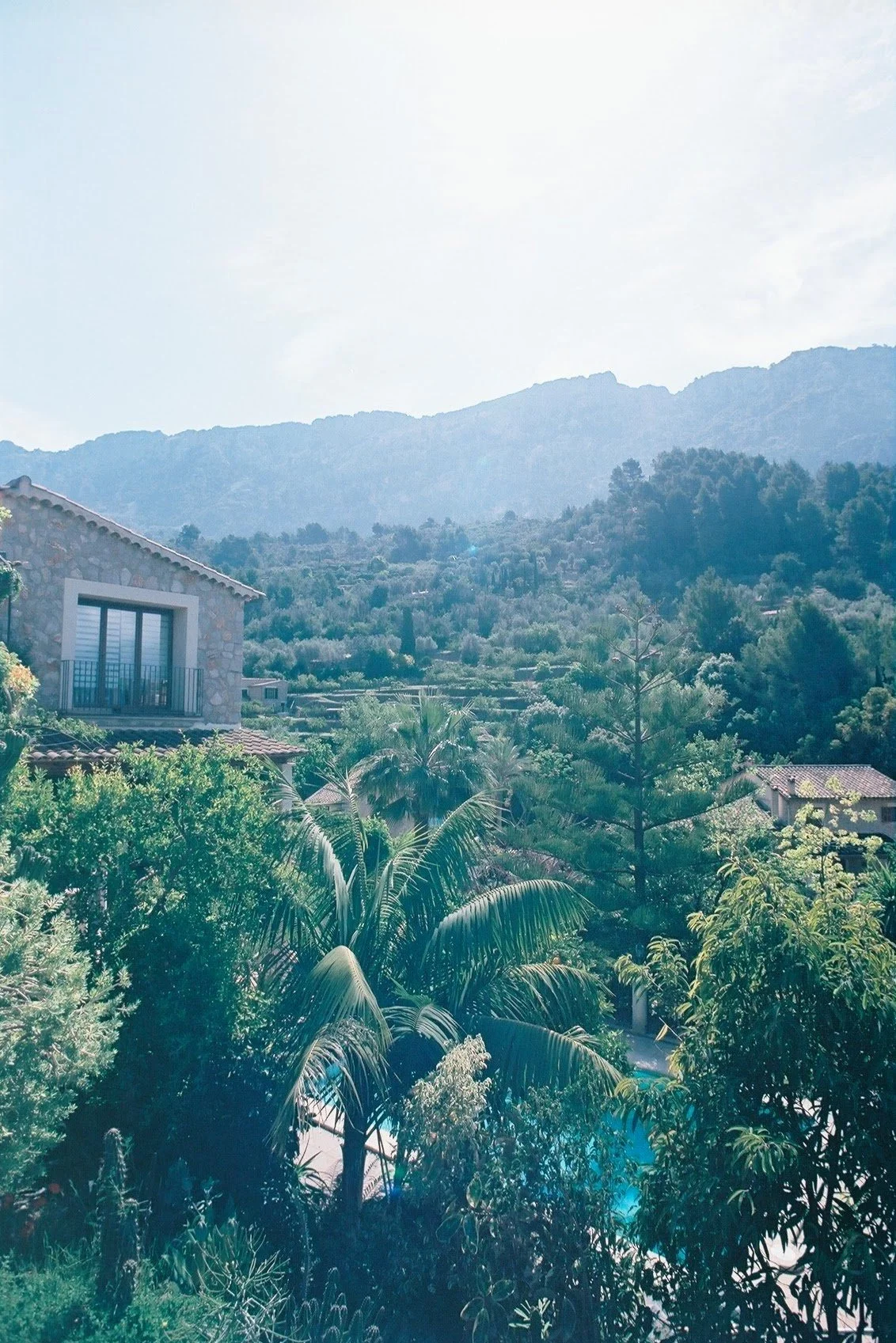
Pollenca, Mallorca, Nikon FE, 20mm Nikkor Lens, Kodak Portra 400
On the outskirts of Pollenca we stumbled upon Son Brull Hotel & Spa, a captivating blend of ancient and mid-century modern design. The hotel's exterior, marked by slab sides and towering solid wood doors, hints at the luxury within. During our visit, we were drawn in for a cocktail and ended up staying for a delightful late lunch on one of it’s patios. Son Brull appeared the perfect retreat for those who appreciate pampering, local cycling routes (favored by pro riders for training), and an exquisite ambience. It's a must-consider for any return trip.

Son Brull Sanctuary Hotel & Spa, Pollenca, Mallorca, Nikon FE, 20mm Nikkor Lens, Kodak Portra 400
Speaking of return trips, our ensuing journey back to Palma for a couple of nights of Mallorcan big-city living took a scenic detour along some B-roads through the countryside. The decision proved worthwhile, offering serene views that made the drive a memorable and relaxing shift into the final phase of our trip. During my initial research on Mallorcan accommodations, I discovered numerous reasonably priced villa stays in the inland areas and foothills of the mountains. While we did stay at one near the coast on the outskirts of Soller, the drive revealed a plethora of additional options scattered across the island – from grandiose to simple and quaint. I would absolutely select one of these for a future stay, particularly if I wanted to join the cycling crowd with some likeminded friends and pound out some miles on the pavement in our own peloton before returning to mix cocktails and relax by a pool. As we navigated the empty winding roads, the romantic allure of Mallorca's interior unfolded with tree-lined paths and charming stone walls. A delightful reconnaissance for potential future stays.
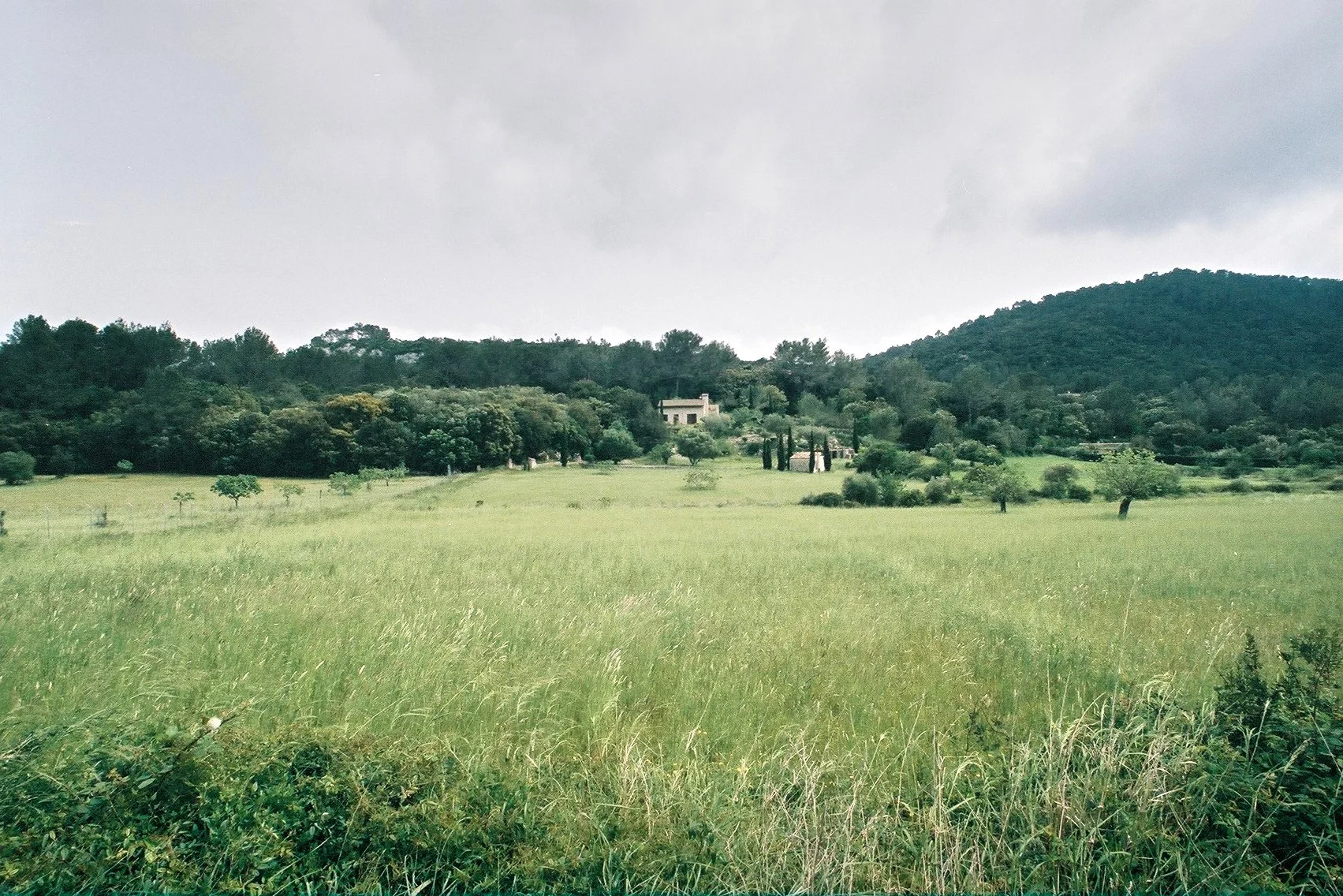
One of many villas along our winding road in Mallorca. Nikon FE, 20mm Nikkor Lens, Kodak Portra 400
The countryside behind us, we finally arrive in Palma. Google map’s directions seemed determined to shave the mirrors off my car (again) so after looping the neighbourhood several times we parked up on a sidewalk and walked our bags over to our accommodation a couple of blocks away. The friendly concierge at the Palma Suites Apartment Hotel helps me get my bearings so I can find an official parking zone while my wife and kiddo prepare to wander out and find dinner. Just a few days left to enjoy our trip, how will Palma pan out?
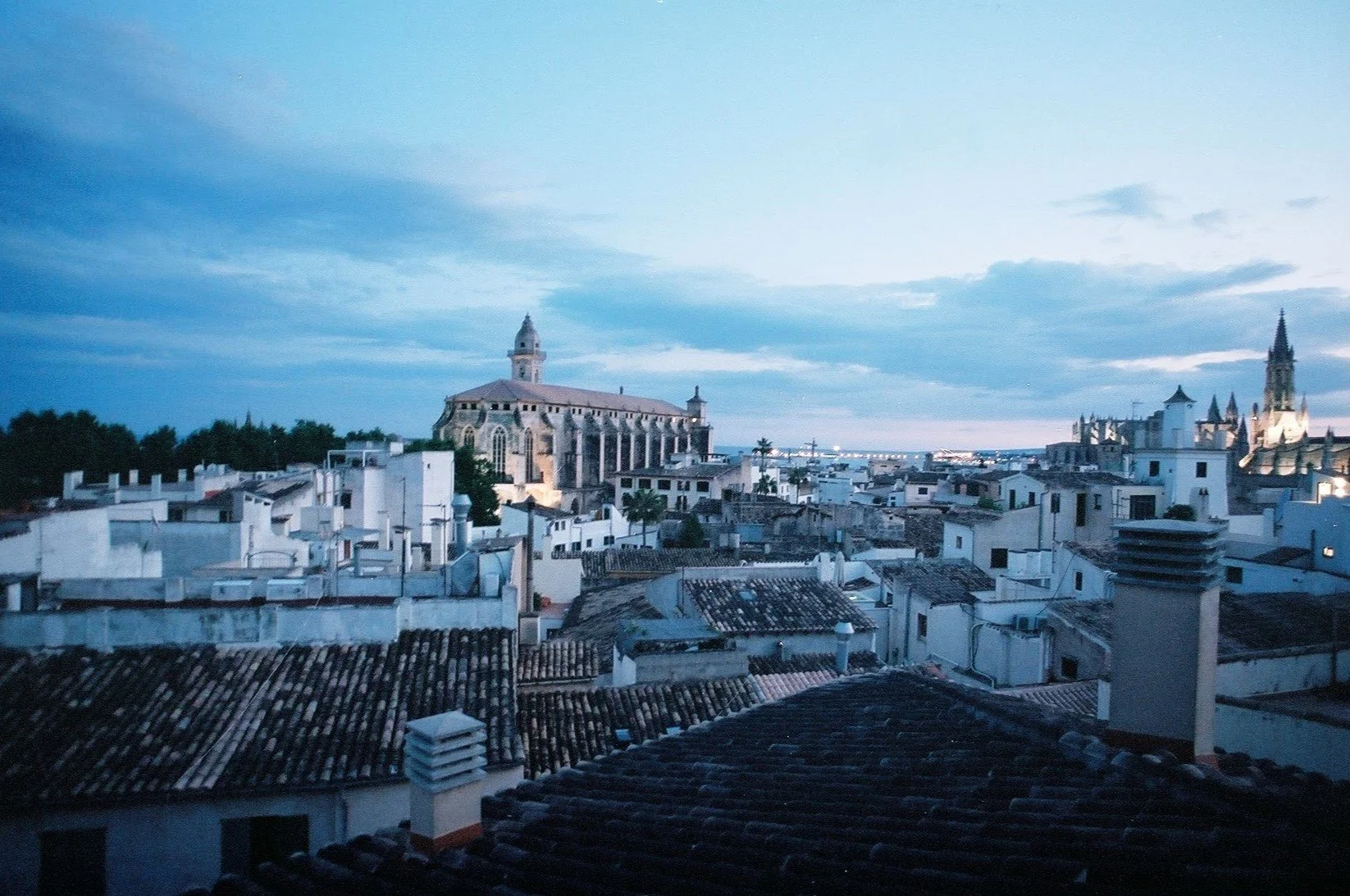
Rooftops of Palma Mallorca, Nikon FE, 20mm Nikkor Lens, Kodak Portra 400

Mallorca - Fornalutx
The views from town are magnificent, especially looking back across the valley at the various and ancient terraced orchards and olive groves. There are a number of hikes up and down available to explore, but with the stroller in tow we decided to stick to the cobble stones streets which were a steep enough challenge on their own.
Fornalutx, Mallorca, Nikon FE, 20mm Nikkor Lens, Kodak Ektar 100
Read Part II: Mallorca - Soller →
From Soller we headed north towards Cala St. Vincenc, with a quick stop in Fornalutx along the way. Fornalutx is a small village perched on the north west side of the valley beyond Soller. It can be approached from above via the MA-10, the main road northward, or from bellow along the MA-212, a relatively narrow winding lane. The latter being the more picturesque if a bit tight depending on what you’re driving. A friend of ours lives in this village and we thought a leisurely visit for lunch would break-up what was otherwise a dedicated travel day.
Hilly on a hillside, Fornalutx, Mallorca, Nikon FE, 20mm Nikkor Lens, Kodak Ektar 100
A Brief Walkabout
Let’s start with a quick tip: There are two official parking lots in town, one at either end of the main road through the village, and I’d strongly recommend using one of them and exploring on foot from there. Here again roads can get very narrow very quickly, and street parking is very tight, if you can find a spot at all. So, rather avoid the hassle (and damage), and use the reasonably priced open-air lots.
We were very fortunate to get a guided tour of this quaint village through the lens of a friend who had settled there for several months with her family. The population is increasingly trending towards expats such as herself seeking a quieter nook of this beautiful island to settle on. Despite this, there isn’t much English spoken here, in fact it’s mostly Catalan amongst the locals.
The views from town are magnificent, especially looking back across the valley at the various and ancient terraced orchards and olive groves. There are a number of hikes up and down available to explore, but with the stroller in tow we decided to stick to the cobble stones streets which were a steep enough challenge on their own. The town itself feels quiet and timeless, managing to preserve a traditional architectural style that blends neatly and naturally into it’s steep surroundings.
Towards the center of town it gets a bit more lively, but far from the tourist density you’ll experience in some of the larger towns on the coast. In the center itself there’s a square and a number of restaurants and cafes situated around it. These seemed to fill up rather quickly, so come early or late to get a seat (or try to book ahead). This square seemed to be a popular spot for the many cyclists that visit the area, no doubt hydrating and carb loading for the rather extreme climbs nearby.

Fornalutx, Mallorca, Nikon FE, 20mm Nikkor Lens, Kodak Portra 400
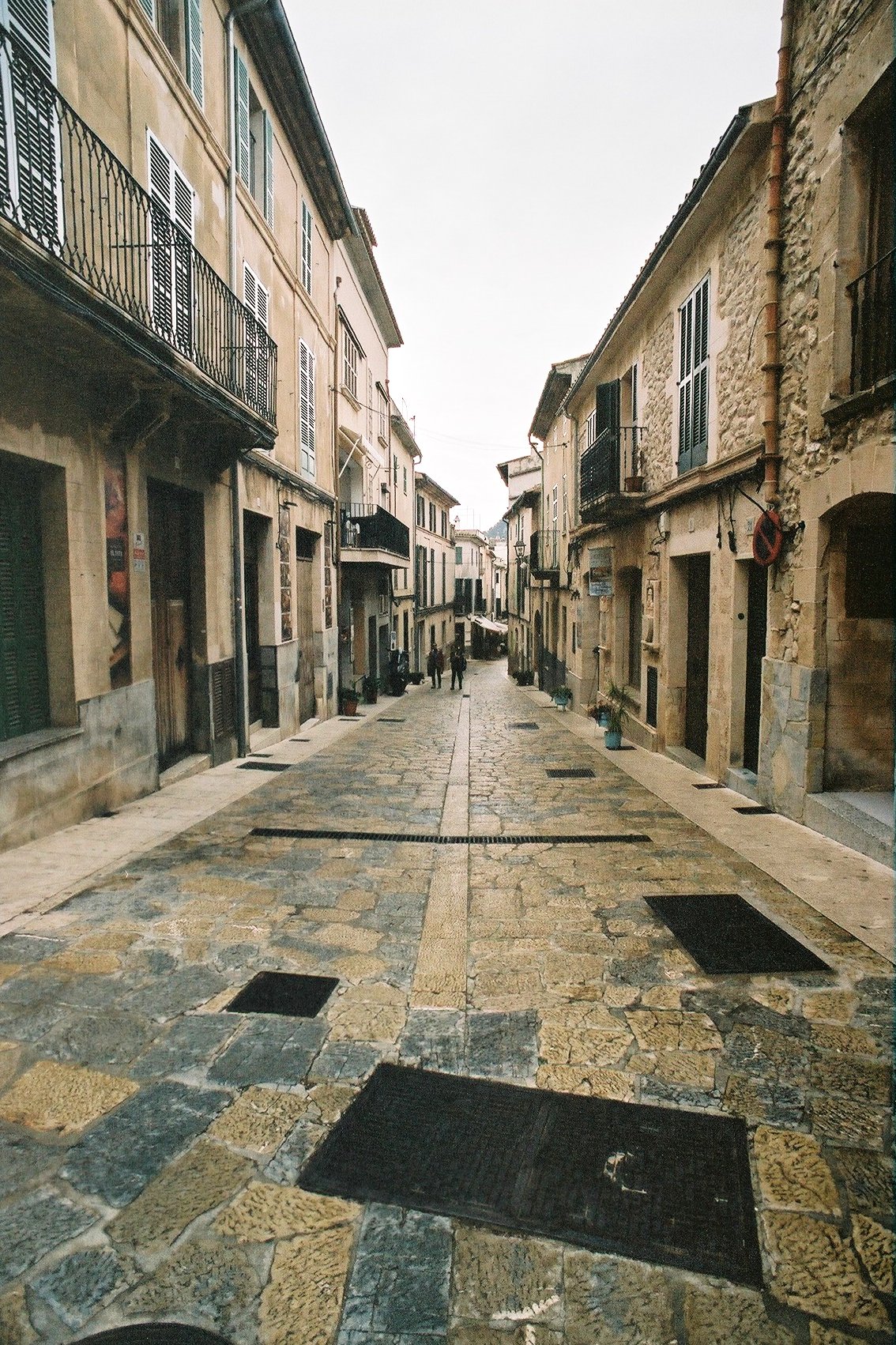
Fornalutx, Mallorca, Nikon FE, 20mm Nikkor Lens, Kodak Portra 400
Fornalutx, Mallorca, Olympus XA, Film Ferrania P30
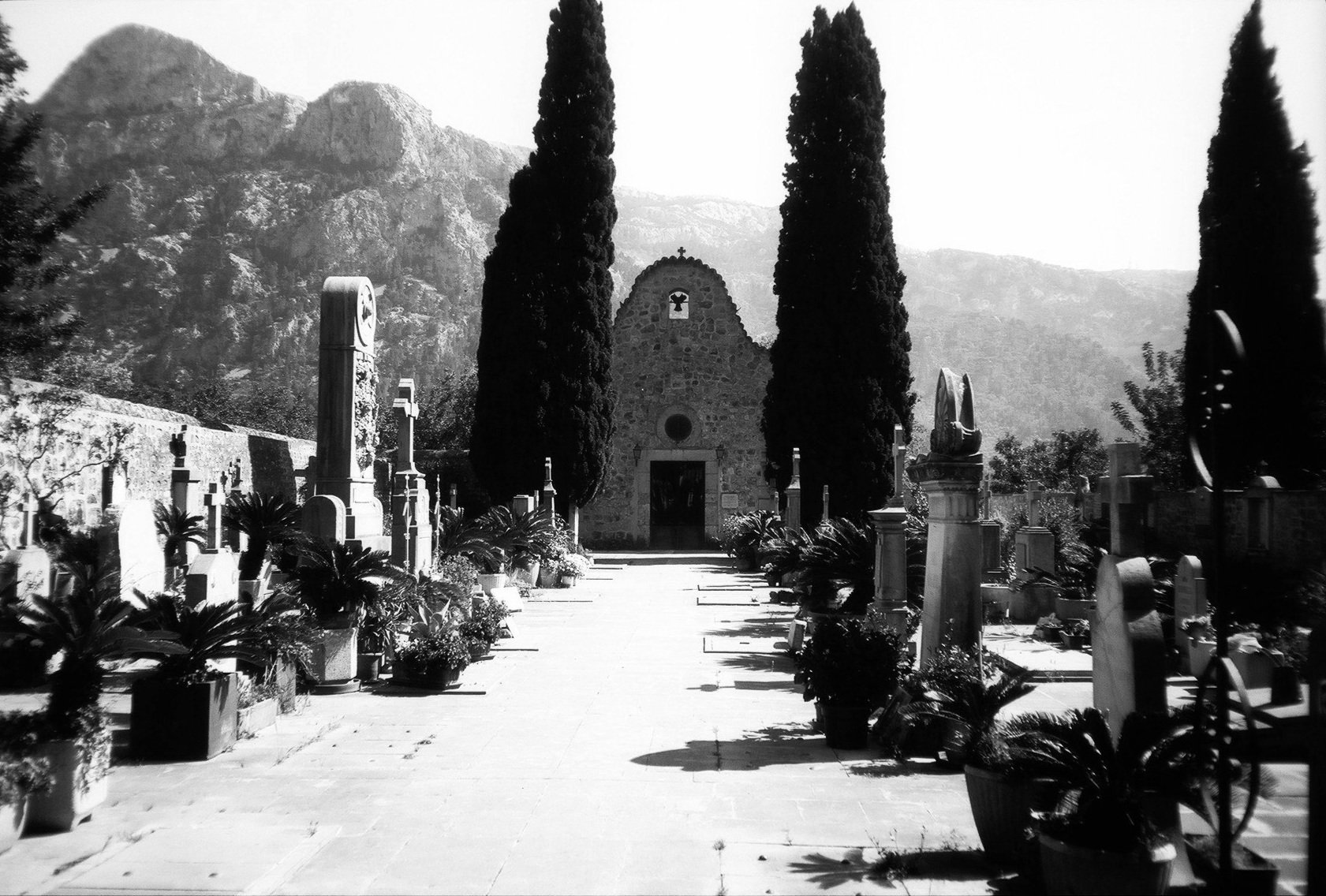
Cemetery in Fornalutx, Mallorca, Olympus XA, Film Ferrania P30
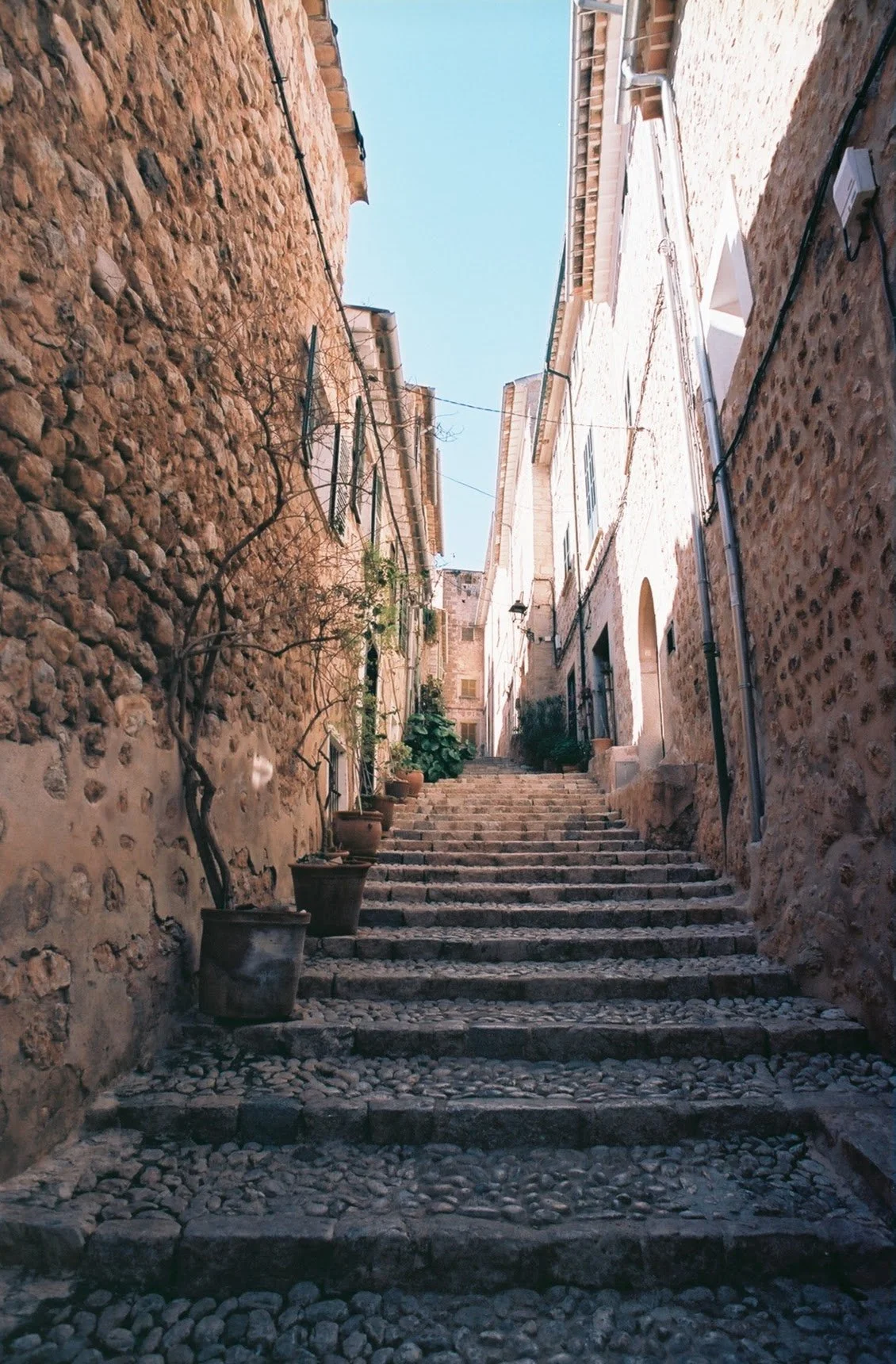
Always seemed to be more ups than downs, Fornalutx, Mallorca, Nikon FE, 20mm Nikkor Lens, Kodak Portra 400
One could stay here as a quieter alternative to staying in Soller proper, and still be a reasonably close drive or cycle to visit the town and port. Our host warned that despite the relatively close distance on a map, the road ahead to our next destianteion could get quite busy and jammed with traffic and cyclists (it did), so our stay was relatively short but refreshing. Our journey continues north to Cala St. Vincenc!

Mallorca - Soller
Soller was buzzing with activity when we were there. While there were plenty of tourists, it’s clear that there is a large local community here and the buzz of them going about their day creates a great vibe in the town center. While bigger than Deia, Soller is by no means large, and exploring it on foot is the best way to go for the most part, especially with the aforementioned narrow lanes.
View from the living room, Soller, Mallorca, Nikon FE, 20mm Nikkor Lens, Kodak Portra 400
Read Part I: Mallorca - First Taste of Spain →
After a beautiful stay in Deia, we drove just 15km or so to our next destination, a small villa we booked in the hills above Soller. The drive, like most on the periphery of the island, is winding and beautiful, with scenic vistas at every turn. It’s also quite narrow, with no passing lanes and many cyclists, so always bank on it taking about double the time you expect. Soller occupies a broad valley and stretches right down to the sea at the westernmost end (Port de Soller). As I dutifully followed google maps towards our stay we quickly encountered a bit of a snag. The route took us through the heart of the city, and as it did, the road got narrower and narrower until our right and left side tires were squealing along the curbs! It got worse before it got better as we came up to a 90 degree right hand bend. Through a feat of geometric genius, we managed to navigate the gauntlet and thankfully the road widened on the other side. Lesson learned, if it’s getting skinny, get out and scout on foot first!
Not entirely sure I was supposed to drive this way, Soller, Mallorca, Nikon FE, 20mm Nikkor Lens, Kodak Portra 400
Casa Azva
I really wanted to experience at least one private stay on this trip, and this would be it. We booked Casa Azva on AirBnb after a protracted, indecisive search online on various booking sites. Mallorca is absolutely full of villa stays, and in the shoulder season many are incredibly good value, so it can be tough to choose. In our case we wanted someplace quiet with a view, and scored 10/10 on both points. The challenge here is that your vehicle parking is at the bottom of the property, so you need to be comfortable with a 5 minute walk up the occasionally steep hill to your accommodation.
The villa itself was quaint and cozy, with two bedrooms, a full kitchen and a wood burning fireplace that we made good use of in the cool evenings of the mountainside. The villa is located on the outskirts of Soller near the village of Biniaraix, it’s about a 20min walk into town but we usually drove given the unpredictable nature of travelling with a little one. There are a few restaurants near the accommodation and many hiking trails in the hills behind for those feeling adventurous!

Casa Azva, Soller, Mallorca, Nikon FE, 20mm Nikkor Lens, Kodak Portra 400
Casa Azva, Soller, Mallorca, Nikon FE, 20mm Nikkor Lens, Kodak Portra 400
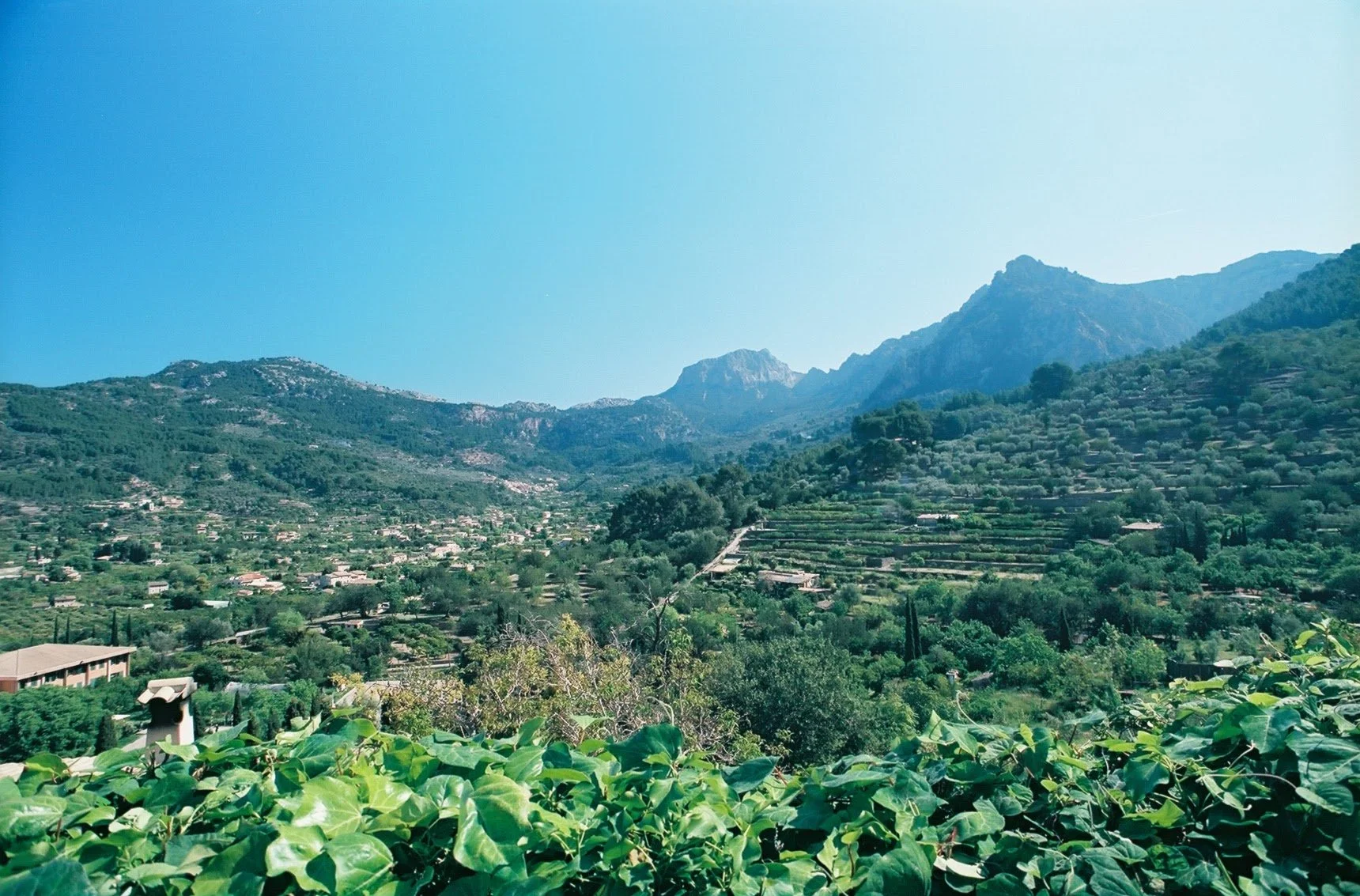
View from our yard, Casa Azva, Soller, Mallorca, Nikon FE, 20mm Nikkor Lens, Kodak Portra 400
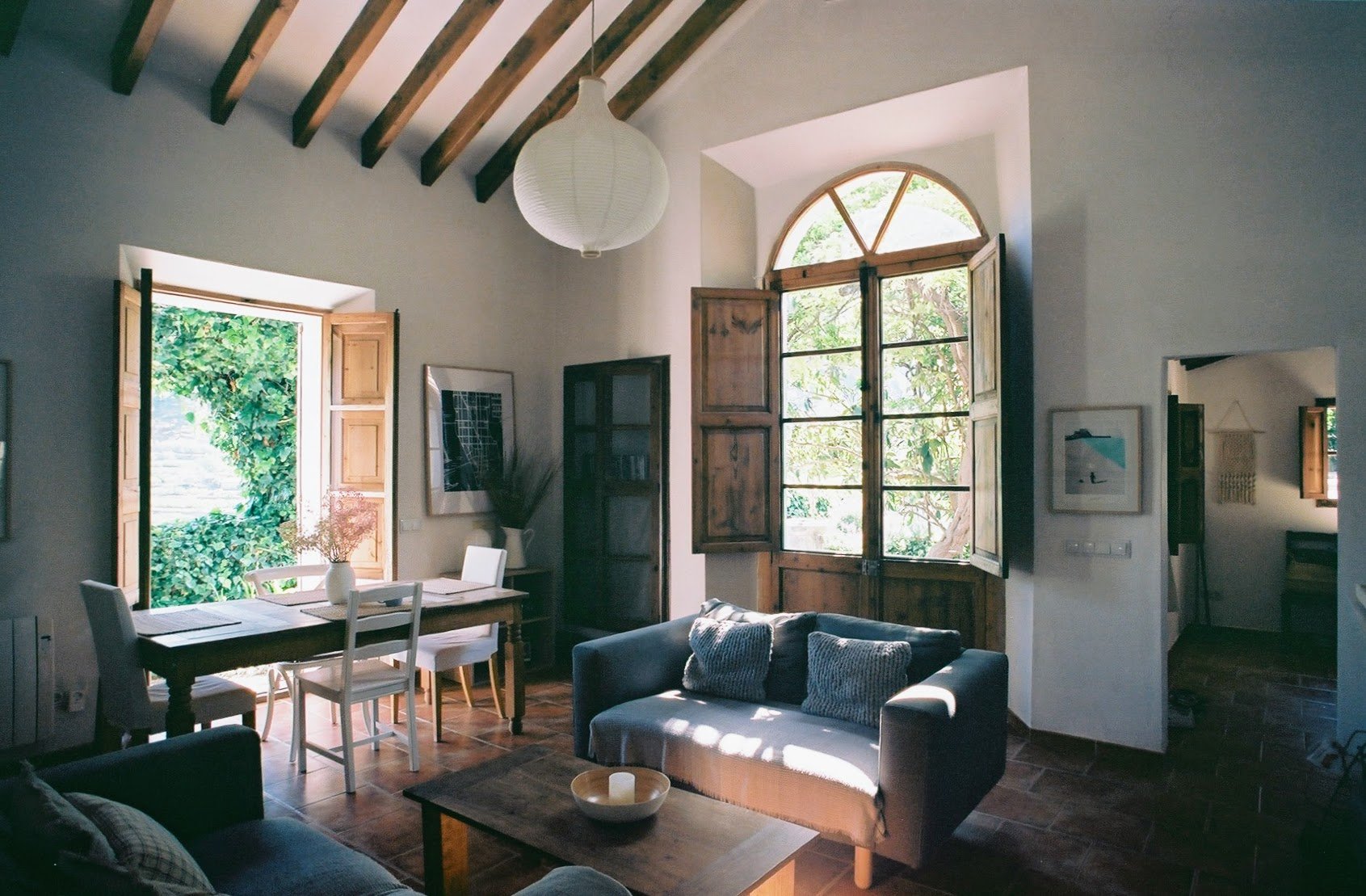
Living room, Casa Azva, Soller, Mallorca, Nikon FE, 20mm Nikkor Lens, Kodak Portra 400
Around Town
Soller was buzzing with activity when we were there. While there were plenty of tourists, it’s clear that there is a large local community here and the buzz of them going about their day creates a great vibe in the town center. While bigger than Deia, Soller is by no means large, and exploring it on foot is the best way to go for the most part, especially with the aforementioned narrow lanes. Hungry and want to try a great local snack? Ensaimadas, are a local delicacy available fresh or pre-packaged in many if not all of the local bakeries. Essentially a sweet bread with powdered sugar on top, it’s a tasty treat for between meals. Fresh squeezed juices are also available from some shops and these are both tastier and less costly than bottled drinks. To try more local fare, or bring some fresh food back to your villa to cook-up yourselves, try the Mercat-Municipal; a large indoor market with butchers, bakers, fish and fresh local produce.
For us, one of the highlights of Soller was simply sitting outside a cafe sipping espresso and watching the world walk by, but as with all such trips we needed to do some exploring, and Soller has a particularly beautiful way of helping you do just that. The town is bisected by a tramway that carries the Tren De Soller, a vintage light-rail carriage that takes you on a 5km journey from near the the city center at the Plaza de la Constitución to the beautiful harbour village of Port du Soller (with a few stops along the way). While you don’t need to ride the Tren to explore Soller itself, it is the ideal way to visit Port du Soller for it’s beaches and seaside cafes and bars.
The Tren de Soller passes right through the central square in Soller, Mallorca, Nikon FE, 20mm Nikkor Lens, Kodak Portra 400
“For us, one of the highlights of Soller was simply sitting outside a cafe sipping espresso and watching the world walk by.”
Plaza de la Constitución, Soller Mallorca, Nikon FE, 20mm Nikkor Lens, Kodak Portra 400
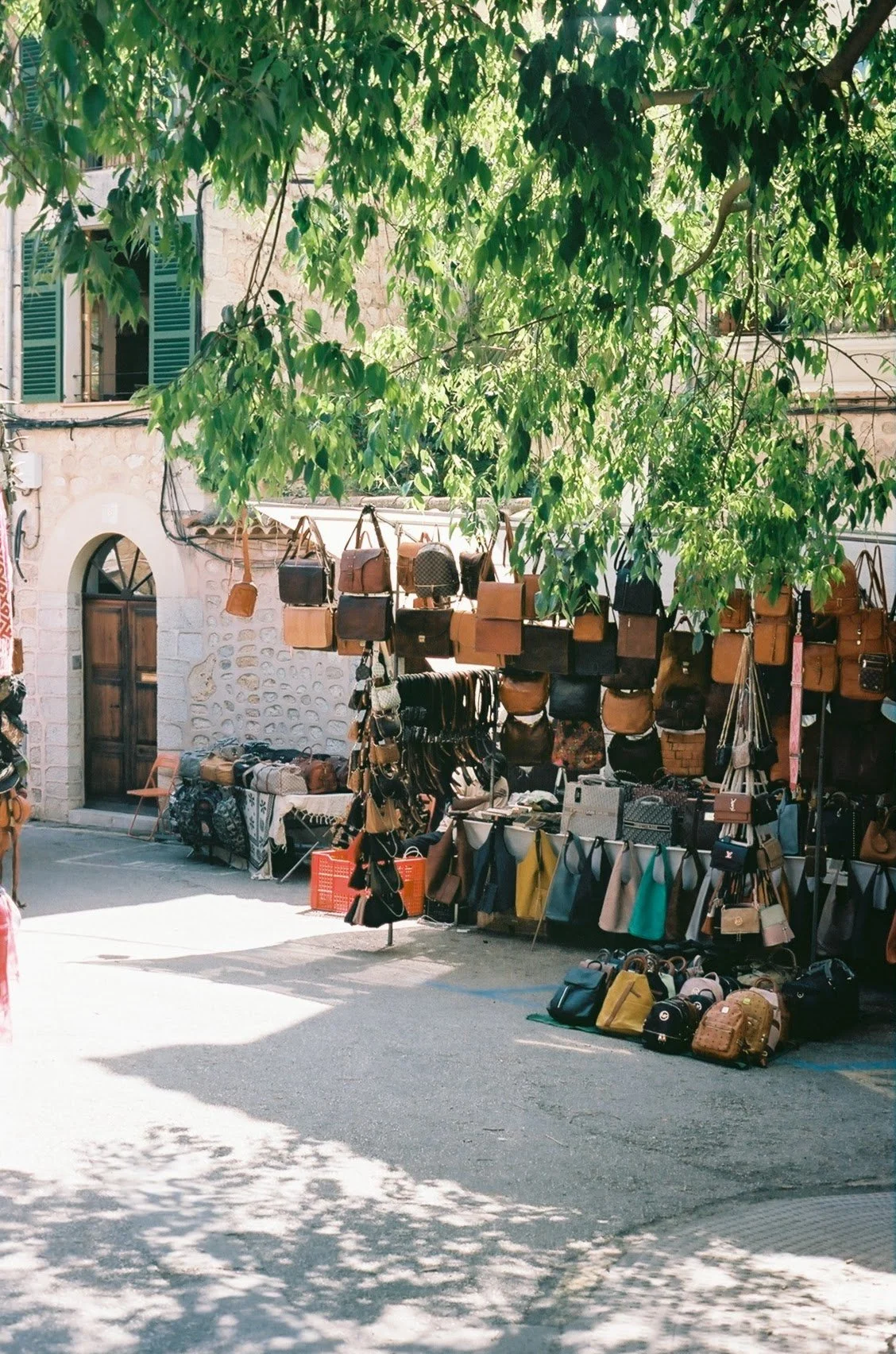
A few more tables and kiosks outside the Mercat-Municipal, Soller Mallorca, Nikon FE, 20mm Nikkor Lens, Kodak Portra 400

Soller Mallorca, Nikon FE, 20mm Nikkor Lens, Kodak Portra 400
Soller, Mallorca, Nikon FE, 20mm Nikkor Lens, Kodak Portra 400
Port Du Soller
Port Du Soller is the beautiful seaside sibling to the more densely laid out Soller. Built around a bay with a narrow opening to the Balearic Sea, this little town may just be the archetypal southern European beachfront village. The Tren line runs along the east bank of the bay, covering about half it’s circumference with a few stops along the way. We found it best to hop off at the very first stop as the rest of the town is very walkable and indeed that’s a great way to enjoy it. We spent a bit of time on the beach, but late April proved a bit cool yet for swimming (I tried). There are many restaurants all facing inward towards the water and a beautiful marina where I’m sure boat rentals and charters are an enticing option, but we weren’t going to try that with our 6 month old in tow.
The Port is a great place to spend a day, and while it’s clearly “touristy” it doesn’t feel obtrusively so and is indeed beautiful enough to invest the time in a visit if you’re on this coast. I suspect during the summer the beach is absolutely packed and the atmosphere overall must be amazing. In late spring it was relatively quiet but in glorious sunshine we didn’t mind a more relaxed day. Absent the beach, there are plenty of cafe’s restaurants and gellaterias to enjoy, as well as a marine museum and various boat-tour operators.
The tren passing by in Port du Soller, Mallorca, Nikon FE, 20mm Nikkor Lens with circular polarizing filter, Kodak Portra 400
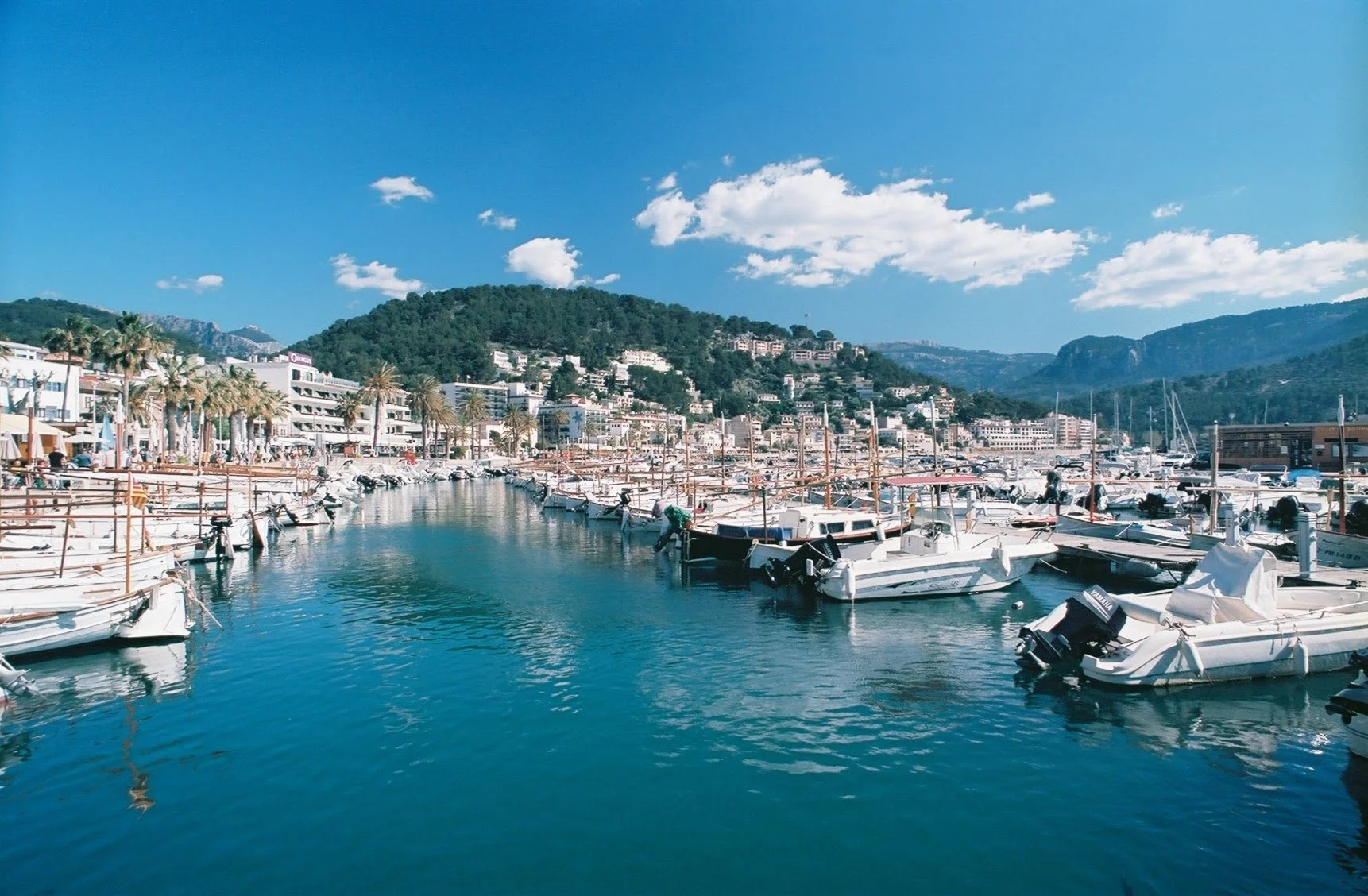
The Marina in Port Du Soller, Mallorca, Nikon FE, 20mm Nikkor Lens with circular polarizing filter, Kodak Portra 400
Interlude
On the Soller leg of our Mallorca trip the sun finally came out in full force and so did my trusty Olympus XA loaded with Film Ferrania’s P30. I’d never shot this film stock before, and with an ISO (ASA) of just 80 I was a bit nervous about trying until I had some really bright light. It felt like a bit of a risk entrusting a lesser known film stock on a trip abroad, but wow am I happy I did.
P30 is a newly manufactured film with high silver content which Ferrania claim provides high-contrast with minimal grain in an effort to capture the look of Italian cinema of the mid 20th century. It delivers triumphantly. While that low sensitivity means it’s not very versatile (a tripod might help with that), when it shines it’s utterly gorgeous. Enjoy a couple shots here and you’ll see more as I cover the second half of the trip.

Port Du Soller, Mallorca, Olympus XA, Ferrania P30

The Tren passing through Port Du Soller, Mallorca, Olympus XA, Ferrania P30
Oops, a car race!
I think it was the third day of our visit to Soller that I awoke to the sounds of engines screaming across the valley. At first I figured some motoring enthusiasts were having a go at the delightfully twisty roads before the local police force had gotten out of bed. It was my wife that noted that the consistency of the sounds which reminded her of attending one of my car races back home. I hadn’t read about any tracks in the area, so what could it be?
It was actually quite challenging to find any mention online about an organized motorsport event, so we decided to hop in the car and drive towards the sound until we found something. It turns out there was a hill-climb race going on that weekend, and they had shut several kilometers of the road north out of Soller down to run it for the day. I raced hill climb in Canada about ten years ago (and won “King of the Hill” at Knox Mountain on my final attempt) so was absolutely delighted to see how it’s done here in Mallorca. The cars for the most part were much different from what I typically would see back home, so that in itself was exciting. I unfortunately had a roll of Kodak Ektar 100 in the camera that morning, which is not the right film for high speed action photography, but I tried my best and got most of my best shots as they came back down the hill. (Always a potential downside to committing to film photography on a trip)
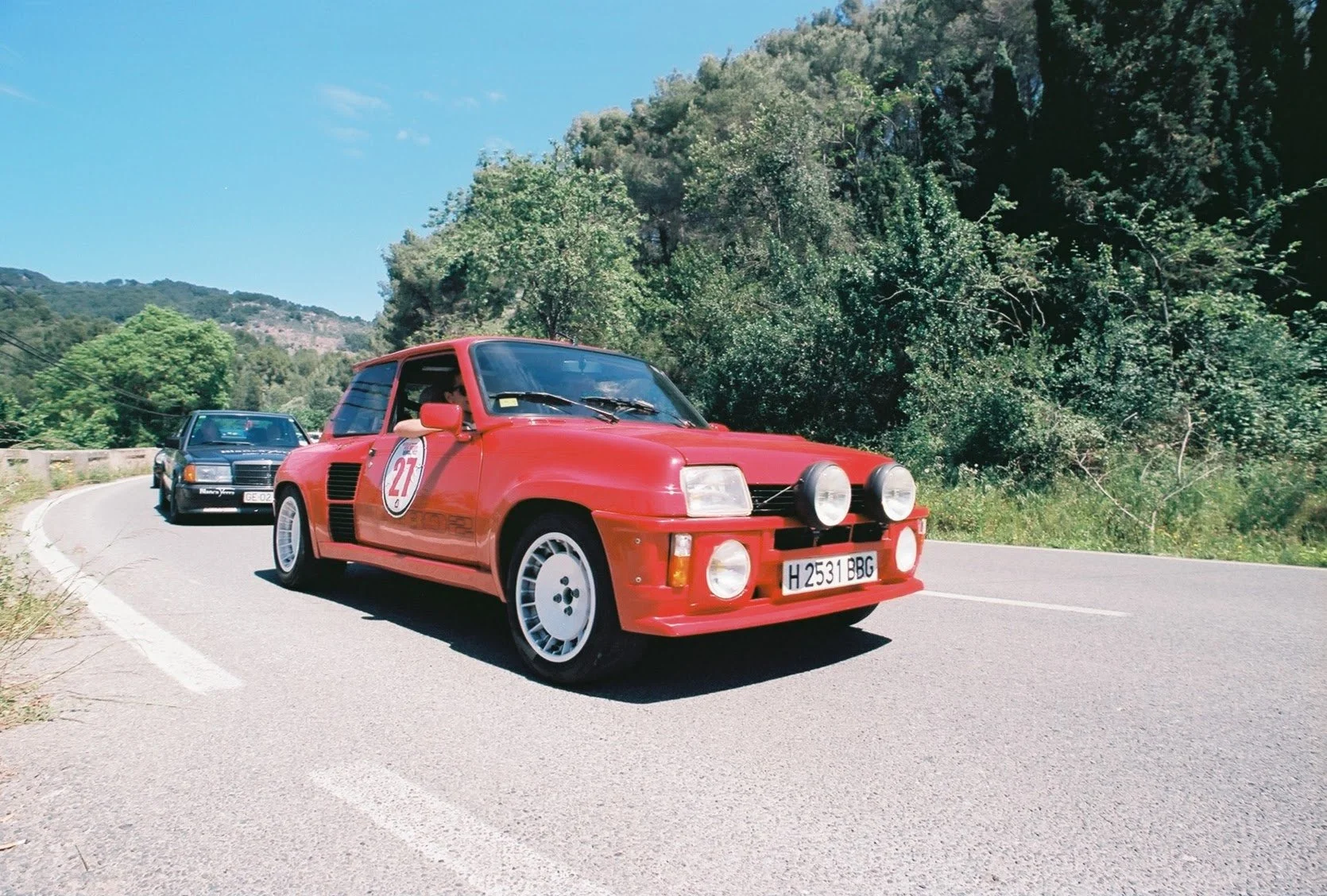
Holy Sh!t, a Renault 5 Turbo, Soller, Mallorca, Nikon FE, 20mm Nikkor Lens, Kodak Ektar 100
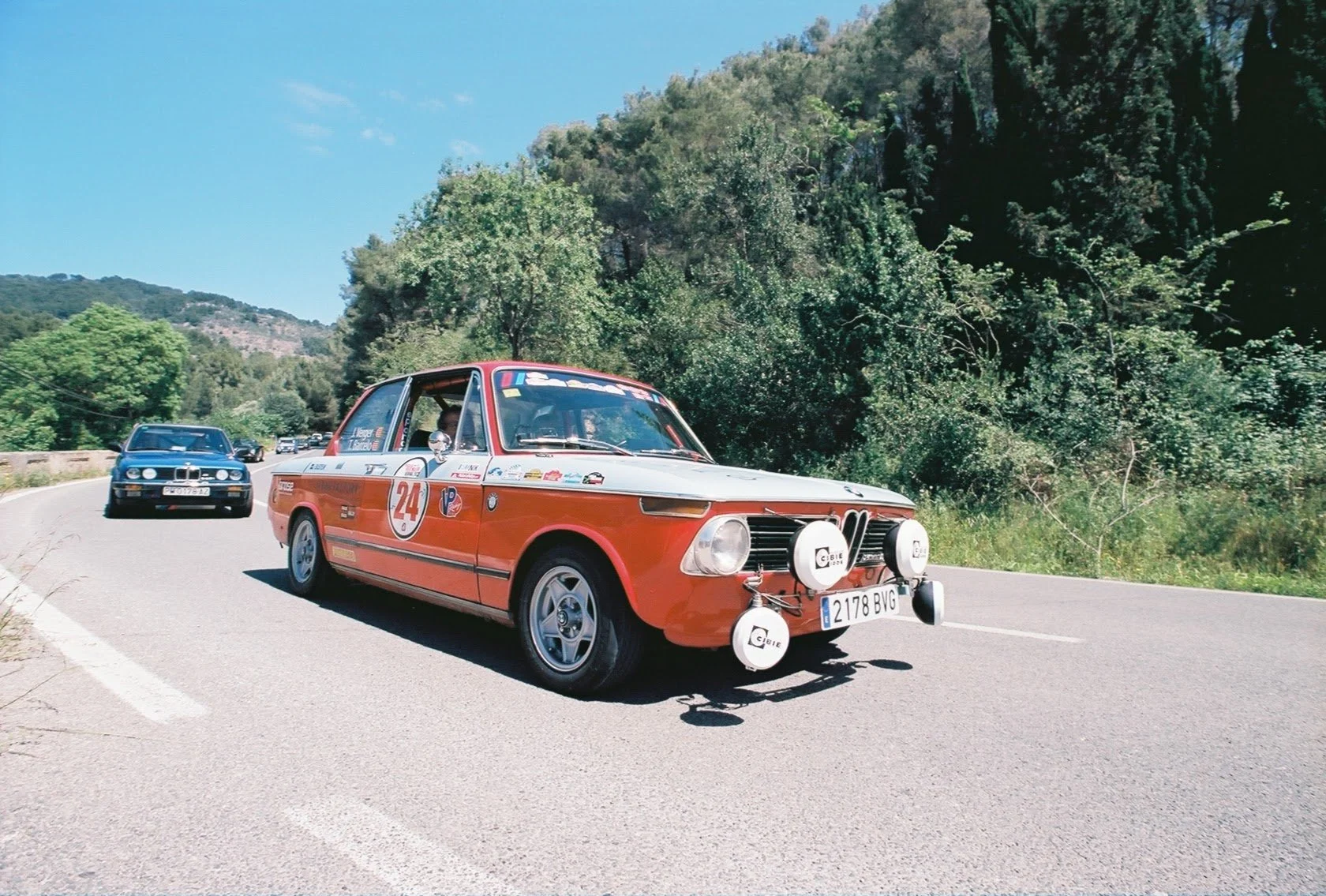
BMW 2002, Soller, Mallorca, Nikon FE, 20mm Nikkor Lens, Kodak Ektar 100
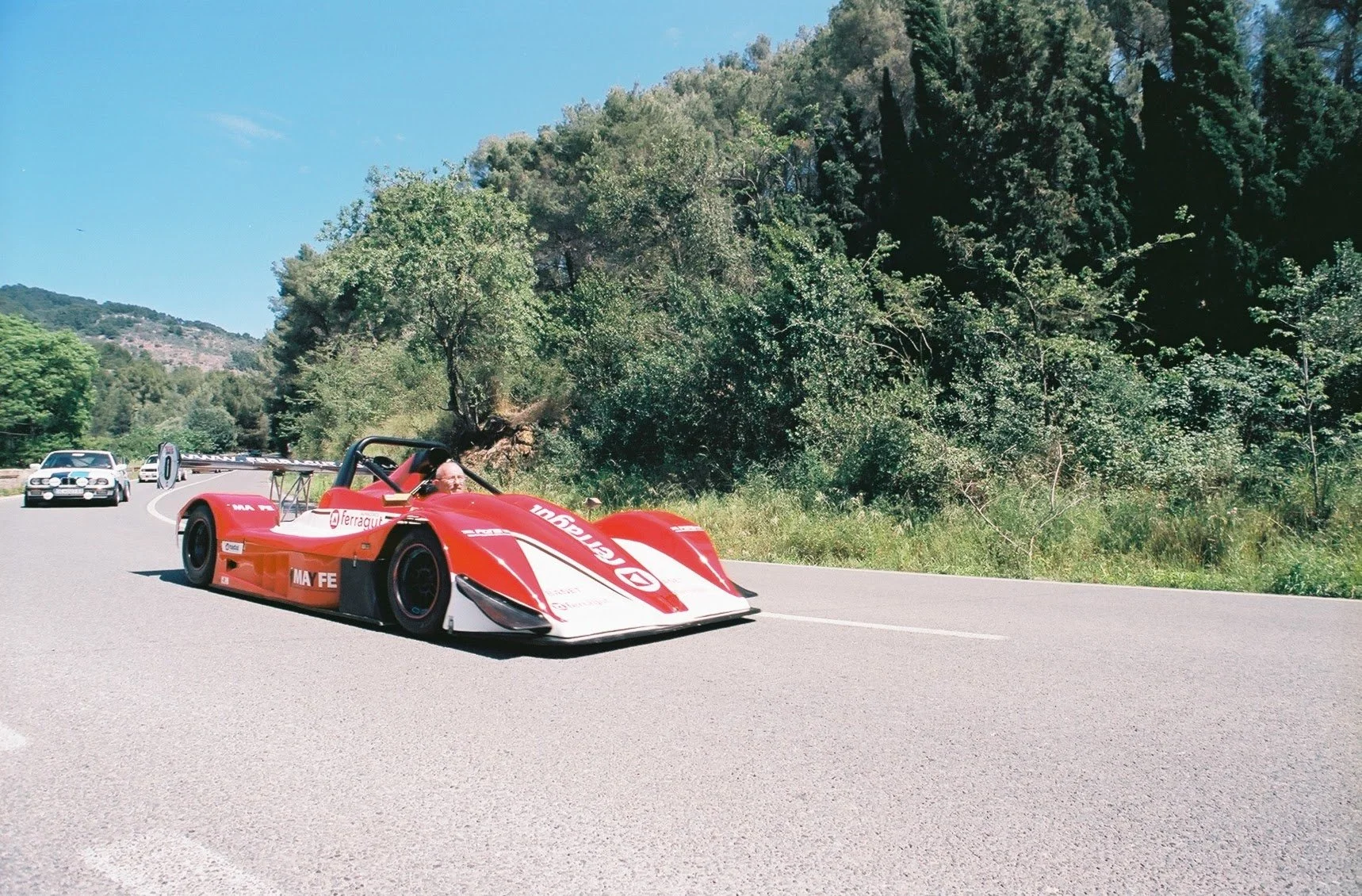
Serious Sports Racer, Soller, Mallorca, Nikon FE, 20mm Nikkor Lens, Kodak Ektar 100
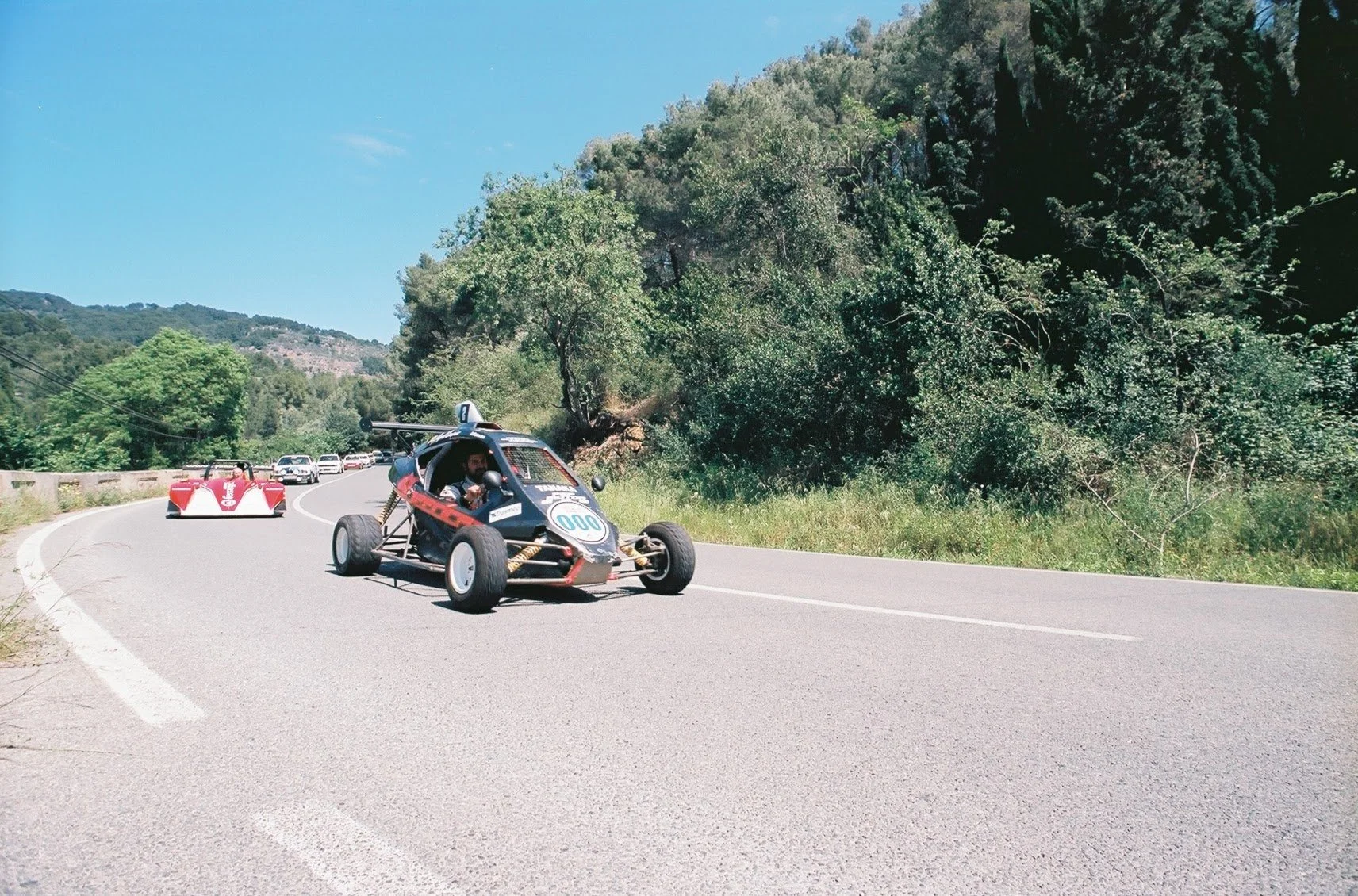
Bike Engined open-wheeler, Soller, Mallorca, Nikon FE, 20mm Nikkor Lens, Kodak Ektar 100
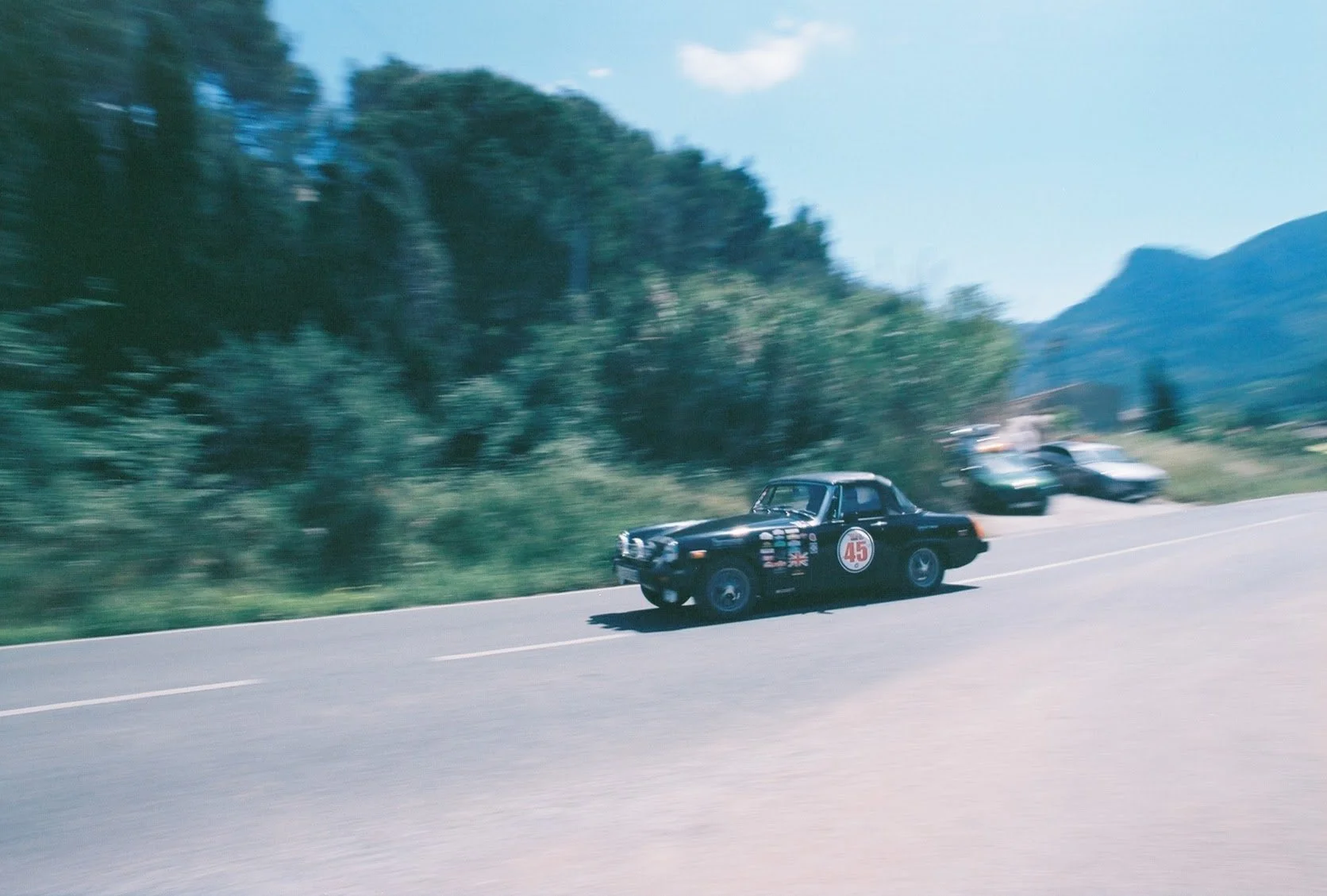
MG haulin’ butt, Soller, Mallorca, Nikon FE, 20mm Nikkor Lens, Kodak Ektar 100
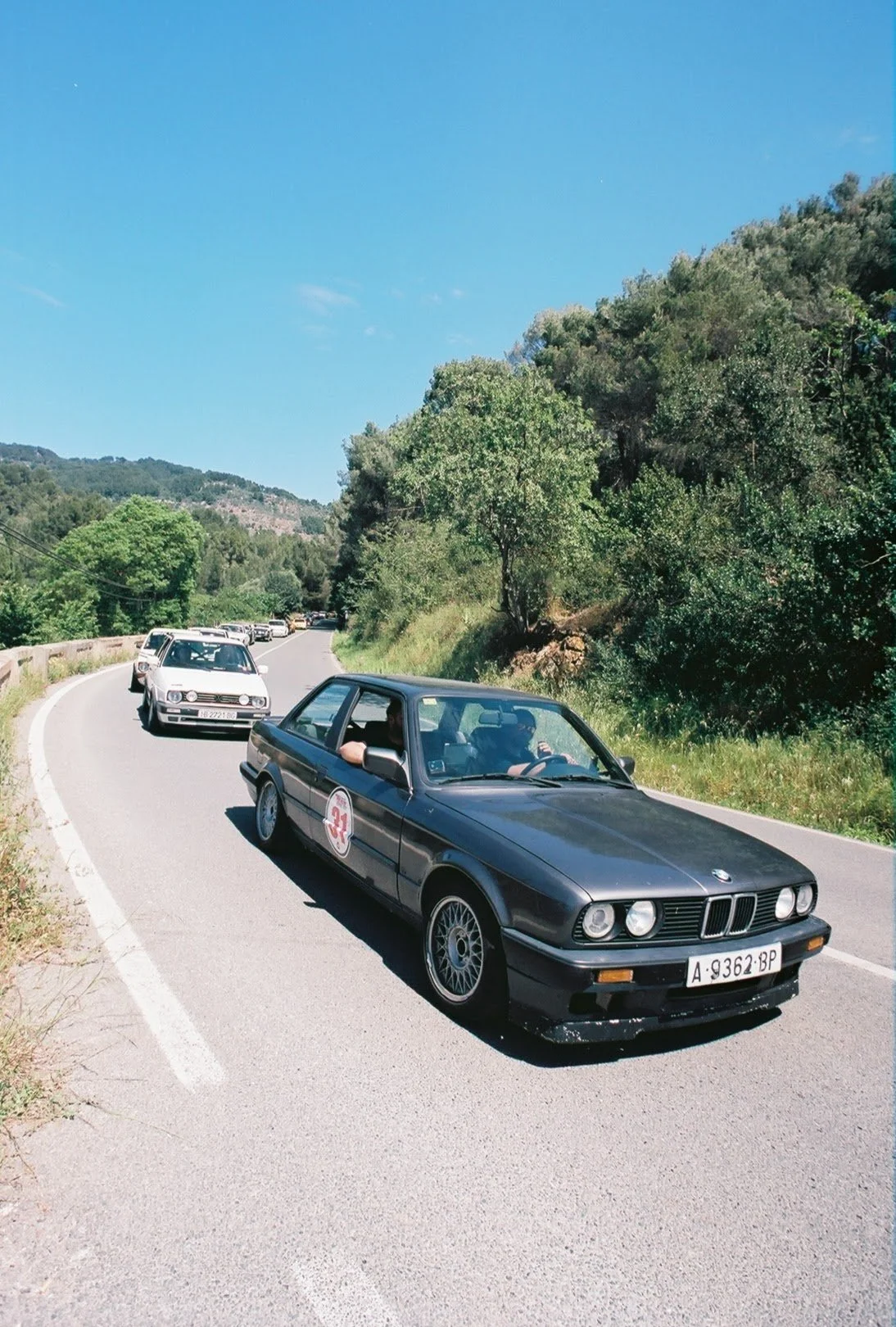
The ubiquitous E30, Soller, Mallorca, Nikon FE, 20mm Nikkor Lens, Kodak Ektar 100

Renault racer, Soller, Mallorca, Nikon FE, 20mm Nikkor Lens, Kodak Ektar 100
We would have the opportunity to drive the hill climb route as we left Soller a day or so later and I can confirm (despite the rather anemic engine in our rental) that this would have been an amazing route to race with sharp corners with an incredible amount of banking that should allow for high G’s and big grins. Perhaps I can arrange an arrive & drive on a future visit!
Our next stay would be a seaside resort in Cala St. Vincenc, but not before a brief stop to visit a friend in the beautiful village or Fornalutx -a gem of a location not to be missed on your way out of Soller!

Mallorca - First Taste of Spain
It was a last minute idea. From intention, to booking, to flight in less than two weeks. It’s not often one makes a significant career change, and this one warranted a few weeks abroad to rest and reset. Mallorca was not an obvious destination for us, coming from Vancouver where Hawaii or Mexico might be the more frequented, and frankly closer, destinations.
The Pool at La Residencia, Deia, Mallorca, Nikon FE, 20mm Nikkor Lens, Kodak Portra 400
It was a last minute idea. From intention, to booking, to flight in less than two weeks. It’s not often one makes a significant career change, and this one warranted a few weeks abroad to rest and reset. Mallorca was not an obvious destination for us, coming from Vancouver where Hawaii or Mexico might be the more frequented, and frankly closer, destinations. But shoulder season meant there were some amazing deals to be had, and if you’re going to spend the same money, why not try somewhere new? With that in mind and our 6 month old in tow, we created a simple plan; 2 weeks, 4 stays, 4 very different approaches to beautiful Mallorca.
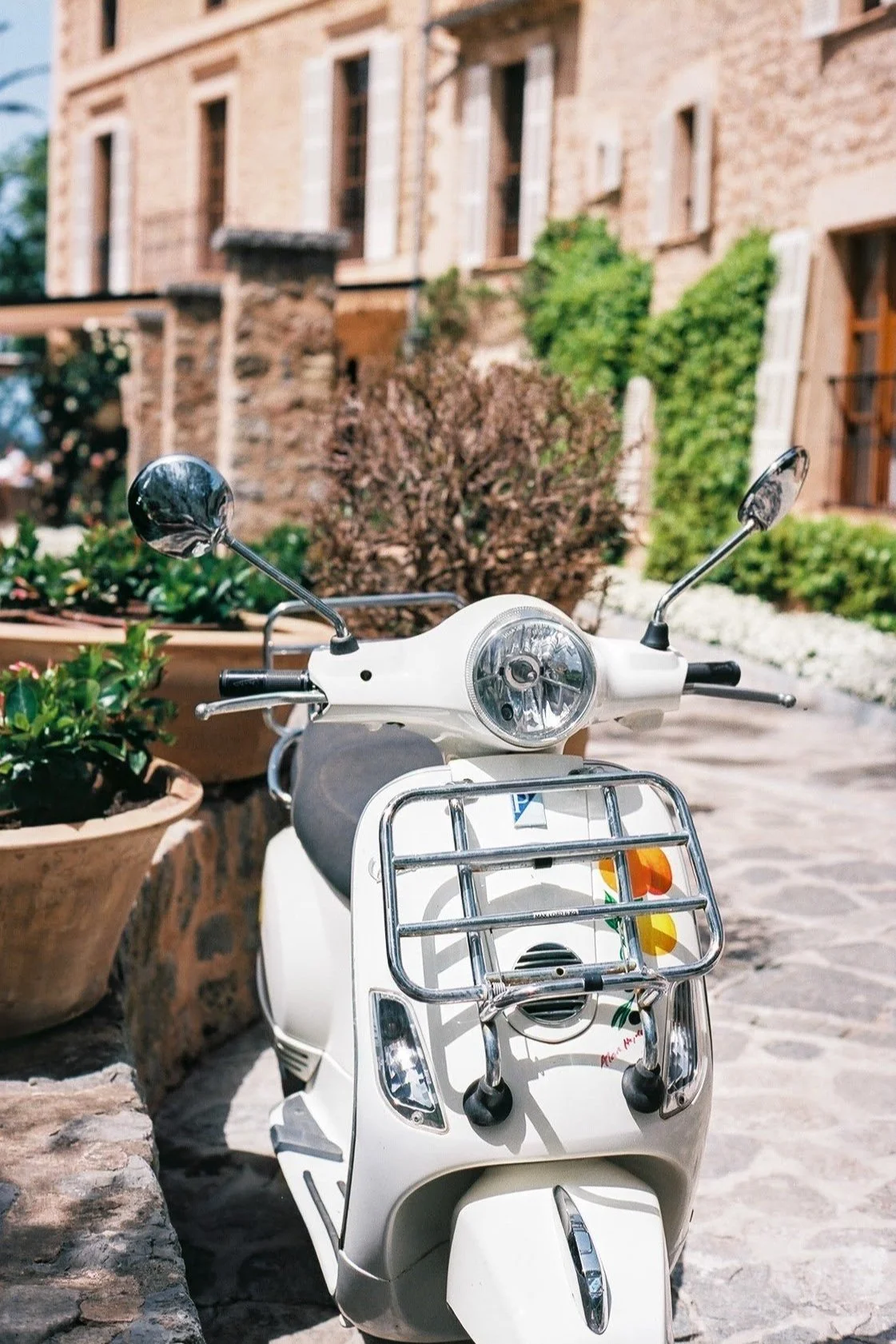
Tempting, but no baby seat. Deia, Mallorca, Nikon FE, 20mm Nikkor Lens, Kodak Portra 400
La Residencia
This one was my wife’s pick. Her reasoning? -You’ve worked your butt off for years, let’s treat ourselves and start with a real rest. Of course, our prior 6 months with our young son had been exhausting as well, so a touch of luxury was well earned by all. La Residencia sits in the beautiful valley-village of Deia on the western side of Mallorca. It’s about a 45min car ride from Palma airport depending how many cyclists are on the road -more on this in a later post. The hotel is owned by Belmond, a hospitality company dedicated to creating amazing experiences for it’s guests.
The history of the compound dates back to medieval times and has changed hands and purpose many times. It was most recently owned by Sir Richard Branson, before being acquired by Belmond (LVMH). The hotel blends luxury and exceptional service with ancient charm and architecture quite seamlessly as it’s myriad buildings seem to be chiseled right out of the hillside it occupies. A village within a village. Upon arrival, our bags are cheerfully grabbed by porters as the valet hops in to park the car and we are whisked off to the patio where champagne awaited. It took about two minutes of sitting, sipping, and listening to the live piano before I melted into my chair.
The patio at Cafe Miro, La Residencia, Deia, Mallorca, Nikon FE, 20mm Nikkor Lens, Kodak Portra 400
Reception waiting area, La Residencia, Deia, Mallorca, Nikon FE, 20mm Nikkor Lens, Kodak Portra 400
Our patio, La Residencia, Deia, Mallorca, Nikon FE, 20mm Nikkor Lens, Kodak Portra 400
A few glasses of champagne later we made our way up to our suite near the top of the property above the main pool and breakfast area. We were delighted to find a large room with a four post bed, private patio with a mountain view, a bottle of wine and some fruit and chocolate as well as a crib already setup for our son. Inside the crib, a toddler-sized branded canvass backpack for him with a stuffy inside -nice touch. It can be challenging to find accommodations such as these that permit young children, but here our son was welcomed warmly. There’s even a family center with activities for kids although our little guy was too young to take advantage of it this time around.
Part of the main road that bisects Deia, Mallorca, Nikon FE, 20mm Nikkor Lens, Kodak Portra 400
That first night we hadn’t made reservations so we decided to wander the town and find a place to eat. All three of us were jet-lagged, and I’m sure the little guy hadn’t the slightest idea what was going on. On the recommendation of the hotel we walked to Restaurante Sebastian in the center of the village. As we carried our little stroller up the three steps into the restaurant my first thought was “uh-oh” -I was the only guy without a sport-coat on, and there wasn’t another stroller in sight between the white linen covered tables. We were about to spin around and leave when the owner warmly greeted us and directed us to an open table. It was here we really realized what a family friendly culture we’d stepped in to in Mallorca. As we ordered our meal, the owner swept our son from his high-chair and began to show him around the restaurant stopping at various guest tables, and off to the kitchen to show the chef. The meal was a delight and the distraction for our son meant we could eat it in peace. Amazing.
This happened to us again on the second night when we ate at El Olivo on La Residencia’s property. In this case the waiter excitedly told us how he hopes to have a son like ours one day before whisking him off to parade around the restaurant. This certainly wouldn’t happen back home, but it was most welcomed!
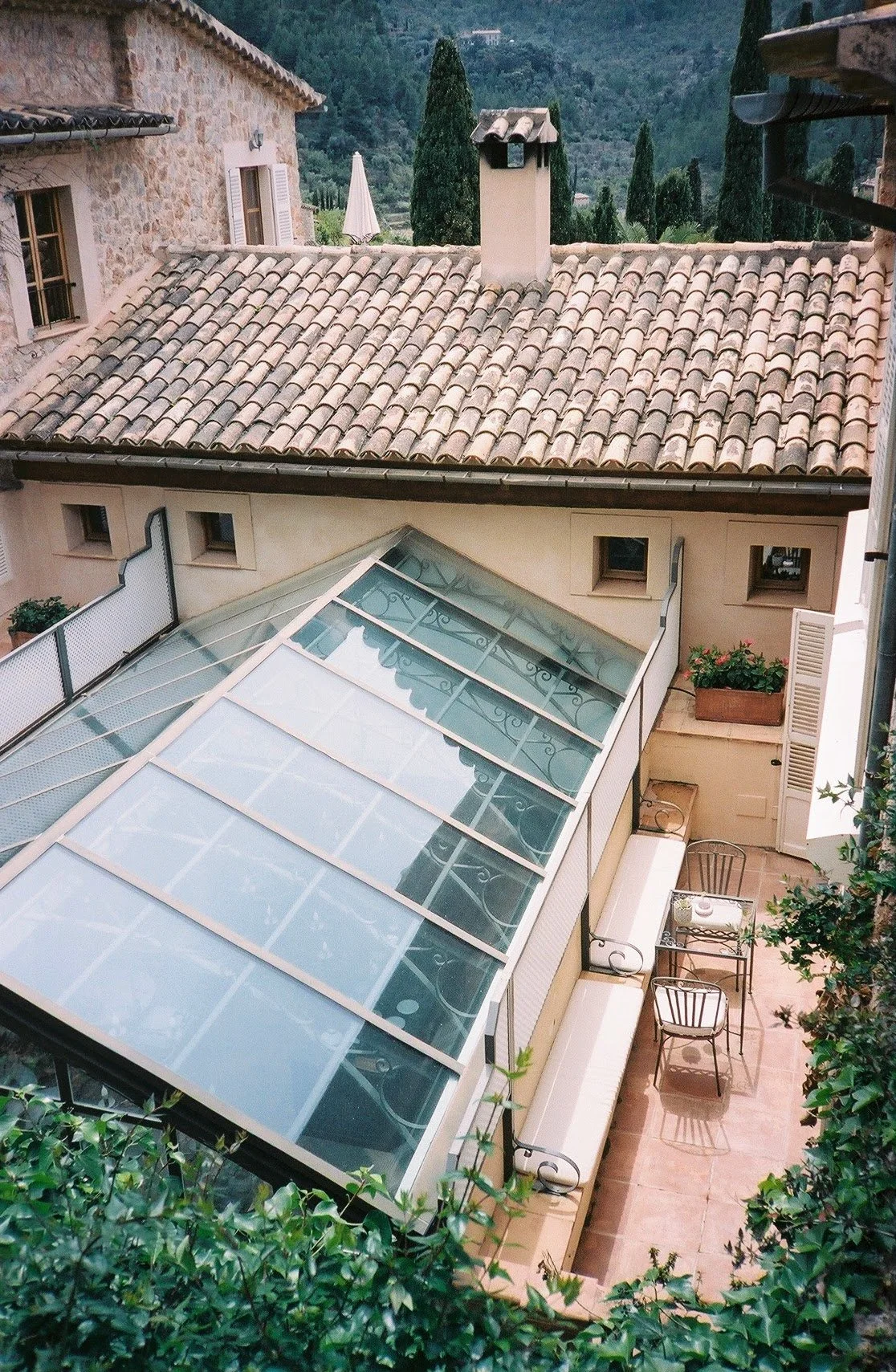
Looking down on Son Fony from our private yard, La Residencia, Deia, Mallorca, Nikon FE, 20mm Nikkor Lens, Kodak Portra 400
La Residencia’s property itself is massive, you could spend an entire morning just wandering the grounds as we did, and you might even stumble upon the resident donkeys!
Couple of locals, Deia, Mallorca, Nikon FE, 20mm Nikkor Lens, Kodak Portra 400
On the second day we were delighted to be invited to enjoy afternoon cocktails on the lawn by Thomas, general manager of the hotel. His passionate articulation of his vision for the future of the property -retaining it’s old-world charm while updating the rooms with more modern amenities- certainly has us looking forward to a return visit one day.
Terraced hillside of La Residencia, Deia, Mallorca, Nikon FE, 20mm Nikkor Lens, Kodak Portra 400
The indoor pool at La Residencia, Deia, Mallorca, Nikon FE, 20mm Nikkor Lens, Kodak Portra 400
Wandering Deia
Deia, and Cala Deia below it, is a gorgeous village nestled in a u-shaped valley with a small mount in the center. It is well known for art and ex-pats, in fact there are hardly any “locals” at all, with workers traveling here from other towns. It is in effect a ‘one-road town’, at least as far as cars are concerned, and like most of the Mallorcan coast, that road is winding with remarkably tight corners in places. I do recommend renting a small car to get here (and indeed most of the places we traveled on this trip), but once in town everything is walking distance. There are a few shops, cafes, and restaurants as you might expect, but it truly is a small village so don’t come expecting a lot more than that. Boutiques and galleries are hidden down many lanes and alleys, so be sure to venture off the main road and get lost a little.
If you make your way down a steep switch-backing road to the west of town you find yourself in Cala Deia, a tiny fishing cove with a rocky beach and locally famous seafood restaurant Patro March. The food was good with an excellent view of the cove. In the summer I imagine Cala Deia is an amazing place for a swim and day in the sun, but in April, it would be tough even in a wetsuit! I tried regardless, but got out pretty quickly.
Deia, Mallorca, Nikon FE, 20mm Nikkor Lens, Kodak Portra 400
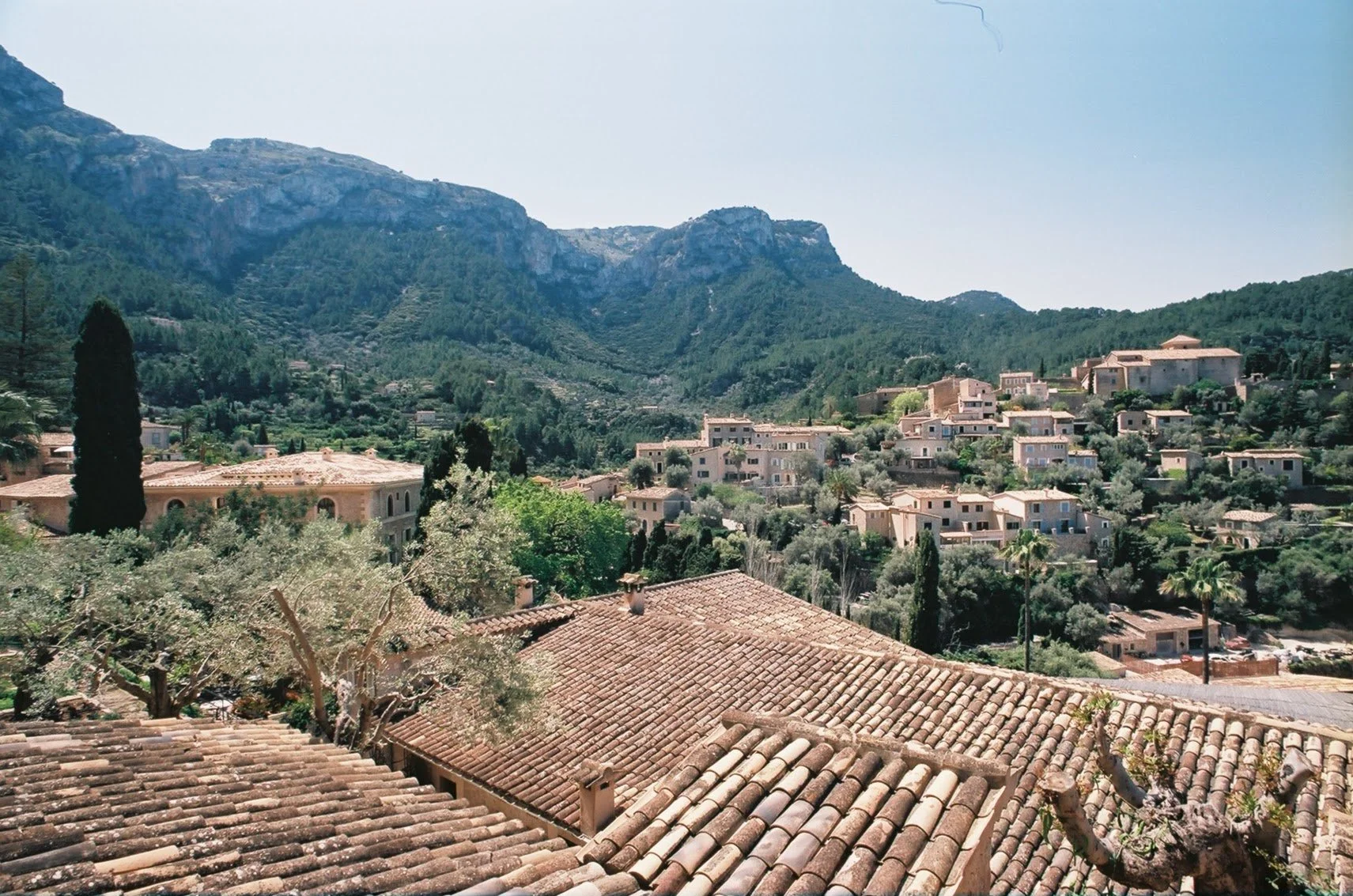
Deia, Mallorca, Nikon FE, 20mm Nikkor Lens, Kodak Portra 400
Deia in the hazy morning light, Mallorca, Nikon FE, 20mm Nikkor Lens, Kodak Portra 400
Thankfully it’s a light stroller! Deia, Mallorca, Nikon FE, 20mm Nikkor Lens, Kodak Portra 400
Box of Fruit, Deia, Mallorca, Nikon FE, 20mm Nikkor Lens, Kodak Portra 400
“Boutiques and galleries are hidden down many lanes and alleys, so be sure to venture off the main road and get lost a little.”
The main street through Deia, Mallorca, Nikon FE, 20mm Nikkor Lens, Kodak Portra 400
There’s only one route up the west coast, so every town becomes a tourist stop. Deia, Mallorca, Nikon FE, 20mm Nikkor Lens, Kodak Portra 400
It gets narrower. Deia, Mallorca, Nikon FE, 20mm Nikkor Lens, Kodak Portra 400
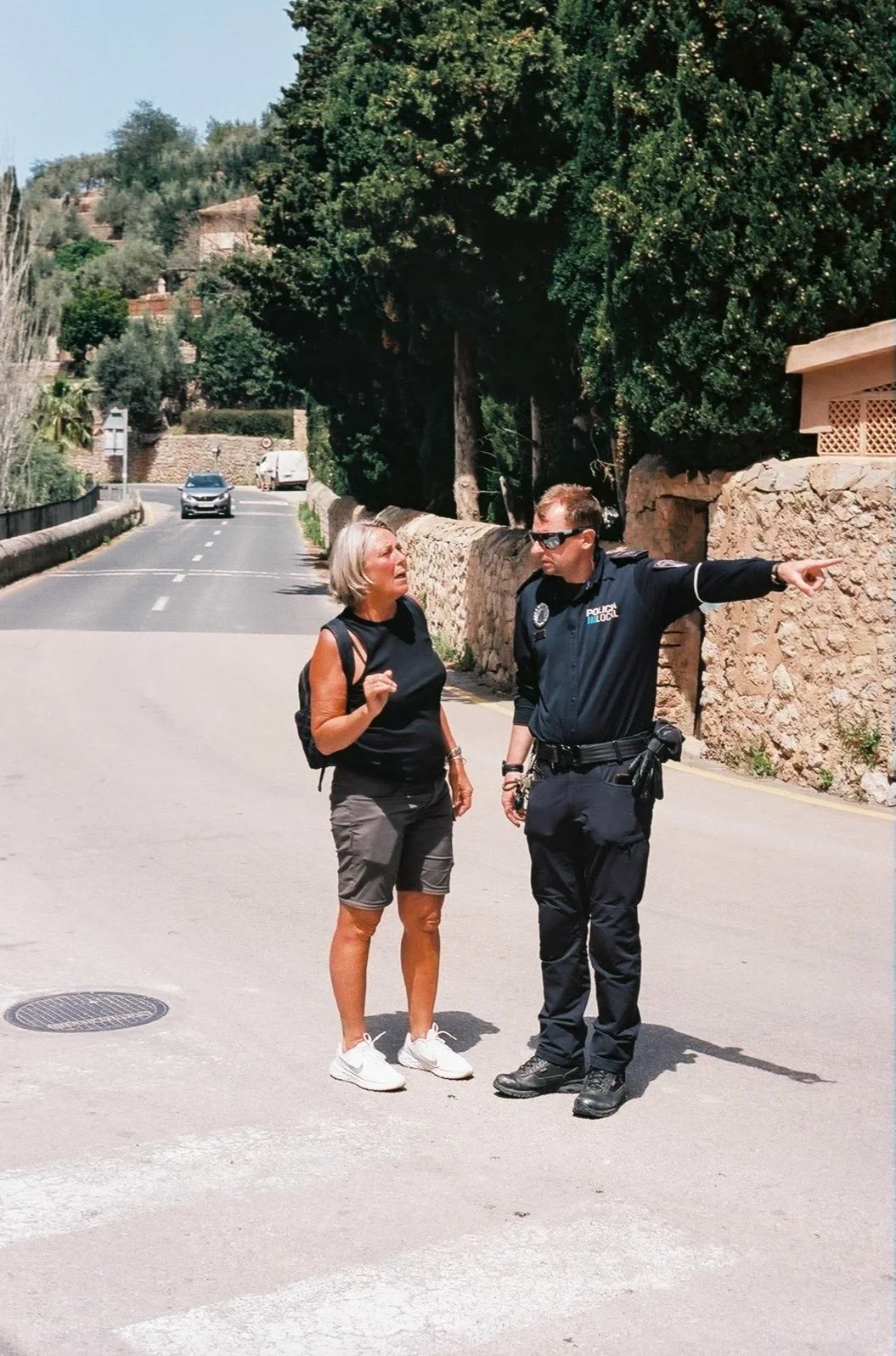
He didn’t seem enthused about giving directions. Deia, Mallorca, Nikon FE, 20mm Nikkor Lens, Kodak Portra 400
Wandering Deia, Mallorca, Nikon FE, 20mm Nikkor Lens, Kodak Portra 400
La Residencia, Deia, Mallorca, Nikon FE, 20mm Nikkor Lens, Kodak Portra 400
Parting Thoughts
You could cover Deia in half a day, but stay at La Residencia for much longer. Four nights suited us best, and while we were sad to go, we knew we had a lot more to see ahead. From here we’d be heading to Soller, just a winding half hour further up the coast from Deia. We set the bar pretty high (again) at the beginning of our trip, how would our next destination on the island compare?
Spend the day sitting here? Don’t mind we I do. La Residencia, Deia, Mallorca, Nikon FE, 20mm Nikkor Lens, Kodak Portra 400

Japan - Epilogue - Travelling with Film Photography
One Camera, one lens, and one film stock. That’s where we started this first photographic sojourn to Japan. A fitting assignment, I think, considering the countries’ own reputation for blending the new with the old. What follows is a few of my learnings for would-be film photography travelers.
Temple complex in Kyoto. Praktica LTL, 50mm Meyer-Optik Domiplan Lens, Kodak Portra 400,
First Trip Abroad with Film
One Camera, one lens, one film stock. That’s how I approached my first trip abroad shooting film. A fitting assignment, I think, considering the countries’ own reputation for blending the new with the old. What follows is a few of my learnings for would-be film photography travelers. Of course, I’m an enthusiastic amateur rather than a pro, so take what you like, throw away the rest, and share your own thoughts in the comments at the bottom!
Harbour View in Wakayama, Praktica LTL. 50mm Meyer-Optik Domiplan Lens, Kodak Portra 400
Read the full Japan series:
Tokyo → Kanazawa → Koyasan → Hiroshima
The Camera
I chose my camera for this trip based on availability and price. Availability being immediate, as I found it in dad’s basement, and price being free for the same reason. I’ve subsequently picked up quite a number of other film cameras (Gear Acquisition Syndrome is real, folks) and my go-to film camera for travel has shifted to the venerable Nikon FE with an Olympus XA as back-up. Regardless of what camera you bring, from TLR to Point & Shoot, it’s a good idea to develop some proficiency with it before leaving for your trip. This includes challenging weather and lighting conditions and different film stocks in order to learn what the output looks like in each case.
The Praktica being fully manual, albeit with an effective light meter, it was easy to get things wrong in the panic of trying to capture a decisive moment. I only put a couple of rolls through it before leaving for Japan and that was probably a mistake. Investing more time in advance would likely have meant more “keepers” on the trip itself. Here are some other tips related to choice of camera:
Simpler, in general, is better: Film Cameras are aging, and in some cases that means failing. This is more of a problem for point & shoots which rely on electronics and servo motors that are starting to get beyond their “best before” date. A mechanical shutter and focus system, if well maintained, should last a very long time, and in many cases are repairable. An SLR and a point & shoot in combination could make a mighty pairing.
That said, does it have shooting modes? Later film cameras benefitted from better light meters and electronics that allowed them to shoot in semi auto modes such as Aperture priority. This can help take one more item off your mind to allow you to concentrate on focus and framing. The Praktica is fully manual with stop-down TTL metering, but my Nikon FE shoots aperture priority when in “auto”. I never use that feature, however; as I find it has a tendency to overexpose when doing so.
A bright viewfinder: Traveling can mean shooting in challenging lighting conditions, can you see the light meter in your viewfinder, or confirm your focus? This was something I took for granted when I started this trip, and luckily the Praktica performed well, although occasionally I’d loose sight of the black exposure needle in lower light situations. The light meter lever moves slowly on the Praktica, so a trick I learned was to quickly point towards something bright and see where the needle was before it jumped. Far from perfect, but it did help on some occasions.
Pick the package: Do you want to carry a bag of lenses and stuff? Or, are you comfortable that you can shoot with one lens and make the most of it? (potentially saving a fair bit of weight in the process) I’ve done it both ways, there’s no right or wrong answer here. Sometimes the tyranny of choice gets in the way, others you might find yourself thinking “if only I had a wide angle…”. Err on the side of simplicity for your first time out. If you are shopping for a bag to carry your equipment, by the way, this one by Peak Design is my favorite.
Are the batteries still available: Do some quick research on the type of battery the camera you’re considering purchasing uses. There are some where the original battery no longer exists, although people have found workarounds in some of these cases. Check the battery compartment for corrosion as well!
Hiroshima Cyclist, Praktica LTL. 50mm Meyer-Optik Domiplan Lens, Kodak Portra 400
What to pack
Here’s a quick list of what I’m packing with film photography in mind on a trip:
Basic Cleaning kit: A puffer, brush and some dedicated wipes are really all you need. I often have one of those cleaning “pens” in my bag as a matter of course.
Spare Batteries: I have literally used the same batteries that came in most of my film cameras for years now. In general, they just don’t drain much power. That said, and especially if you bought yours with a battery of unknown provenance, grab a couple of spares. They add no appreciable weight, and you may not find them if you need them where you’re headed.
Film: How much, what brand, what iso, color or black & white are all factors to consider.
If I’m going somewhere bright and sunny (or at least, I hope it is when I get there) I’m typically comfortable going with ISO 400 or even lower to something like an Ektar 100. Keep in mind if you still have half a roll of 100 in the camera when you’re heading out for a night on the town, you’re likely leaving that camera at your accommodation. It’s tempting to go low ISO for landscapes, however; when you’re aiming for minimal grain and beautiful color rendering.
I’m more accustomed to shooting color than b&w, so that’s my first choice. That said I have done b&w only trips, and it can make for an engaging project that might just challenge how your look at the world and light in particular. There is some glorious b&w film out there to try out, including my current favorite, Ferrania’s gorgeous P30.
Film brands are a matter of taste. For some reason I’ve gravitated to Kodak for color but given I’m partly colorblind, your mileage may vary! I do note it’s quite consistent from roll to roll, as is Fujifilm. With some niche brands I’ve found occasional issues with the emulsion that seem like bubbles or waves in the edges of the image.
Spare Camera: Not required, but it’s a way of overcoming some of the issues noted above. For example, the venerable Olympus XA which I once wrote an article on for Emulsive (here) is tiny and pocketable with a stunning lens. I don’t mind bringing that along with a different film stock in it, such as a black and white or low ISO option. Or, perhaps pack a digital point & shoot? There’s no sticking to dogma on this blog, so I certainly won’t judge you for mixing mediums, many pros do just that!
Tripod: I’m yet to travel with one but even just writing this article I’m realizing what a good idea it is, if you can make the space. A lightweight tripod could be extremely helpful when you have lower ISO film in your camera and sub-optimal lighting.
If I had to pick one lens: All of my Japan photos were taken on a cheap and cheerful 50mm Meyer-Optik Domiplan f2.8 lens. The 50mm focal length is generally regarded as quite versatile, but with this particular lens sharpness definitely suffers the more open the aperture. The photos remain quite pleasing despite that weakness (wabi-sabi, I think, is the Japanese term I’m looking for here), with an almost dreamlike quality to them and enjoyable bokeh. So, would I use that one again? Not exclusively. I’ve gotten wider with age (ha!) and would probably pick a 35mm if I were to only take one. I have done trips with a 20mm Nikkor f3.5 on my Nikon FE and that can get addictive as well. What should you take? Provided you’ve had a bit of practice with it/them there really isn’t a wrong answer.
Dreamy Vision of Gardens in Kanazawa, Praktica LTL. 50mm Meyer-Optik Domiplan Lens, Kodak Portra 400,
The Airport
Don’t stress. We’ve all heard about the dangers of airport x-ray scanners to film. In reality, with anything under 800 ISO I haven’t seen any issue, despite even two or three passes through x-ray machines. That said, if you can avoid it, why not try?
Be Polite: Easy, right? The security clearance staff have no doubt heard the argument before about damaging your film. Most would roll their eyes but if I was humble in my request, and there wasn’t a crazy huge security line, they’d often hand-check my bag of film. It’s important to have it ready before they ask, and organized in a clear plastic bag. Japan, China, Spain, Slovakia, Croatia, even London Heathrow hand checked my film when I asked nicely. The only time I was flatly refused was Vienna airport. You win some you lose some.
The Burner Roll: I don’t recall where I learned this technique, but essentially you choose a sacrificial roll of high ISO film (Ilford Delta 3200 for example) and ensure it’s prominent in your film bag. High ISO film will not tolerate xray machines and in some airports there’s even signage saying so. Displaying this to the security team may get you an extra ounce of sympathy to get a hand-check of your entire film collection.
Airport Security asking me to take a photo to prove the camera works…I never did mail them the photo. Praktica LTL. 50mm Meyer-Optik Domiplan Lens, Kodak Portra 400
The Routine
In the morning, I’d look to see how many shots I had left on a roll and typically plan to take an extra roll or two with me depending on how long we were going to be out. Speaking of the roll, while most rolls of 35mm film are designed to give 36 shots, I’ve often found I can get 2, 3,+ more if I’m careful about how I load my film. Once it’s engaged I’d give the film advance one full click then shut the rear, then one full click more and start my shooting. Occasionally you’ll end up with a “first of the roll” image with a partial light burn on the side, but this can actually make for an interesting effect (or happy accident). Ensure you feel some resistance in your film advance. I’ve been lucky to only once shoot an entire roll only to find out it didn’t properly catch and I got exactly zero images out of it.
With film photography, there’s no checking if the photo turned out, just shoot and go. Obviously, there’s risk in this, but I feel it also unencumbers me, allowing me to be more present in the moment and leaving capacity to maintain my attention on the world around me to look for the next opportunity that catches my eye. Many digital cameras allow you to switch preview off (or like the X-Pro 3, hide the screen), so this isn’t exclusive to film but it certainly eliminates the temptation. The pitfall of this is the lack of immediate quality control. There’s no reminder or feedback for potentially forgetting to check some key settings before taking your photographs. For example, whether your ISO is set correctly for the film you’re using. When shooting a single filmstock it’s a non-issue, but swapping between different films it’s easy to forget to change the ISO accordingly.
Depending on the length of your trip and your workflow when you get home, it can be quite some time before you review the pictures you took and by then you can forget a lot! Immediately sort and label your images when you receive/create your scans. I also generally try to take notes in a little notebook to remind me where I was, or which film and camera I was using. I’m beginning to sound like an analog snob…
Kyoto Streets, Praktica LTL. 50mm Meyer-Optik Domiplan Lens, Kodak Portra 400
Getting the most out of your photos
If you develop your own film, I take my hat off to you. I have neither the time nor enough skill to be confident in doing so, yet. I’m fortunate to have a lab in Vancouver that I trust for developing, printing and scanning my shots (Rocket Repro), and there are also great mail-in services still available in North America and no-doubt other continents. I don’t print every shot on every roll, rather I review the scanned copies and then decide what I’d like to do with them. I’ve printed a number of sizes and formats from simple 4x6, to a roughly 37x72 landscape that hangs in the dining room. I also enjoy creating photobooks (thus far using google photo) and do flip through them often. Film photos look glorious printed though, so I do strongly encourage doing so. It’s what they were always meant for.
In any of these cases you should prepare to do some minor editing depending on the result of your scans. A high quality scan still isn’t going to be as malleable as working with a RAW file, but you’d be surprised what you can recover in highlights and shadows. It’s generally easy to recover a slightly over or under exposed image. It feels pretty great though when a roll comes together with a great scan and almost/no editing at all is required. This is a neat facet of shooting with film in the modern era, your “presets” are already dictated by the filmstock you’ve chosen!
A lesson I learned from my friend Farzaan at fcracer.com in his post here, is not to shy away from cropping photos. While most images I share in the same format as the image comes out, there are definitely cases where a well thought out crop can demonstrably improve an image, or perhaps, align it more so with the photographers’ vision. The effective digital resolution of a 35mm film image is quite high so you can safely crop a fair bit. I’ve read it can be anything from 21MP to 80+MP, depending on the film and scanner used, but there seems to be a lot of debate on the topic and needless to say, film photography is not for pixel peeping. Some labs will offer a higher resolution scan for large printing purposes, but the cost to do so increases significantly from a standard scan. Keep your negatives, and if you find a keeper you’d like to enlarge and print, have the lab re-scan the specific image at high resolution to maximize your subsequent print quality.
Temple Complex in Kyoto, Praktica LTL. 50mm Meyer-Optik Domiplan Lens, Kodak Portra 400
The People
There’s a delightful tactile experience to using a manual film camera. It’s not unlike the appreciation for mechanical watches over digital. Anachronistic, sure, but special and still remarkably capable. You can tell by the nods of appreciation from certain passers by when seeing what’s hanging around your neck that film photography still carries a special places in many hearts. That connection, particularly when you meet another film photographer “in the wild” can make for great conversations and experiences, so don’t shy away from making those connections when you can!
Taking photographs of people, be they locals or other tourists can add more dimensions of context to your travel photos. No difference conceptually here between film and digital, but be mindful that some film stocks are better suited to candid portraiture than others. As always, check local laws and customs on photographing strangers in public and smile when taking the photo.
Harajuku, Praktica LTL. 50mm Meyer-Optik Domiplan Lens, Kodak Portra 400
The Cost
In a recent video, street photographer Samuel Lintaro Hopf mentions that Kodak is increasing the price of it’s film by up to 40%, apparently in response to it’s skyrocketing popularity and low supply. This highlights just a part of the increasingly challenging economics of shooting with film for amateurs. It’s pretty easy to calculate the cost per image, factoring in the cost of a roll of film plus the cost to develop & scan. Even film camera prices are inflated, though I find local online peer to peer marketplaces generally are the best places to find a deal followed by local shops with used and consignment items that in some cases are even tested.
I choose not to do the math, only because I prefer not to associate each click of the shutter release with a dollar amount. But ultimately, it would be foolish to ignore it entirely. For candid family snaps, picnics, and life around the house I’ll rarely take a film camera out; choosing instead the versatility of Fujifilm’s excellent Xpro-2, or even my cellphone in a pinch, though the latter is my least favorite way to capture an image. Like any hobby, you must decide what it’s worth to you, and budget accordingly to enjoy it. Many photographers I follow still work with both film and digital depending on the project they’re working on, or indeed what they feel will get them motivated creatively that day.
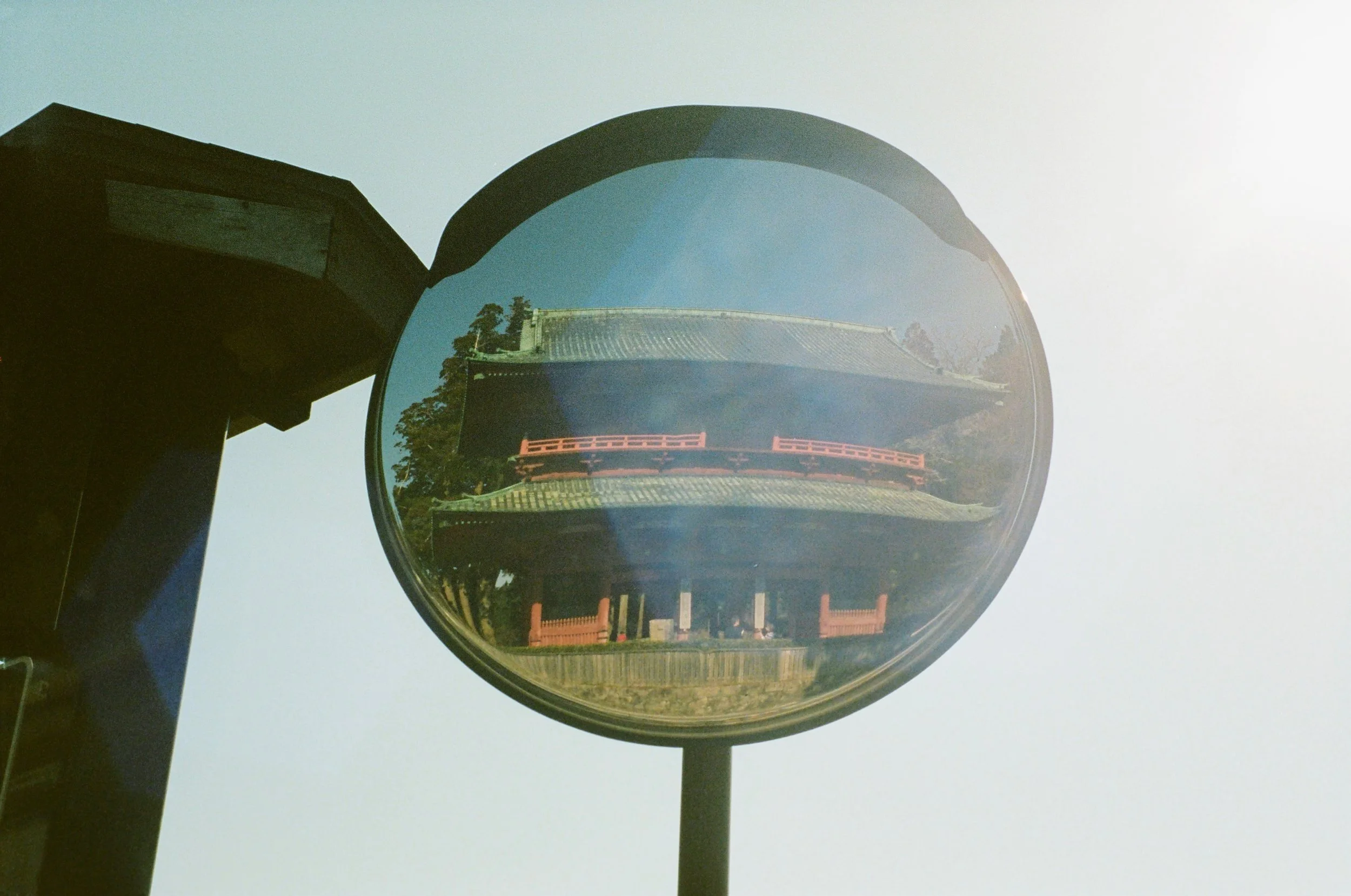
Daimon Gate reflected in a traffic mirror, Koyasan, 50mm Meyer-Optik Domiplan Lens, Kodak Portra 400
I’ll be Back
I hope you’ve enjoyed this short series on Japan, as well as my experience on this first trip abroad with film photography. As always, I welcome your comments and ideas, and most of all hope I’ve provided some inspiration to visit these places and share the images you capture there. At the time of writing I’m planning another trip back to explore more of this beautiful country. What camera will I take on my next travels there? Film and/or digital? Well, I may not be able to help myself this time as I’ll certainly be taking more than one, but a hint would be that Daido Moriyama had some influence on my decision, and it’s going to be fun.

Hiroshima - Japan
I was at times perhaps too stingy with my shooting, and other times I felt compelled to snap a photo of some okonomiyaki. In time I’d develop a rhythm (and tendency to overpack) to my shooting that freed me to shoot unencumbered by worry of running out out of film.
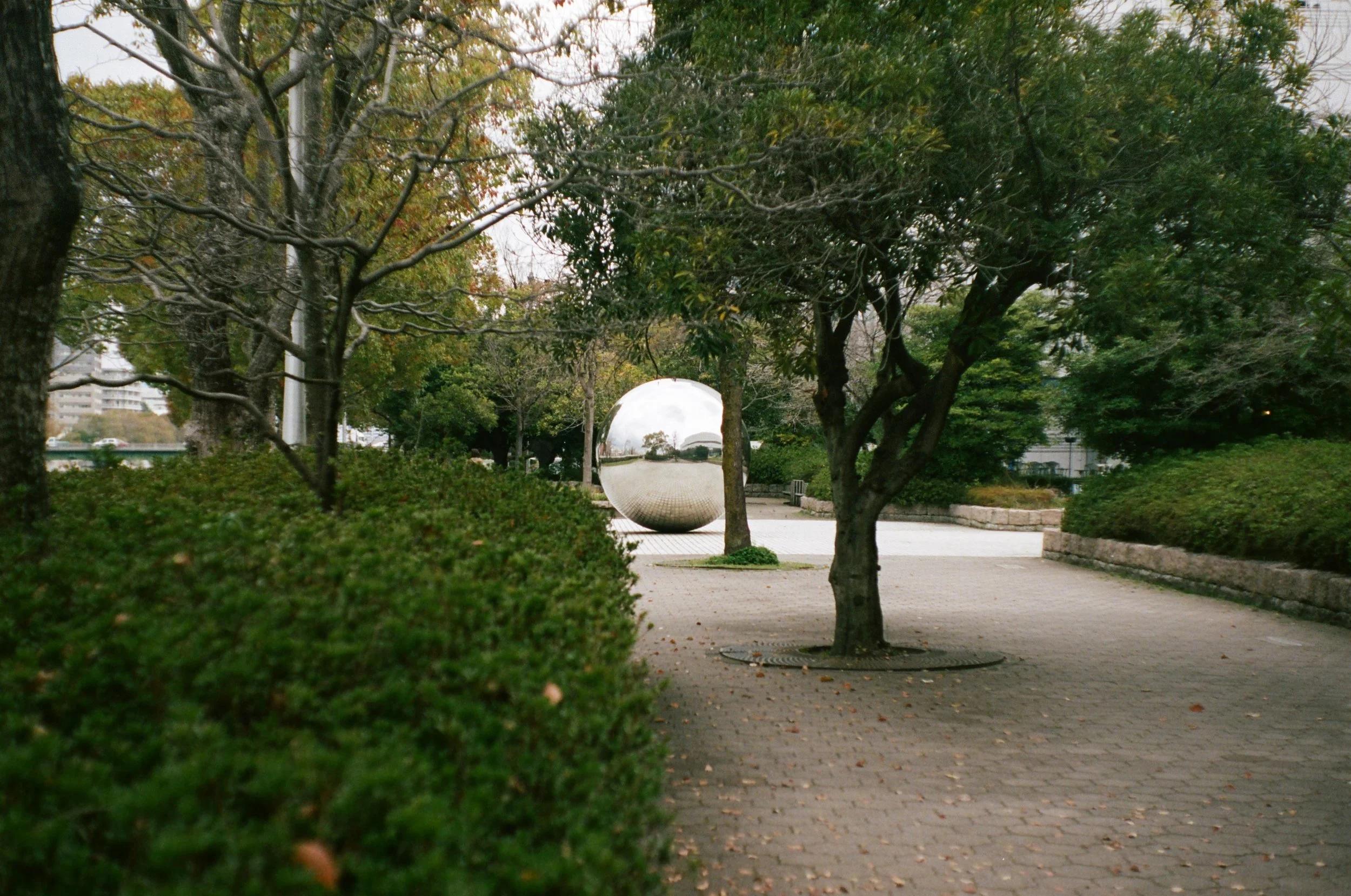
Orb in Hiroshima. Praktica LTL. 50mm Meyer-Optik Domiplan Lens, Kodak Portra 400
Humidity & Hope
Read Previous Part III: Koyasan, Japan →
After our serene visit to Koyasan, our group spent a night in Wakayama taking in the palm trees, ramen and huge public onsen, before boarding another train for our final destination, Hiroshima. It’s a name we’re all familiar with from history class, but what’s it like to visit today? Could a city with such a sad history enjoy a bright future?

Cycle commuter in Hiroshima, Praktica LTL. 50mm Meyer-Optik Domiplan Lens, Kodak Portra 400
Of course having done my research I knew that I’d find a vibrant city with a bustling economy, arts scene, food scene and everything else you’d expect of a major urban center. What amazed me was that being there, if you didn’t know when you arrived about the city’s terrible demise in the second world war, there’s not much to give away it ever happened.
Unlike the rest of the stops on our Japan trip, Hiroshima was already hot and humid in early spring. We were sweating within minutes of leaving our door in the morning. That, coupled with this being the tail end of our trip, made for a fairly relaxed pace and wandering more centered on “Where do we eat next?” than “What do we see next?”. Hiroshima is a treat for foodies (most of Japan is, really) so whether it was pastries at patisseries or katsu at a corner shop, this was the stop that was going to pack on the most weight for our crew. It’s a large city, but well served by a bus and trolley system that is easy to navigate. We rented an apartment just outside the city core, which was conveniently located on a trolley line that took us right where we’d want to go within minutes.
With the humidity came a thick layer of cloud and since I was committed to ISO400 I found myself having to shoot at fairly open apertures to allow for a quick-enough shutter speed to minimize blur. My film stock running low, I decided to focus more with my eyes and less with my lens but still grabbed the occasional snap as something caught my eye. Although I knew at this stage that film is readily available in Japan, limiting the number of shots I could take to the rolls I brought with me made for an interesting project and challenge. I was at times perhaps too stingy with my shooting, and other times I felt compelled to snap a photo of some okonomiyaki. In time I’d develop a rhythm (and tendency to overpack) to my shooting that freed me to shoot unencumbered by worry of running out out of film.
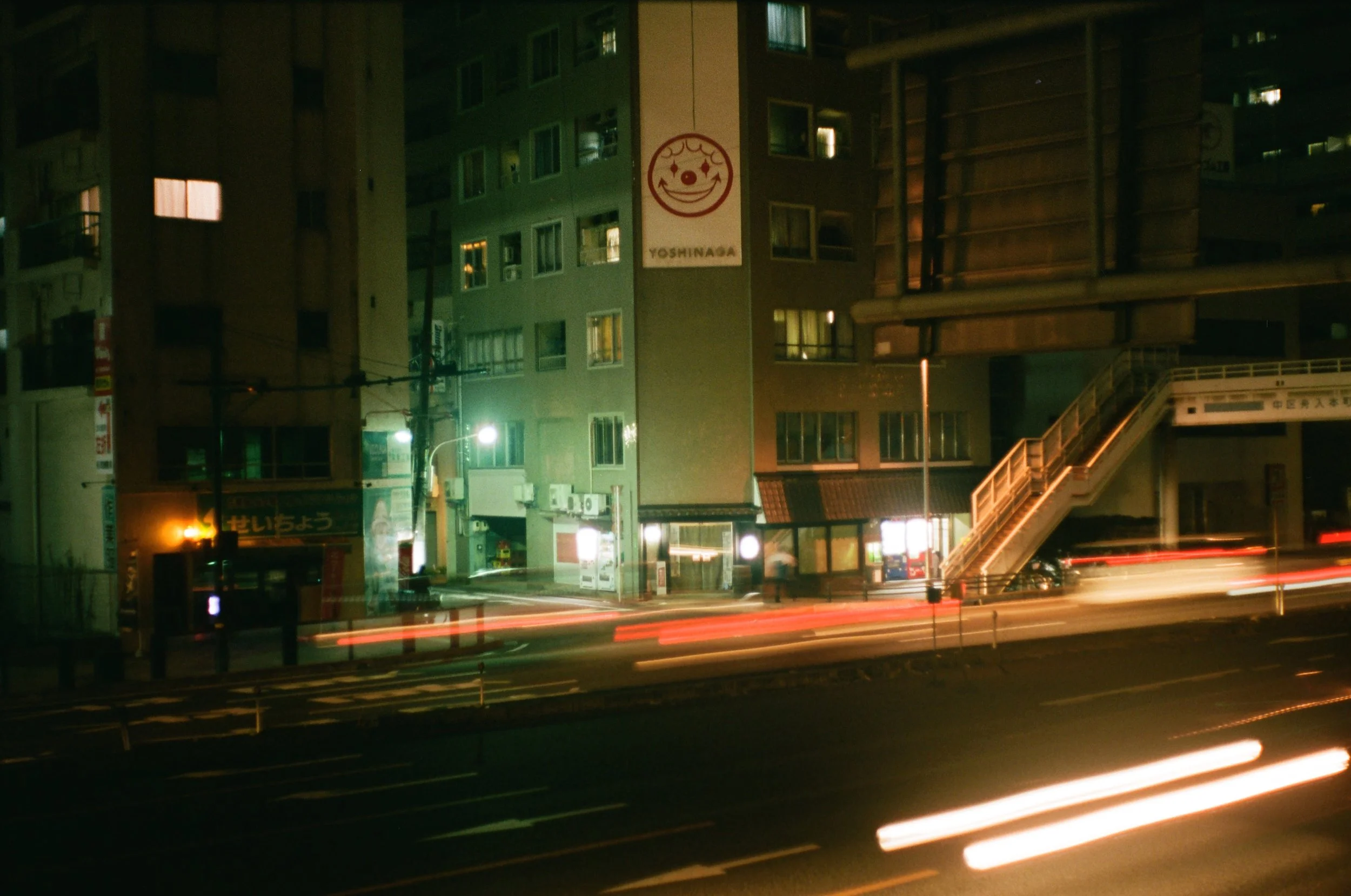
Outside our window. Praktica LTL. 50mm Meyer-Optik Domiplan Lens, Kodak Portra 400
““I was at times perhaps too stingy with my shooting, and other times I felt compelled to snap a photo of some okonomiyaki.””
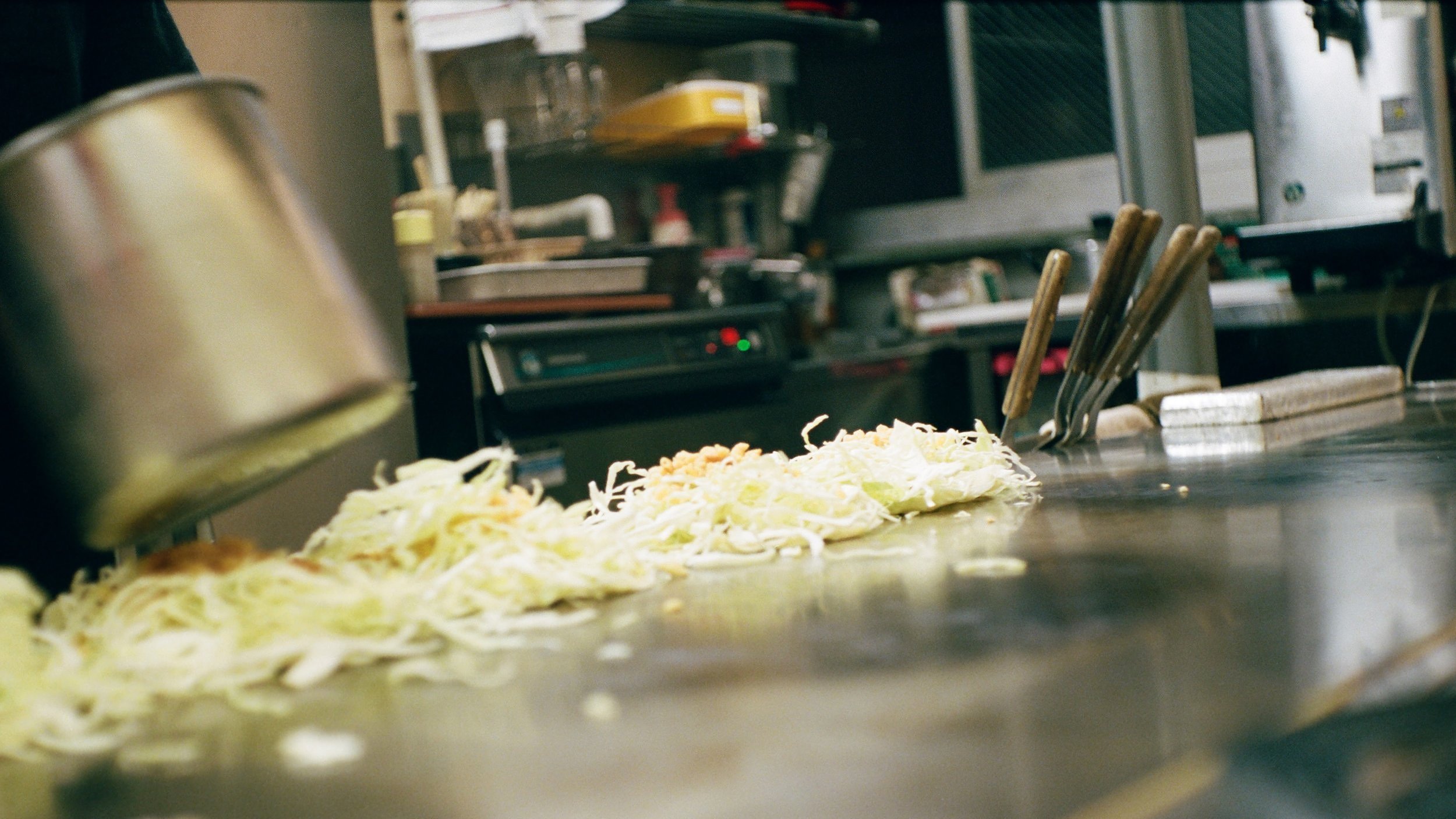
Hiroshima’s Famous Okonomyaki on the way. Praktica LTL. 50mm Meyer-Optik Domiplan Lens, Kodak Portra 400
Playing with bokeh, Praktica LTL. 50mm Meyer-Optik Domiplan Lens, Kodak Portra 400
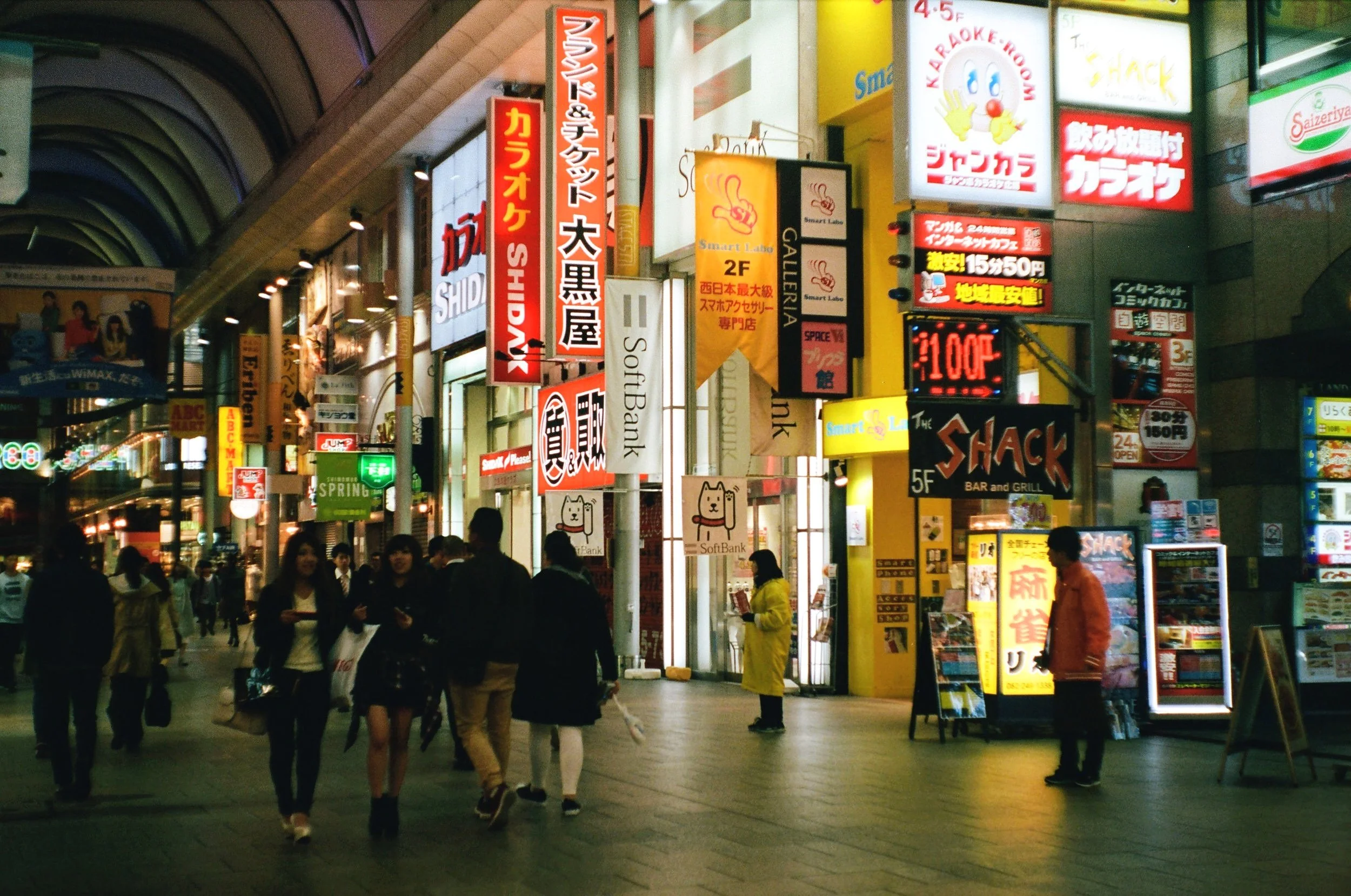
Trying to keep the camera steady while shooting at relatively low ISO and manually focusing. Praktica LTL. 50mm Meyer-Optik Domiplan Lens, Kodak Portra 400
The Bomb
I suppose one can’t really visit Hiroshima without speaking about it’s history with “the bomb”, and perhaps it would be rude not to. The recovery of this city from utter devastation at the end of the second world war is remarkable. It gives me hope that even after the darkest of times humanity can still flourish. One of my main objectives in visiting Hiroshima was to tour the Hiroshima Memorial Peace Museum. Walking through its maze of halls and galleries with detailed dioramas, relics, audio clips and video interviews of survivors, your mind is assaulted by a single thought; why does our species keep doing this? The answers aren’t here, but the opportunity for observation and reflection this atmosphere fosters is more than worth the price of admission. It’s things you’ve learned in books brought closer to life, to reality. Things you are cognizant of but likely haven’t felt (if you are lucky, as I am, to live in a place far from war) until you’ve experienced it in this thoughtfully curated immersion. If you can make it out of the building without shedding tears, you’re made of sterner stuff than I.
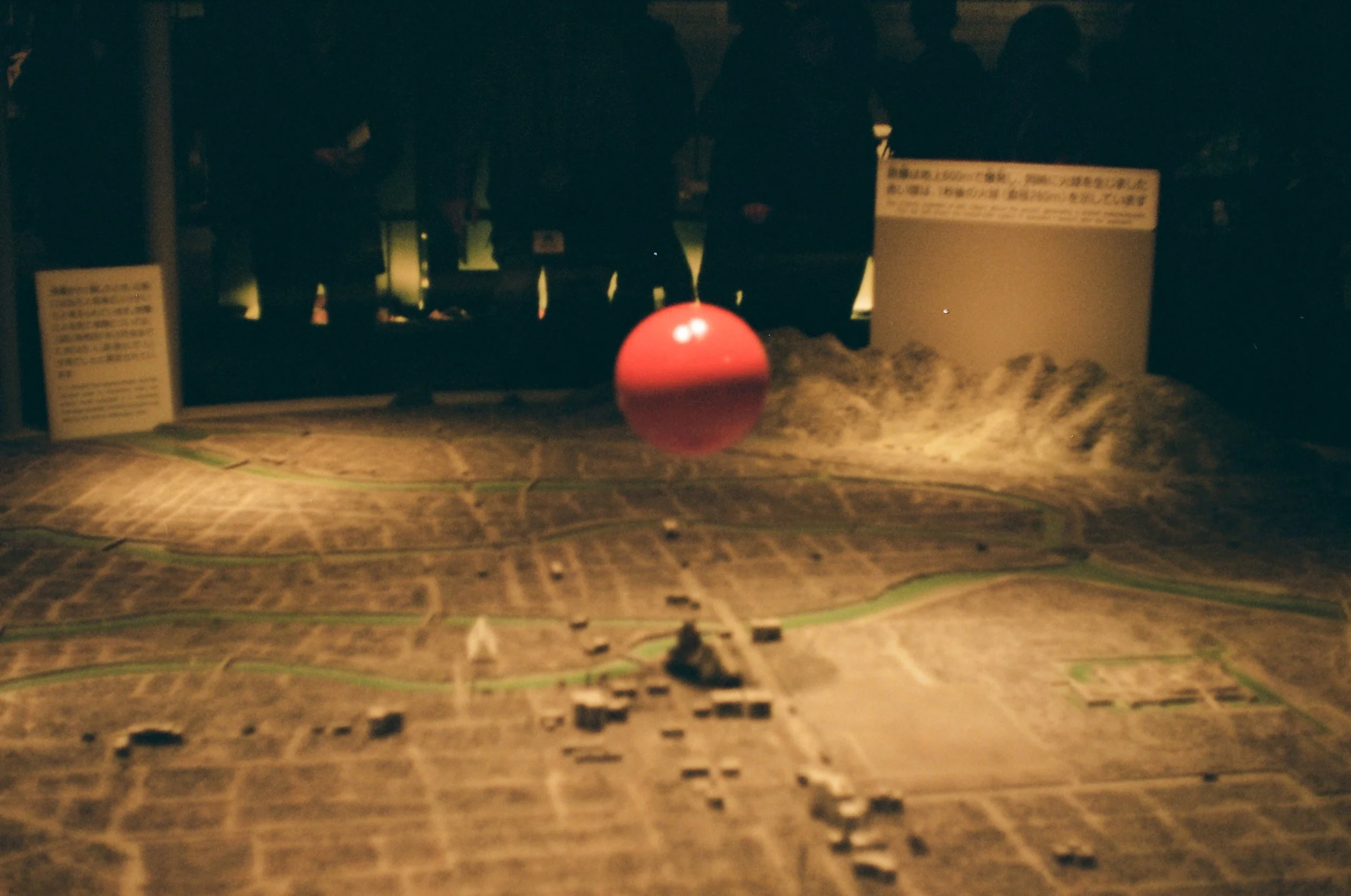
The Bomb, one of many dioramas at the museum. Praktica LTL. 50mm Meyer-Optik Domiplan Lens, Kodak Portra 400
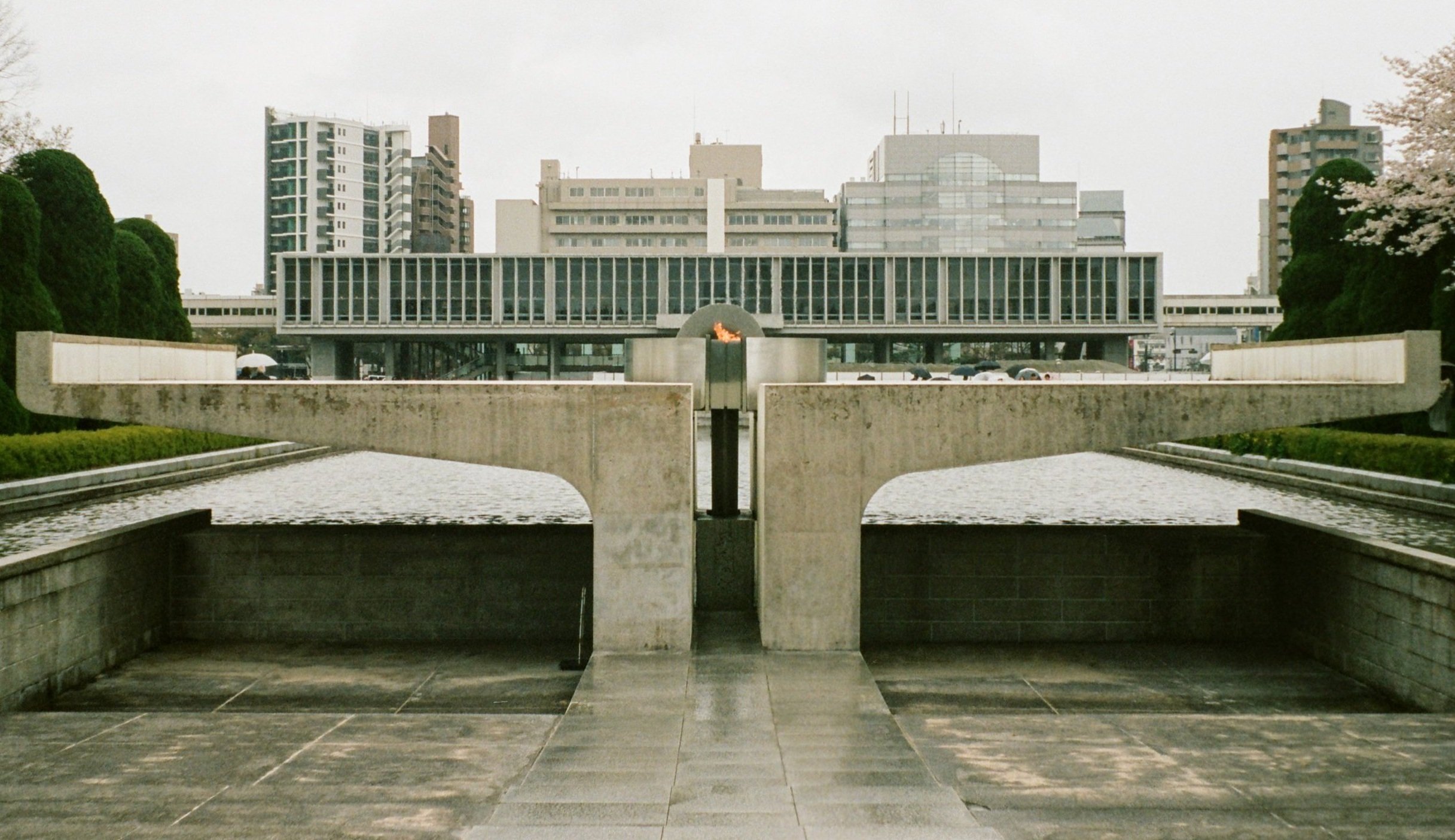
Hiroshima Memorial Peace Museum, Praktica LTL. 50mm Meyer-Optik Domiplan Lens, Kodak Portra 400
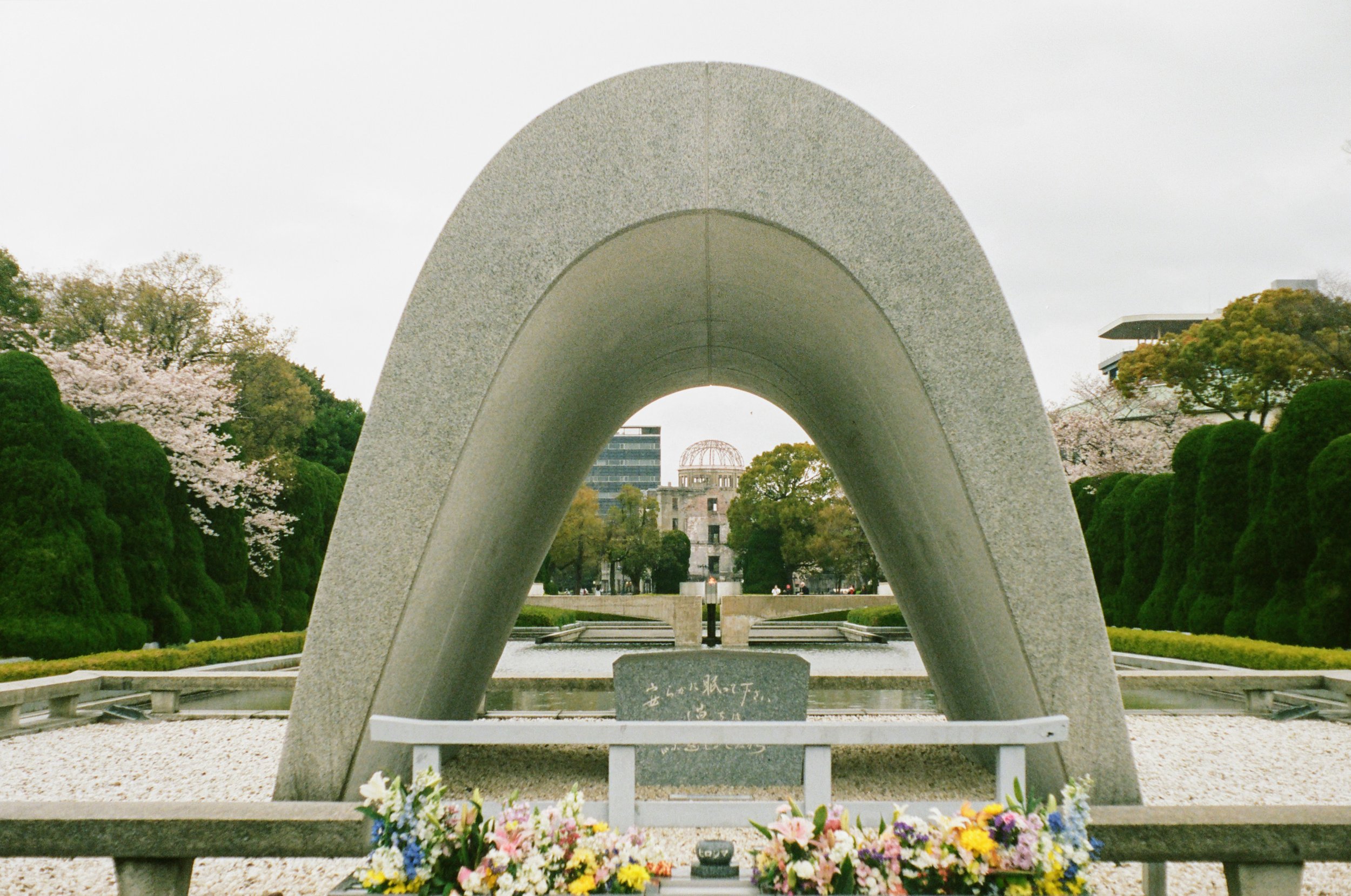
Looking towards the epicenter from the grounds of the Hiroshima Memorial Peace Museum, Praktica LTL. 50mm Meyer-Optik Domiplan Lens, Kodak Portra 400
It Followed Me Home
The visit to Hiroshima went by in a blur. Before we knew it, it was back to Tokyo by high speed rail for a short overnight stay before flying home to Vancouver. At this stage of the trip I’d realized I’d done almost no shopping and thought to grab a few mementos of this visit other than the photos I was hoping would turn out. A quick stop at Lemonsha in Ginza and I found myself a like-new condition Yashica Electro GSN. Ok, I thought it was quick stop, but nearly missed my train as a result of a high degree of indecisiveness. This led to my first opportunity to sprint down a train platform, just like in the movies. The Yashica? A joy to look at, if not a powerhouse of photographic potential. That, along with a new-old-stock Seiko SKX007 that I found in a tiny clock shop in Koyasan, and my printed photobooks, are all tangible reminders that immediately elicit memories of this wonderful country that I will undoubtedly visit again.
It was a couple of years later that I decided to actually write up a story on this trip. Looking through my photographs while doing so, I was amazed by how quickly my memories of the experience sharpened. I guess that’s the beauty of travel photography. Its ability to transport you back in time and across the world to relive moments that otherwise might just be lost in the back-catalog of our minds. Even more special in this instance perhaps, is the memories of taking the shots themselves; composing, adjusting, fretting, forgetting, and as is the case when shooting film, hoping. Hoping the shots turn out, trusting your equipment, your film and your skill adds a bit of uncertainty to the experience that -for me- augments the adventure you’re on.
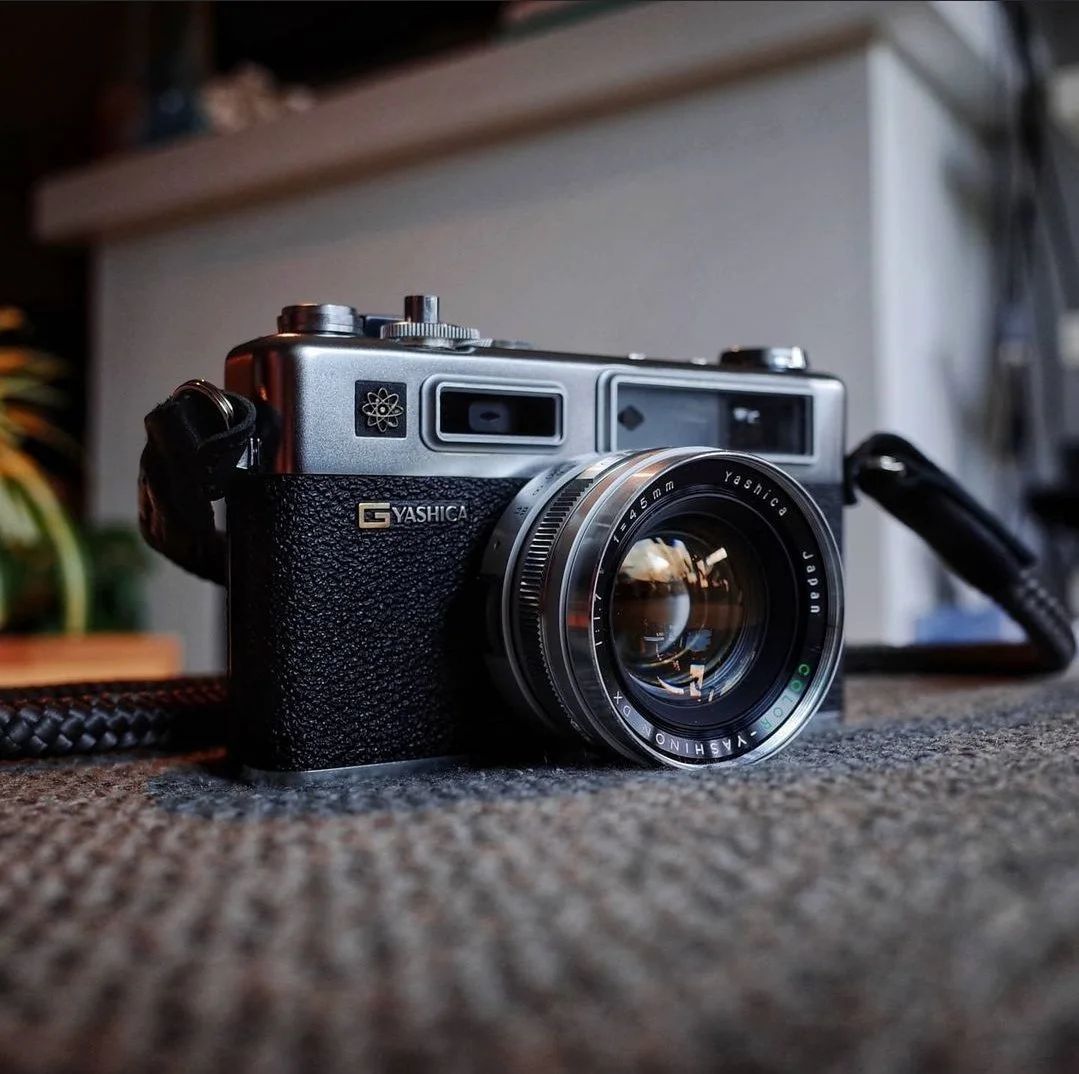
Yashica Electro GSN from Lemonsha, using a Huawei Smartphone with integrated Leica Summilux-H 27mm f1.8 ASPH

Seiko SKX007, arguably one of Seiko’s most loved pieces, found in a tiny clock repair shop in Koyasan. Shot on a Samsung S20 FE.
Stay tuned for my Japan series follow-up post where I’ll share some lessons learned on this first film-photography-only experience abroad. I learned a lot, and while I’ve shared some tips and thoughts throughout these articles, I look forward to preparing a summary of some of these key learnings for those of you contemplating a similar project.
Continue to the Epilogue: Japan - Travelling with Film Photography →

Koyasan - Japan
After a long day of travel getting here, we lay on our comfortable mattresses preparing to sleep when the deep hum of a gong reverberated from the forest and filled the room. It was a low tone that you feel more so than hear and one that had the hairs standing on the backs of our necks.
Kongobuji Kompon Daito Pagoda. Praktica LTL. 50mm Meyer-Optik Domiplan Lens, Kodak Portra 400
Serenity and the Ghost
Read Previous Part II - Kanazawa, Japan →
It’s tempting to focus on dazzling urban centers when visiting Japan, especially for a photography enthusiast. If you’re up for taking-in a breathtakingly ancient and quiet place for a few days, however; I’ve got just the spot for you. Koyasan, the home of Shingon Buddhism in Japan, is a tiny mountaintop village known for it’s clean air, dense forests, beautiful monasteries with their ryokan accommodations, and the ancient Okunoin cemetery. If that sounds interesting, read on! Let’s start with how to get here.
Rail is the way to go in Japan, Praktica LTL. 50mm Meyer-Optik Domiplan Lens, Kodak Portra 400
Chasing trains on the way to Koyasan. Praktica LTL. 50mm Meyer-Optik Domiplan Lens, Kodak Portra 400
This way up to Koyasan! Praktica LTL. 50mm Meyer-Optik Domiplan Lens, Kodak Portra 400
The interior of the funicular forms a bit of an optical illusion. Praktica LTL. 50mm Meyer-Optik Domiplan Lens, Kodak Portra 400
Nankai Koyasan Cable Line, the funicular that takes you up the steep slope to Koyasan Station. Praktica LTL. 50mm Meyer-Optik Domiplan Lens, Kodak Portra 400
As is the case with most travel in Japan, the train is the mode of choice for getting to Koyasan. We left from Kyoto and spent a lovely morning winding through Osaka and into the more quiet villages in the southern foothills. You change trains twice, once in the village of Hashimoto and again when you arrive at the funicular station. This was my first time on a funicular and it was definitely a fascinating experience. Our minds are programmed for trains to be level, so walking up a staircase within the train to get from the back to front can be a bit vertigo inducing! The short ride up the hill and through the trees gives the sense of gradually entering a different world, which proved a fitting feeling given where we ended up.
Awe-inspiring 11th century Daimon Gate, Praktica LTL. 50mm Meyer-Optik Domiplan Lens, Kodak Portra 400
Most of the lodging in Koyasan is in the form of “ryokan” or pilgrim’s lodgings, which are effectively private rooms within a monastery. We stayed at the Fukuchi-in Temple Ryokan and I’d highly recommend it. (Since our visit they updated their website which now provides some great guidance to visiting Koyasan). The accommodation is spartan but impeccably clean and comfortable, and in keeping with the lifestyle of the monks who live there. Food is served to you in a dedicated room and with multiple servers who bring delicate traditional vegetarian dishes unique to the area that are as delicious as they are simple. There is an onsen on site which again is basic but utterly relaxing with its hot-spring fed waters bubbling in silent surroundings.
If you’re willing to get up early (and you really should), the monks invite you to join them for their morning prayer ceremony. I’ve never attended a Buddhist ceremony before, let alone one in the village at the heart of Shingon Buddhist lore, and I found myself utterly engrossed in the chants and rituals. A tip for would-be worshipers; the room the ceremony is conducted in is open to the outdoors and at that time of year, the air was just above freezing at sunrise. I was underdressed and pretty cold having chosen to wear the traditional garments offered to guests upon arrival but it somehow didn’t detract from (perhaps enhanced?) my enjoyment of the experience.
Fukuchi-in Temple, Koyasan, Praktica LTL. 50mm Meyer-Optik Domiplan Lens, Kodak Portra 400
In classical Japanese fashion, the sleeping room is an open and largely empty space with tatami mats on the floor and a large window facing into the deep coniferous forest. After the lengthy day of travel getting here, we lay to rest early on our comfortable mattresses when the deep hum of a gong reverberated from the forest and filled the room. It was a low tone that you feel more so than hear and one that had the hairs standing on the backs of our necks. It was at that moment that one of our friends felt a deliberate but gentle tap right on the center of her forehead. She yelped, startling all of us from our wispy near-sleep states. Was a playful travel companion pranking a friend? Or, a playful spirit passing through? To this day no-one has claimed responsibility for the tap, so…
Manihouto Buddhist Temple. Praktica LTL, 50mm Meyer-Optik Domiplan Lens, Kodak Portra 400
Koyasan is essentially a one-road-town and easily walkable. While there are a few tiny shops and restaurants along the road, the village is largely dominated by temples, shrines and monasteries. Most visitors eat at their ryokan, but a tiny izakaya just a couple of blocks east of our lodging proved a delightful spot for dinner one night. Even at the izakaya, the restauranteur bade us trust him with the menu (or so we surmised) and served up terrific plates of sushi, pickles and tofu. Very few people we encountered here speak English, but that never seemed to be a barrier.
Okunoin, Praktica LTL, 50mm Meyer-Optik Domiplan Lens, Kodak Portra 400
At the far western end of the town lies the Okunoin Cemetery and this is a sight you simply cannot miss if you are in the area. The Okunoin is a deeply spiritual place, the kind you read about in fantasy novels where hero’s and heroines have epiphanies and meet mystical beings. My skin tingles thinking back on it now even as I write this. Its grounds are essentially a 2km long meandering path through dense, tall and lush forest with tombs and graves dating back to at least 816AD lining the path and even scattered hidden behind trees and bushes. It is not as orderly as one might expect in Japan, a product of it’s ancient and seemingly haphazard expansion through the forest over hundreds of years. In Japan it is said that you are born Shintoist but die Buddhist and you certainly feel that here. There are even massive corporate tombs here for firms such as Toshiba, Mazda and other Japanese industrial giants and it is apparently a great honor for an employee to be buried here.
At the end of the walk is the tomb of Kobo Dashi, the founder of Shingon Buddhism. While photos of the tomb are not allowed, you are invited to observe the ceremonies that take place there every day, with monks feeding the spirit of Shingon’s ancient founder. While we experienced the Okunoin with daylight sun filtering through the thick green of the trees, nightime walks are available where the forest is lit entirely by lanterns. I wasn’t aware of this at the time, but might just make the trip back next time I’m in Japan just to experience that -with a different camera of course! The peril of committing to a single ISO with a choice of film stock is missing out on certain opportunities.
Incredible wood patterns under the roof of a pagoda, Praktica LTL, 50mm Meyer-Optik Domiplan Lens, Kodak Portra 400
On the eastern end of town lies the Danjo-garan Buddhist Temple complex filled with a variety of ancient buildings and structures including the Kongobuji Kompon Daito Pagoda pictured at the header of this article. There was a nominal fee to enter this area and it’s well worth the spend to see and learn more of Koyasan’s history. The structures themselves are impressive, stunningly large in some cases, and beautifully painted in bright colors with intricate hanging lanterns.
One of the many buildings in the temple complex, Praktica LTL, 50mm Meyer-Optik Domiplan Lens, Kodak Portra 400
Walking through history, Praktica LTL, 50mm Meyer-Optik Domiplan Lens, Kodak Portra 400
A trip to Koyasan provides an opportunity to see a part of Japan’s history unfettered by modernity. A rare place, that caters to pilgrims and tourists without loosing it’s authenticity and charm. I hope this short piece entices you to visit someday! Next on our journey, we were back into the hustle of urban Japan with a stop in Hiroshima. A place I’d never thought I’d see, but I’m glad I did.

Kanazawa - Japan
A guide to Kanazawa, Japan—Kenroku-en gardens, historic districts, incredible seafood, and a slower, more local side of Japan.
The Moat surrounding Kanazawa Castle, Praktica LTL, 50mm Meyer-Optik Domiplan Lens, Kodak Portra 400
Gardens and Sake
Read Previous Part 1: First Frames, Tokyo, Japan →
We left the urban expanse of Tokyo by train, headed for the west-coast city of Kanazawa. The train is by far the easiest and most reliable way to travel Japan and in our case, the two-week JR Rail Pass was worth every Yen. I recommend ordering your tickets in advance of your trip and picking them up when you arrive. My Canadian friends can click here to find and book the package that suits your plans best.
So, why Kanazawa? Our friend Kaeko would be in town and was excited to host us in her home city, so we jumped at the chance of a guided visit to a place a little off the typical tourist path. Compared to Tokyo, we would throttle back the pace for these next few days. Our aim, to see where our friend grew-up, enjoy it’s renowned gardens, preserved historical districts and of course, enjoy a local’s tips for where to eat & drink.
The Tea House, Praktica LTL, 50mm Meyer-Optik Domiplan Lens, Kodak Portra 400
Kenroku-en
Considered one of the top three most beautiful landscape gardens in Japan, Kenroku-en was as lovely and peaceful as one might expect. The spring was late in Japan that year, so the sakura which would normally be blossoming were only just budding at the time. This also meant the garden was relatively free of tourists, and thus allowed for largely unfettered exploration. It also meant we were easily able to arrange to take part in a traditional tea ceremony at the tea house which sits perched over Kasumiga-ike pond. I can still smell the tea brewing if I think back to it, a memory that calms my mind as if I were still kneeling at that table.
View from the Tea House, Praktica LTL, 50mm Meyer-Optik Domiplan Lens, Kodak Portra 400
Budding Sakura, Praktica LTL, 50mm Meyer-Optik Domiplan Lens, Kodak Portra 400
Beauty Around the Castle
Surrounding the grounds of the castle and Kenroku’en are a variety of parks, gardens and temples to enjoy. Gyokusen’inmaru is another award winning garden built in the shape of an amphitheater around it’s meandering central pond. There’s a delightful coffee shop on the west side of the garden where one can sit and sip while taking in the view.
Across the street you find the Oyama shrine and the beautiful pond adjacent to it. I particularly enjoyed the bridge across the pond with it’s seemingly eccentric jagged pattern of sudden stops and turns. Evidently the design is strategic, it’s unexpected turns and surprise drops tricking unfriendly spirits into “walking the plank” to their doom. Near the shrine, Kaeko pulled a few strings to get us an up close look inside a one-time samurai-sword making factory that now houses artisans hand crafting some of Kanazawa’s renowned pottery.
Gyokusen’inmaru Park, Praktica LTL, 50mm Meyer-Optik Domiplan Lens, Kodak Portra 400
Bridge at Gyokusen’imaru Park, Praktica LTL, 50mm Meyer-Optik Domiplan Lens, Kodak Portra 400
Pond at Oyama Shrine, Praktica LTL, 50mm Meyer-Optik Domiplan Lens, Kodak Portra 400
One time sword factory, now making pottery. Praktica LTL, 50mm Meyer-Optik Domiplan Lens, Kodak Portra 400
Plenty of museums also surround the area, one of the more stunning of which is the D.T. Suzuki Museum, dedicated to the prominent Buddhist philosopher of the same name. Unfortunately it was closed when we were there, but the grounds alone are worth the visit and some quiet contemplation.
D.T. Suzuki Museum, Praktica LTL, 50mm Meyer-Optik Domiplan Lens, Kodak Portra 400
And Plenty of Normal Life
Of course Kanazawa isn’t all castles and gardens, and while I left the camera at home most nights for fear of sake-induced damage, there’s plenty of enjoyment to be found in the city’s everyday life. Highlights included an all you can drink sake bar (yes, really), the Nagamachi historic samurai neighborhood (visited by moonlight, after the sake) and what must be the tiniest, most delicious and characterful yakitori restaurant I could imagine (I’ve sadly heard it’s no longer open). The Higashi Chaya district blends history and real life and is perhaps your best chance of spotting a real geisha on the way to/from work (or tourists attempting to dress like one). The area is known for it’s ultra-fine gold-leaf based crafting, so we jumped at the chance to make our own real-gold coated chopsticks!
Speaking of chopsticks, the seafood in town is remarkable, we tried a kaiten-zushi style restaurant with a mini-shinkansen delivery system ordered off a tablet menu. Aside from the novel delivery system, I’ve never experienced melt-in-your-mouth sashimi like that before and it’s reason enough for me to day-dream of returning soon.
Light Leaks at the market, Praktica LTL, 50mm Meyer-Optik Domiplan Lens, Kodak Portra 400
Kazuemachi Stroll, Praktica LTL, 50mm Meyer-Optik Domiplan Lens, Kodak Portra 400
Craft Beer, Kanazawa style, Praktica LTL, 50mm Meyer-Optik Domiplan Lens, Kodak Portra 400
Your Own Path
Kanazawa may not be a destination that springs to mind when planning a trip to Japan. But with the Shinkansen ride through beautiful countryside taking only 2.5 hours from Tokyo, and an abundance of culture, atmosphere and food to enjoy, it’s a place worth considering for your itinerary. We covered a lot of ground in a short time during our visit, but never felt rushed or busy about it; a great little reprieve before diving into the rest of our journey.
Kanazawa Alleys, Praktica LTL, 50mm Meyer-Optik Domiplan Lens, Kodak Portra 400
At Sarakiniko Beach in Milos, Greece, an otherworldly landscape becomes a stage for modern-day photographic rituals. A candid street photography essay.